In Conversation – Zoljargal Purevdash on her film ‘If Only I Could Hibernate’ – Releases in UK & Irish cinemas on 19th April
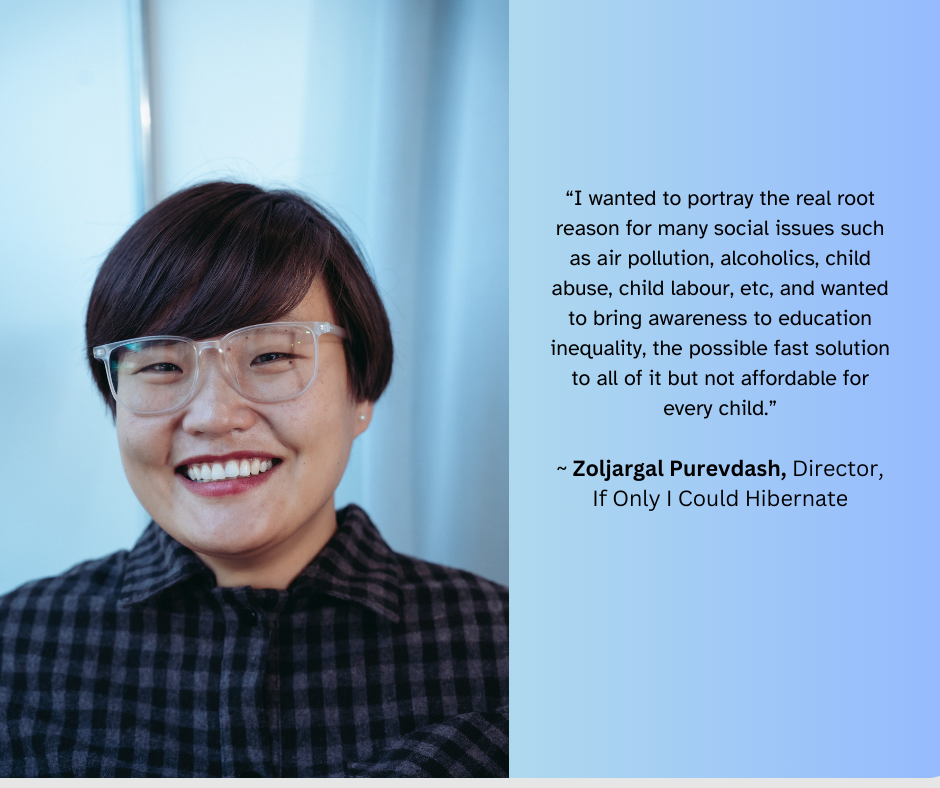
In the run-up to the film’s release we speak to award winning director, Zoljargal Purevdash about her journey into the making of the film, exploring the underlying socio-political conditions in Mongol...
In the run-up to the film’s release we speak to award winning director, Zoljargal Purevdash about her journey into the making of the film, exploring the underlying socio-political conditions in Mongolia.
With breath-taking scenography and landscape, Ulzii’s story is introduced to us in this outstanding Mongolian film. Ulzii gets excited after winning a physics competition. But life isn’t as easy as it seems. When his mother has to leave for the countryside to get a job, Ulzii has to make a decision that will shape his future – should he leave with his family, or should he stay in the city and try to make a space for himself in this hostile world?
If only I could hibernate is not just another teenage story – it’s a story about hope and trust. About decisions. About survival.
In what ways has your personal background shaped the narrative of your film?
When I was thirteen years old, our family moved to the Yurt district and my mom opened a little corner shop there. Our neighbors were our customers and most of them were migrated nomads. While helping my mom I turned into someone who knows the undesiring depth of life in the yurt district in Ulaanbaatar. So every time I face a misunderstanding about the citizens of Yurt districts I want to advocate and interpret from their perspective.
What drove you to create something like it?
A little corner shop in a poverty-stricken area never makes good money. It was scary for me to see my family also falling into poverty slowly. So, when I was fifteen, I decided to become an educated person who makes a lot of money to make my mom happy. I was good at physics and maths and I loved attending physics competitions. But never won a gold medal and always entered 5thor 7thplace. I was wondering about who is winning the golden medal. They were all the kids from a good private high school. So I asked my mom to send me to that good high school and my mom did. It is an amazing school that has many clubs that help kids to discover their talents and skills. I love cinema but never dared to say that I want to become a filmmaker, cause I am the oldest child and I had all obligations to take care of my family. But that high school has a drama club and I am so much in love with art. The year I graduated I got a scholarship to study filmmaking in Japan. I went to Tokyo from the yurt district of Ulaanbaatar and arrived back as an educated person who could take care of my family. Unfortunately, I realized this was magic that happened only to me, not to all kids who grow up in my yurt district street. They keep on struggling in the poverty cycle and it is becoming unbearable and unfair for me to witness. So I wanted to make a film about a teenager who is in poverty, but eagerly seeking a good education to get out of it. I wanted to portray the real root reason for many social issues such as air pollution, alcoholics, child abuse, child labour, etc, and wanted to bring awareness to education inequality, the possible fast solution to all of it but not affordable for every child.
What was your experience transitioning to directing a feature-length film after having worked on short films?
I made 3 short films before I made my first feature. I learned a lot from each short film. I made many mistakes but it helped me to grow up and to understand how I love to work, and what types of people I love to work with. Doing 3 days of shooting to 30 days is like expanding everything 10 times including stress level. But somehow I felt I am ready for it after my third short film.
Is this something you’d like to continue working on in the future?
I would love to keep on making movies. But I don’t want to box myself into deciding a particular genre or style. I want to set myself free to explore the stories that constantly haunt my mind. Recently, I started working on a dark comedy on air pollution issues again, because this terrible air of Ulaanbaatar is making me breathless physically and mentally.
What was it like working with such a varied cast, including first time actors?
It was amazing. Child actors were so devoted and hardworking. We talked about the issues we portray in the film at the same time how this film could provoke or bring awareness to the solutions. They trusted the purpose that we aim together through this film. I asked them to live as the characters and set the environment so that they could express all their feelings about the characters they were creating. So they also bring many original emotions to the character. Such pure, kind, passionate kids to work together. The whole film crew was inspired by their great performance and became more passionate.
Following your well-deserved Cannes nomination and further Grand Prize and Cineuropa Prize at the 39th Mons Love International Film Festival, do you feel a shift in the cultural scenery in your home country?
I just made the film, because I really couldn’t keep on living without making it. So, I think I am not the right person who could talk about the shift of cultural scenery in Mongolia.
How does it feel bringing elements of Mongolian culture through your film to an international audience, particularly through unique scenes like the one where Ulziibat places his big toe in his nephew’s mouth for healing?
To connect with an international audience, the story must be universal. At the same time, audiences will expect some Mongolian elements, and Mongolian cultural aspects when they come to watch Mongolian movies. So it was so important and fun to put it all together without being too pushy.
But, the big toe scene is the sarcastic scene I put on purpose for the Mongolian audience to rethink what is our real tradition and what is not. Recently, there have been many fake traditions or rumors, and superstitious beliefs coming out. Sometimes it is difficult for us to clarify what is true or false. On social media, people write many new healing ways or superstitious methods that no one has ever heard of before. Most of the Mongolian audience wonders “Do we have this big toe healing method?”. This is what I wanted to achieve. I want the audience to be more critical thinkers on every new thing they hear..
Interview by Eva Mateos Rodriguez
Eva is an eclectic artist specialising in acting, writing and songwriting. She has been part of several performances, responses and exhibitions, and is now a student of the MA Creative Writing at Birkbeck University.
Read Eva’s latest Review: Sacha Polak’s ‘Silver Haze’ is a dizzying roller-coaster of emotions and experiences – Releasing 29th March in UK and Irish cinemas – Abundant Art
Director’s biography
Zoljargal Purevdash is a Mongolian filmmaker who studied filmmaking at the University of Obirin, in Japan. Her short films were screened at Tampere Film Festival, Short Shorts Film Festival Asia, and Open Doors Locarno Film Festival. In 2021, her short film Stairs won the first prize at the Chicago International Children’s Film Festival and entered the 94th Oscars Award. She is an alumnus of Talents Tokyo, Asian Film Academy, Locarno Open Doors, Torino Film Lab, and Berlinale Talents. Her first feature film If Only I Could Hibernate was officially selected for the Un Certain Regard at the Cannes Film Festival 2023.
Starring: Battsooj Uurtsaikh, Nominjiguur Tsend, Tuguldur BatsaikhanIf Only I Could Hibernate is releasing in UK & Irish cinemas 19th April 2024 – Certificate TBC & Running Time 98 Minutes
Zoljargal Purevdash’s mesmerising debut IF ONLY I COULD HIBERNATE tells the story of a family grappling with challenging living conditions in the Ulaanbaatar district of Mongolia. The film launched to great acclaim at the Cannes Film Festival, making history as the first ever Mongolian film in the Official Selection. After a successful international tour across various film festivals, including the BFI London Film Festival, the film will open in UK and Irish cinemas on 19th April.
When gifted high school student Ulzii unexpectedly wins a local physics competition in Mongolia’s capital city Ulaanbaatar, he sees a chance to escape his deprived neighbourhood by competing in the national finals for the chance of a university scholarship. But when his struggling mother returns to the countryside in search of work, he has to balance the demands of looking after his younger siblings during a harsh winter with pursuing his academic dreams.
Emphasizing the transformative power of education as a pathway to break free from poverty, IF ONLY I COULD HIBERNATE explores critical societal issues such as Mongolia’s pervasive pollution problem and the challenges stemming from fuel shortages. Featuring extraordinary performances from the cast, Purevdash’s beautifully photographed feature is a hope-filled coming-of-age drama about resilience and determination against the odds.
The film is distributed by Conic Film