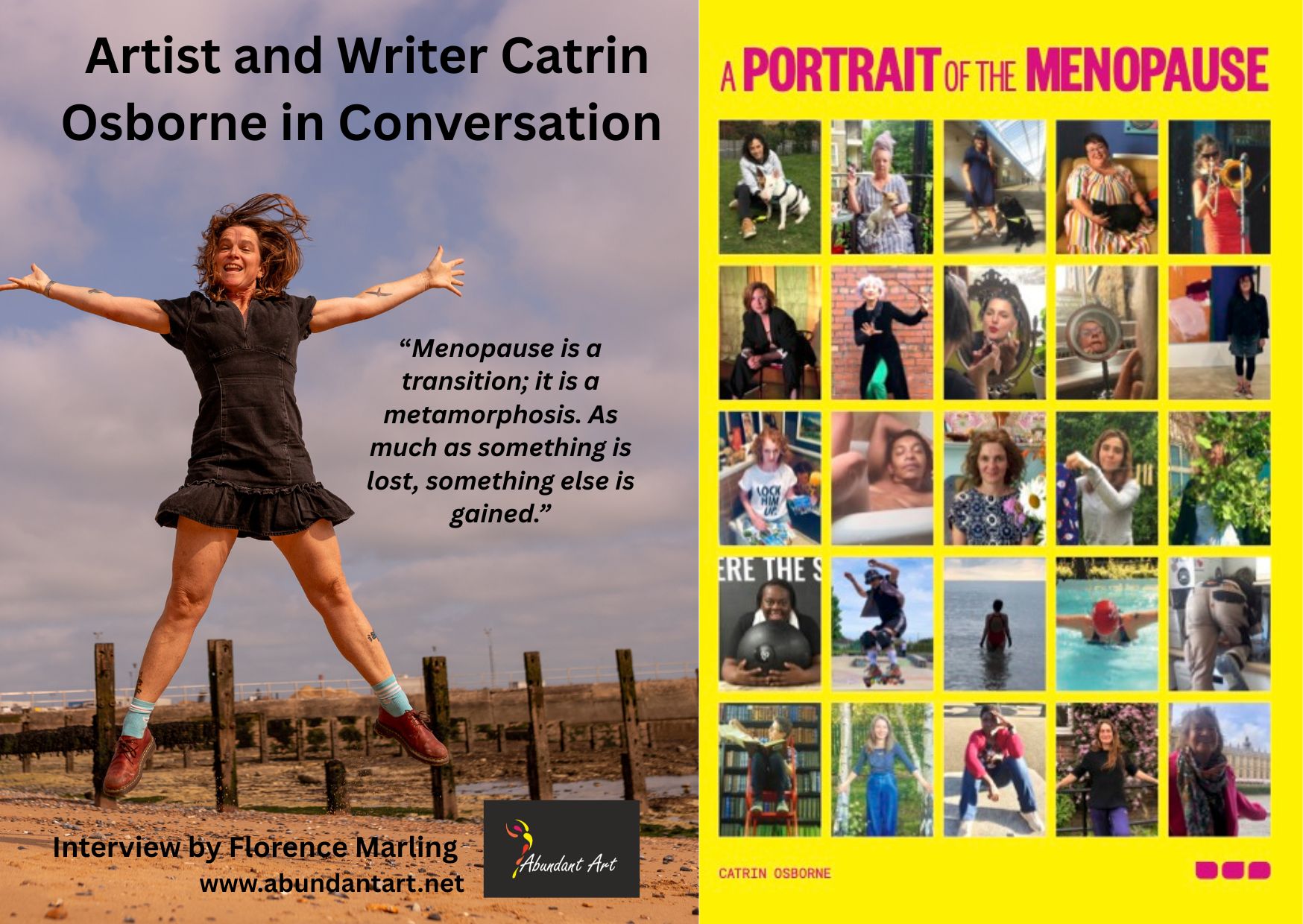
‘Menopause is a transition; it is a metamorphosis. As much as something is lost, something else is gained.’ For artist, DJ, former circus performer and writer Catrin Osborne, that ‘something’ is confidence.
I dialled in to Osborne at her cosy Ramsgate home, curled on the sofa with her dog, to talk about motherhood, miscarriage and menopause; about cold-water swimming, Susan Sontag self-preservation, and the threads that connect all of this to her latest photographic publication, ‘A Portrait of the Menopause’. The book is an intimate and enthralling collection of portraits of women experiencing menopause, accompanied by their written testimonies and recollections in expressive neon type.
Osborne is, in many ways, an interdisciplinary artist: currently completing an MA in Creative Writing, yet working fluidly across forms. Her practice, spanning image, text and performance, seeks to challenge the misconceptions and stigma surrounding this significant, and too often unspoken period in women’s lives.
This project came about during Covid when you put out an Instagram call asking women about their symptoms. What drew you to menopause as a subject, and when did you realise it was something you wanted to document?
I’d actually already begun photographing before I realised the project was forming but it started when I went through a very difficult menopause. I didn’t know it would begin so early, around 45. I thought my period would just stop and it would be a relief, releasing me from the pressure I’d always felt around having a child. I had a miscarriage at 39, and everyone around me told me I’d get pregnant again, but when I didn’t the loss felt even sharper.
I experienced severe headaches and the insomnia was overwhelming. Looking back, I now know I have Complex PTSD, and everything collided at once, sending my mental health to a real low. After starting HRT, everything shifted. I remember lying in the grass near my flat feeling, finally feeling relief. I thought: surely other women are going through this too. I wasn’t thinking about a book or an exhibition. I just wanted to reach out.
Before Covid I photographed 19 women. A friend hosting a night in Homerton told me to come and exhibit my photographs. It was the first time I’d shown my work like that and it felt surreal to see people engaging with my images. Then lockdown hit and I had to stop work so I applied to the Arts Council to develop the project, and it has grown into something far bigger than I imagined.
Were there particular stories or recurring themes that stood out across their experiences?
There were recurring golden narrative threads running through the project, particularly on the more difficult side of the experience. Insomnia came up again and again, even more than hot flushes. Anger was another major theme — a deep, sometimes uncontrollable rage. I think that rage is partly a response to society, not only in how it treats middle-aged women, but also to the internal surges that come with this phase of life.
How did the camera act as a tool/vehicle to unlock these female experiences?
The relationship between the images and text was crucial, giving the photographs a voice. I often think about Diane Arbus in this context. I admire her work, but Susan Sontag criticised her in ‘On Photography’ for portraying outsiders without giving them agency. That idea really stayed with me. While Arbus herself had complexities and struggles that we can’t fully know, the question of privilege was important. Who is looking, and who is being seen feels important for me. My use of text was a way of addressing that, allowing the women represented to speak for themselves rather than the camera speaking for them.
Each woman is also photographed on an iPhone, in her happy place. I was belittled by a few men about this, saying this wasn’t real photography. I do have an SLR camera, but I noticed a lot of male photographers using big lenses, and I didn’t think many menopausal women would want such an intrusion into their safe spaces.
Menopause is rarely depicted in mainstream media and when it is, it’s often caricatured or sanitised. How do you feel it’s been represented, and what narratives are still missing from public view?
Historically, women have been framed as the ‘mad woman in the attic’, and that judgment only intensifies with age. But the menopause has also begun to enter public conversation in a way it never had before. Documentaries like Davina McCall’s ‘Sex, Myth and The Menopause’ and campaigns such as ‘Make Menopause Matter’, have made a real difference. That campaign was founded by Diane Danzebrink, and has been incredibly influential.
So much of your work touches on the medicalisation of women’s bodies. How have you seen menopause treated within the medical sphere, and what does this reveal about the broader silencing or dismissal of women’s experiences?
I think one of the reasons I did the project was because I’d been misdiagnosed a lot. I’ve been a woman in a hospital setting a few times throughout my life and my voice has been ignored. I knew something was wrong and that they could have tested me but I was refused diagnosis multiple times, ending in an emergency operation. It was isolating and frightening being in a sanitised patriarchal space filled with white men in their 60s in lab coats. This dismissal of women’s voices is common, and it’s even worse for black, brown and trans women.
In your conversations, did you find that Black and brown women’s experiences of menopause were shaped differently, both culturally and in terms of medical support or visibility?
I come from a white, fairly middle-class background so I had to be aware that I do have a certain amount of privilege. The first group of women I photographed were queer and straight women but not many black or brown women. So while the group had some diversity, it felt limited, and I became very aware that it should be broader.
I began to move beyond my immediate friendship circles and reached out to women widely and from around ten places across the UK. It felt important to build something geographically balanced and not centred solely on my own networks.
I used the Diversity Wheel, an intersectional visual tool that looks beyond race, disability and sexuality to include factors like class, education and religion, whether you went to boarding school or a comprehensive. It helped me understand how these identities overlap and collide. That process led to the inclusion of trans women, Romani women, homeless women, and those living unconventional lives: women on the road, on boats or without stable housing.
I also included women across age ranges and life experiences: post-menopausal women, older women, very young women, including one who was just 23 when she experienced menopause. While the majority were around 55 to 75, there were voices on either side of that spectrum. I was conscious of representing mixed heritage and experiences beyond a simple black-and-white binary.
Menopause is often framed in negative or reductive terms, as decline, loss or invisibility. Did you encounter any narratives of empowerment, creativity or renewal in the women you met?
For many women, the menopause transformed into something unexpectedly positive. Many are reclaiming their bodies, and in today’s society, being a confident, intelligent woman can feel quite powerful. I’m not sure the mainstream media would agree, but alternative spaces certainly do. Many spoke of letting go of obligations, expectations and emotional labour that they had been carrying for years.
Creativity also emerged as a strong thread. Many women spoke about shedding what no longer served them. Because the symptoms were so intense, they were forced to stop holding everything together for everyone else. They had to become, in their words, more selfish — though really, it was about self-preservation. The focus shifted from constantly supporting others to finally turning inward and looking after themselves. I think this is really beautiful.
Featured Images : Andrew Hastings
Book published by Black Dog Press.
Link to purchase – A Portrait of the Menopause
Interview by Florence Marling
Florence’s latest review can be accessed here Abundantart-Reviews