Akram Khan’s reimagining of Giselle for English National Ballet breathes new life into an already well-loved story and stands as a testament to his choreographic craft. Since its premiere in 2016, Khan’s Giselle has travelled across international stages and returned to the London Coliseum this January to celebrate its 10th anniversary.
This production offers a fresh new version of the story where Giselle is a migrant factory worker (an Outcast) and Albrecht, a wealthy landlord who disguises himself as an Outcast to win her love. When a jealous Hilarion exposes his true identity, Giselle is left dead, driven mad by her grief. This story parallels the original in that it circles the same themes of love, betrayal and redemption, but it delves much deeper through its exploration of some of the darker truths of our modern world. It invites the audience to question the treatment of the workers by the Landlords, and to consider how it applies to our society today, proving to be a powerful statement.
There is a clear division between the Outcasts and the Landlords, strongly articulated through both costuming and choreography. The landlords loom in the smoky shadows of the stage in ornate gowns with almost comically exaggerated curves. The Outcasts are pared down to simple grey outfits. This sharp visual contrast between the two groups evokes a dystopian feeling, somewhat reminiscent of The Hunger Games. It compels the audience to draw parallels between the production and the reality of the treatment of ‘Outcasts’ in the world today. Just the costuming and set design command attention on their own, drawing the audience in for the full emotional intensity that the music and choreography bring.
The Landlords remain stoic throughout the show, restricted by their stuffy costumes and displaying little emotion. In contrast, the Outcasts dance with a livelier, jumpier motif, which emphasises the class division between the two groups. Much of the Outcast’s choreography in Act 1 carries a familiar, folky quality which comes through in their light, bouncy movements. This invites the audience closer and forges a bond with the dancers, making the experience deeply immersive as the characters move through the rest of the story.
Giselle is rich in powerful, evocative moments, captivating the audience from the moment the dancers emerge from behind the curtain until the final bow. One such scene is the duet between Giselle (danced by Emily Suzuki) and Albrecht (danced by James Streeter), beautifully choreographed. Bathed in soft orange light, the dancers are alone on the once-bustling stage. The duet is incredibly moving – it appears as if the two characters are completely entangled as they wind and unwind in twirls and lifts. It evokes the feeling of remembering a fond memory, and it is easy to feel the romance flowing between them. A new motif is established during this dance, where Suzuki and Streeter gently caress each other’s faces, a seemingly simple gesture that elevates the duet into a tender and deeply moving moment. The scene is raw and romantic, and skilfully executed by both dancers.
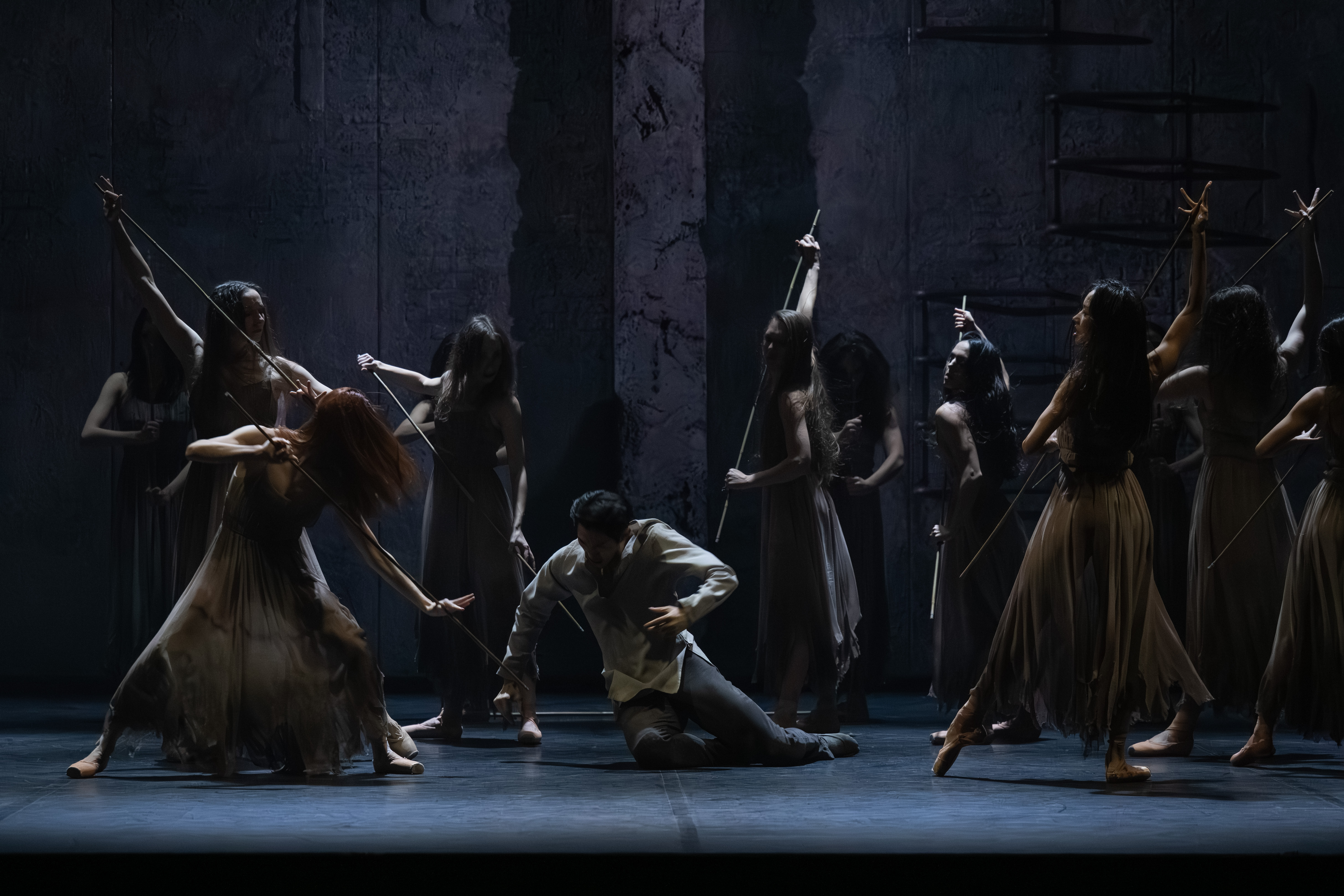
Act two takes place after Giselle has been driven mad by grief. However, in keeping with the production’s theme, the audience is transported to an abandoned factory where the Wilis reside. No longer the ghosts of betrayed brides, the Wilis are instead the spirits of the women workers who entered the factory walls and never left, now seeking revenge for the wrongs done to them. In the original ballet, the entrance of the Wilis is hauntingly beautiful, creating an ethereal scene. This production takes a darker perspective on this moment, perhaps more so than in Act one. The dancers wear ragged costumes and have their hair loose, falling over their faces. The stage is lit by an eerie blue glow that mimics the moonlight that would filter in through the broken windows of an abandoned factory. The choreography emphasises movements that send the dancers’ hair flying and obscuring their faces in a way that feels unsettling. In the light, the women’s hair takes on a silvery, vaporous quality that renders the dancers truly ghostly. Myrtha, Queen of the Wilis is danced by Emma Hawes, who delivers an exceptional performance in act two. She appears tall and commanding in her point shoes, and though nothing visually distinguishes her from the other dancers, her energy leaves no doubt as to who rules this ghostly realm. Hawes’ stage presence during this scene makes her character’s authority feel truly powerful and makes for a strong continuation from the captivating first act of the production.
Akram Khan’s Giselle is densely packed with incredible scenes. Choreographically, it is a well-crafted creative masterpiece, blending traditional kathak, ballet, and the identifiable movement language Khan has developed – a style that sits within contemporary dance while offering its own distinct voice in 21st-century choreography. Vincenzo Lamagna’s score perfectly complements this re-imagination, cleverly incorporating the sounds of factory machines as well as a recurring motif drawn from Adolphe Adam’s score. Altogether, Giselle makes for an incredibly moving, powerful evening of dance – an experience it would be a great loss to miss, and one that rewards being revisited time and again.
Featured Image – Ken Saruhashi as Hilarion in Akram Khan’s Giselle © Photography by ASH
Review by Aishani Chatterjee
Read Aishani’s latest review here Abundantart-Reviews
English National Ballet’s upcoming performances What’s on – English National Ballet