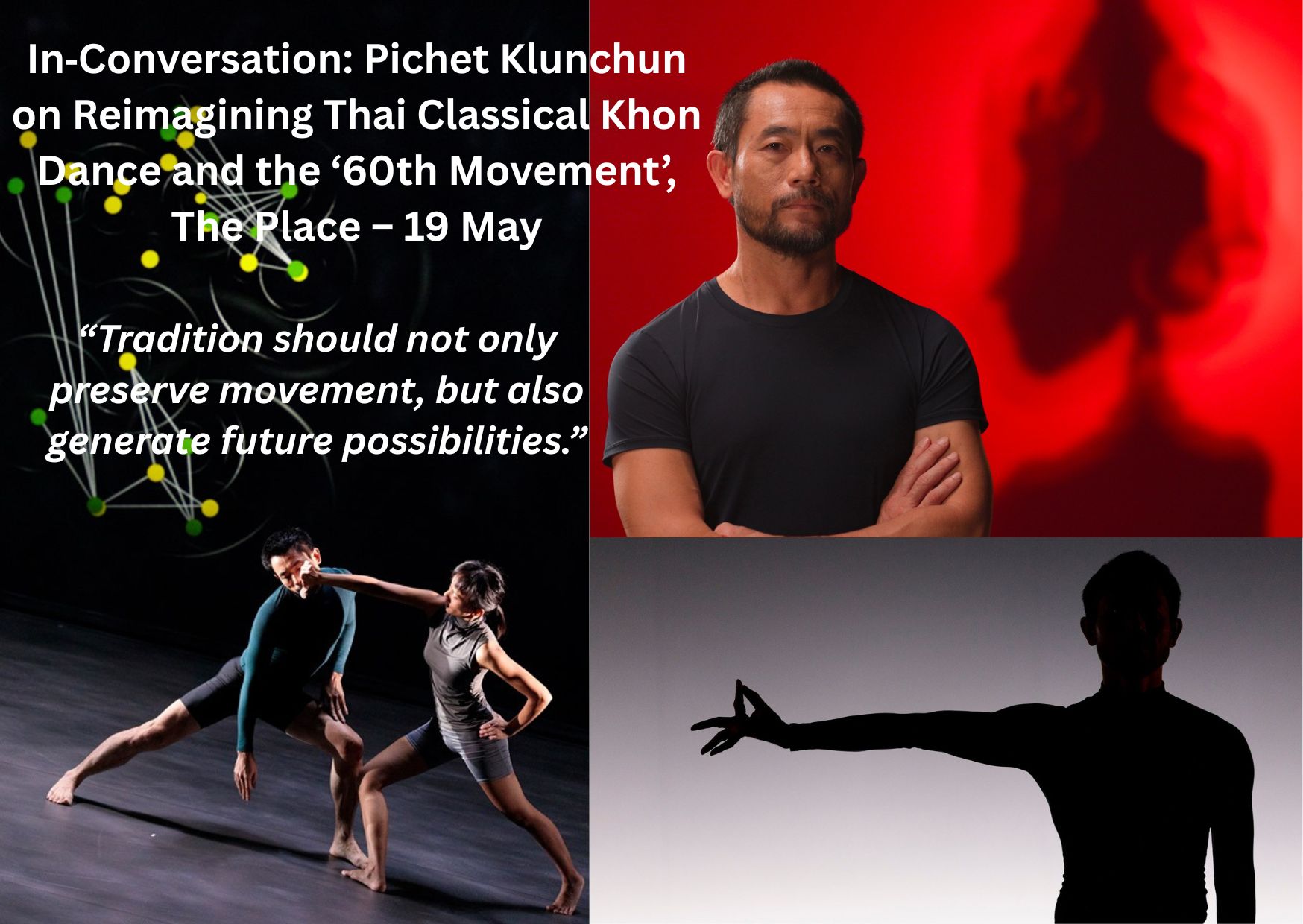
Pichet Klunchun’s No. 60 arrives in London as both a performance and a proposition. A bold rethinking of Thai classical Khon dance that questions how tradition can evolve without losing its roots. Presented at The Place as part of Queer East Festival, the work distils Klunchun’s decades‑long research into the 59 canonical poses of the Theppanom system and his search for a “60th movement”: a principle that frees dancers from rote inheritance and opens space for analysis, agency and new creative futures.
Speaking with Klunchun, what becomes immediately clear is that No. 60 is not an act of breaking away from tradition, but a return to it with deeper questions. His reflections resonate strongly with my own practice in the Uday Shankar dance style, another contemporary form shaped by Indian cultural memory, inspirations from classical and folk vocabularies, and the lived experiences of a society in motion. Though emerging from different cultures generations and processes, both approaches share a belief that tradition is not a boundary but a foundation. That innovation must grow from understanding, and that contemporary expression can honour lineage while imagining new possibilities.
Speaking ahead of his performance at The Place, he shares how questioning lineage, freeing the body and returning to foundational principles can open new creative futures resonating across cultures, generations and dance practices. In this conversation, Klunchun also speaks about the turning points that shaped No. 60, the challenges of reinterpreting a 700‑year‑old form, and the evolving dialogue between Thai classical dance and global audiences. His insights offer not only a window into his artistic philosophy, but also a wider reflection on how dance traditions across cultures can continue to live, shift and transform.
Q: Your work in No. 60 deconstructs the 59 classical poses of Khon and proposes a new “60th movement.” What was the turning point that made you feel this classical system needed to be questioned or expanded?
The turning point came from necessity as much as curiosity. I wanted to create my own choreographic language and develop a sustainable method for training dancers within my company. In Thailand, there has never really been a stable system for professional contemporary dancers working independently in the performing arts. I needed a process that could support long-term artistic growth. At the same time, I began to question how Thai classical dance could communicate beyond its original cultural and historical context. International audiences often admire its beauty, but cannot access its internal logic. No. 60 emerged from this need – to create a system that remains rooted in tradition while allowing freedom, analysis, and new forms of expression. For me, tradition should not only preserve movement, but also generate future possibilities.
Q: Reinterpreting a 700-year-old form can be bold, even controversial. How has the Thai classical dance community responded to your contemporary approach, and how do you navigate respect for tradition while pushing its boundaries?
A: In the beginning, the response was not positive. I had very little support, very small audiences, and was often perceived as someone destroying tradition rather than creating from it. But I chose not to spend my energy defending myself. Instead, I focused on continuing to work – spending time in the studio, researching, learning, and creating. My curiosity was always stronger than the resistance around me. For me, respecting tradition does not mean freezing it in time. It means understanding it deeply enough to engage with it critically and honestly. I am not interested in rejecting Thai classical dance; I am interested in understanding how it can continue to live and evolve in dialogue with the contemporary world.
Q: You’ve spoken about liberating dancers from mysticism, ideology and rote-learning. What does “freedom of thought and body” mean to you in practice, and how do you cultivate that in your performers?
A:Traditionally, Thai classical dance is transmitted through memory and imitation. Students learn by repeating the movements of their teachers, often without access to deeper explanations about structure, technique, or embodied knowledge. The goal becomes precision and preservation rather than individual understanding. This process leaves little space for personal interpretation or creative agency.
For me, freedom of thought and body begins with awareness. No. 60 is designed as a tool that helps dancers understand the principles behind movement, rather than simply reproduce form. Once dancers understand structure, balance, energy, and spatial relationships, they can begin making choices for themselves. In this way, freedom does not mean abandoning tradition. It means being able to create through it consciously, using one’s own body and imagination.
Q: The piece embodies your ideas of relativity and fluidity. How do these philosophical principles shape your choreographic decisions, and what do you hope audiences understand through this dual-study structure?
A: I was interested in creating an ecosystem where tradition and the contemporary can coexist and interact, rather than oppose one another. The two choreographic studies reflect different ways of understanding the body. One is more abstract and analytical, revealing systems, structures, and internal logic. The other is more expressive, connected to narrative, emotion, and imagination.
This duality also reflects two modes of thought. Traditional Asian training often operates through embodied repetition and belief-based discipline, while Western contemporary methodologies tend to emphasize analysis, articulation, and conceptual frameworks. By placing these approaches in dialogue, I am not trying to resolve the tension between them. I want audiences to experience movement as something fluid—where knowledge, identity, and meaning continuously shift depending on perspective and context.
Q: As someone deeply trained in Khon, how do you reconcile your classical lineage with your contemporary artistic identity? Do you see these as opposing forces or parts of the same continuum?
A: I do not see them as opposites. For me, the contemporary is a way of returning to tradition with deeper questions.
No. 60 began with an investigation into the foundations of Thai classical dance—particularly the canonical positions known as Mae Bot Yai. These movements are usually transmitted through repetition, but I wanted to understand how they function structurally. Tradition often operates through cultural continuity and inherited belief, while the contemporary operates through analysis and dialogue with the present. Through this process, I realized that Thai classical dance already contains an internal logic capable of transformation.
Without understanding the root, innovation easily becomes superficial. The contemporary, for me, is not a rejection of lineage, but a continuation of it through new methods of thinking and creation.
Q: You’ve performed and collaborated widely outside Thailand, including here in London. What has your experience been like sharing your work with UK audiences, and do you notice any differences in how people here respond to your reimagining of Thai classical dance?
A: My works have been developed internationally for many years, often through collaborations and commissions outside Thailand. No. 60 alone has already been presented in ten countries, and each context changes how the work is perceived. In the UK, this feels like the beginning of a renewed dialogue. The last time my company presented work here was in 2011 with Nijinsky Siam at the Norfolk & Norwich Festival. Returning now with No. 60 is meaningful.
I am especially grateful to The Place, Queer East Festival, and the British Council through the Connections Through Culture programme for making this possible. What interests me most is that UK audiences often engage through curiosity and analysis. Even without prior cultural knowledge, they actively search for systems, structures, and conceptual meaning within the work.
Q: At Abundant Art, we’re always interested in how artists open doors for the next generation. With No. 60 offering dancers a new kind of freedom, what do you hope young or emerging Thai artists take away from your work, especially those trying to balance cultural heritage with their own contemporary voice?
A: I hope younger artists understand that tradition is not a limitation. It can be a foundation for invention. But before transforming tradition, it is important to understand it deeply. Returning to the foundation is essential—without understanding the root, innovation risks becoming superficial. At the same time, I want artists to feel that they have permission to question, reinterpret, and construct their own language. Cultural heritage should not prevent personal expression; it should expand the possibilities for it.
If No. 60 offers anything to the next generation, I hope it is a sense of agency – the ability to remain connected to where they come from while still imagining new futures for themselves and for contemporary performance.
Our conversation with Pichet Klunchun offers a rare window into how tradition can be questioned, expanded and carried forward with integrity. His reflections remind us that dance is a living language that grows through curiosity, rigour and the courage to return to its roots with new questions.
A heartfelt thank you to Pichet for sharing his time and insight, and to The Place for continuing to hold space for these vital cross‑cultural dialogues that keep contemporary performance alive, porous and evolving.
Interview by Protima Chatterjee
Featured Images by Hideto Maezawa and Thatchaphon Butcharaporn
Tickets and Information No. 60 by Pichet Klunchun Dance Company | The Place
This performance is presented as part of Queer East – a cross-disciplinary festival that showcases boundary-pushing LGBTQ+ cinema, live arts, and moving image work from East and Southeast Asia and its diaspora communities.
Queer East Festival runs until June 6. For more information https://queereast.org.uk/
Read our latest in interviews Abundantart-Reviews