Chinese artist Gordon Cheung fuses cultural, political and economic experiences to explore how the psychological conditions of geopolitics and global capitalism shape identity and belief. In his upcoming exhibition Many Worlds, One Mind at CLOSE Gallery, he draws on Chinese philosophy and aesthetics while engaging with European economic and political histories. Working across painting, sculpture, print and installation, Cheung incorporates digital processes into his practice, often using financial data as a material foundation.
Born in London to Hong Kong–born parents, Cheung studied at Central Saint Martins before completing his MA at the Royal College of Art. His work is held in major public collections including the Museum of Modern Art, the Hirshhorn Museum and Sculpture Garden, the Whitworth Art Gallery and the British Museum. A tranquil essence runs through many of his paintings, where images of nature and carefully modulated colour create a sense of stillness. Even his sculptural forms carry soft, smooth contours.
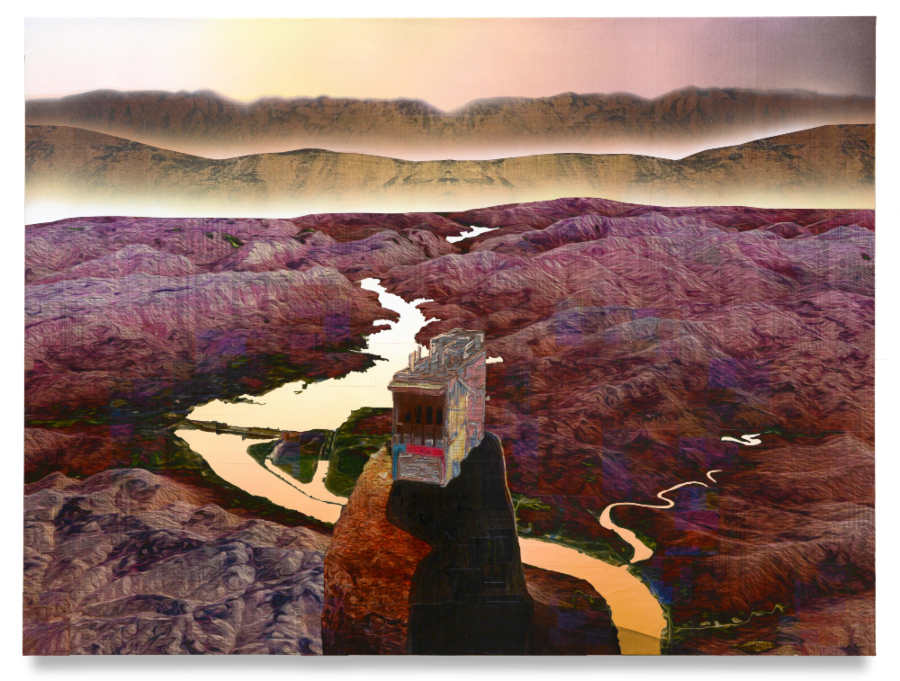
This serenity often masks deeper tensions. Living Mountain, for instance, is painted over Financial Times stock listings, which form the underlying structure of the work. From a distance, the piece appears as a peaceful landscape of mountains and a lone “nail house” – a term used in China for properties whose occupants refuse to vacate during redevelopment. Cheung’s dreamlike palette of purples and blurred gradients blankets the cultural and economic struggle beneath, revealing its conflicts only upon closer inspection.
Many Worlds, One Mind brings together 28 works – paintings, prints, etchings and sculptures that reflect Cheung’s ongoing meditation on global capitalism and the mythologies it produces. The exhibition title echoes the central thread in his practice: the ways different cultures, histories and belief systems intersect through the structures of economic and political power. Cheung invites viewers to consider how these systems shape our landscapes, both the world we inhabit and the worlds we imagine.
In conversation, Cheung speaks with the same layered clarity that defines his work, moving fluidly between personal history, philosophy, technology and the shifting architectures of global power. What follows is an insight into the ideas, experiences and material choices that shape Many Worlds, One Mind.
I hope viewers experience a sense of realities and revelations when they encounter the layered surfaces where spray paint, sand, acrylic, and digital prints meet the raw data of stock listings. The natural elements, like blooming flowers or rocky formations inspired by Chinese scholars rocks, represent enduring forces: beauty, impermanence, and the sublime. These are set against the rise and fall of civilisations, constructed realities of capitalism, geopolitics, and technology.
I want audiences to feel encouraged to deconstruct the interwoven narratives. The financial crisis of 2008 was a major catalyst for my work, pushing me to explore the roots of modern capitalism and how civilisations rise and fall. By contrasting the organic with the economic, I invite people to reflect on their own place within these systems of how power, identity, and belonging are shaped by forces often invisible in daily life. The work aims to spark poetic meditative connections between the visible canvas and the unseen structures governing our world.
Growing up in London as the child of Hong Kong immigrants, I have always navigated an in between identity rooted in both Chinese heritage where I can trace my clan back 29 generations and Western culture. This transnational perspective is deeply personal and informs everything I do. My work is not just about observing culture and identity; it emerges from lived experience, from the tension of belonging to multiple worlds at once.
I pour my own search for roots and understanding into the artwork blending Eastern philosophy, mythology, and European painting traditions with contemporary digital processes. It is intimate because these themes are not abstract to me; they reflect my family’s migration story, the clash of empires, and the human condition in a technologised world. The in between spaces I create are where I process my own reality.
Technology has always been central to my practice from early experiments painting without paint using digital tools at Central Saint Martins during the rise of the internet, to layering algorithms, inkjet, and now AI. I see AI as a powerful new tool in the long evolution of artistic media, much like photography, photoshop or the printing press before it. It is disruptive, and like previous shifts, it raises fears about creativity and jobs, but artists have always adapted.
I use AI to reimagine motifs like Dutch Golden Age tulips as reflective commentary on capitalism and consumerism that recently have then converted 2d images into 3d. I then harness them into the physical world with paint, sand, varnish, and traditional techniques. This keeps the dialogue alive between the algorithms’ ghosts and the human hand between the digital and material. It has enriched my practice, allowing me to mine the collective visual unconscious and create new mythologies for an increasingly digitised age where perceptions of time and space are in a state of constant flux. Transparency matters, especially around training data and compensation for artists. Ultimately, it is about intent: how we use these tools to interrogate meaning.
The Financial Times pages are both material and metaphor. I have collected them for over thirty years, and they embody the invisible flows of global capital data, speculation, power that move at light speed shaping our realities. In sculptures like Passage of Time (2023), I compress and build them into forms inspired by traditional Chinese scholars rocks or spirit stones. These are meditative microcosms of landscape, sitting between nature and civilisation, utopia and dystopia.
By turning the ephemeral detritus of finance into solid, rock like structures, I highlight the monolithic weight and fragility of these systems. Capital moves at light speed, yet it constructs and destroys worlds. The sculptures invite contemplation of how economic forces sculpt our environment and psyches, much like natural erosion shapes stones over time. It is a way to make the abstract concrete, to map a way to comprehend the shape of things to come and to question the narratives of progress and power embedded in the interwoven narratives of the art.
Interview by Rim Alkaiat
Featured Image – Gordon Cheung’s Living Mountain, 2015, Financial Times stock listings, acrylic, pumice and sand on canvas and sail cloth150 x 200 x 5 cm, Photo credit – (c) Hannah Goldsmith
Many Worlds, One Mind opens 6 June 2026 and runs until 15 August 2026 at CLOSE Gallery, Somerset, with an additional project space in Marylebone.
Full details and visitor information: closeltd.com
Read Rim’s latest review Abundantart-Reviews