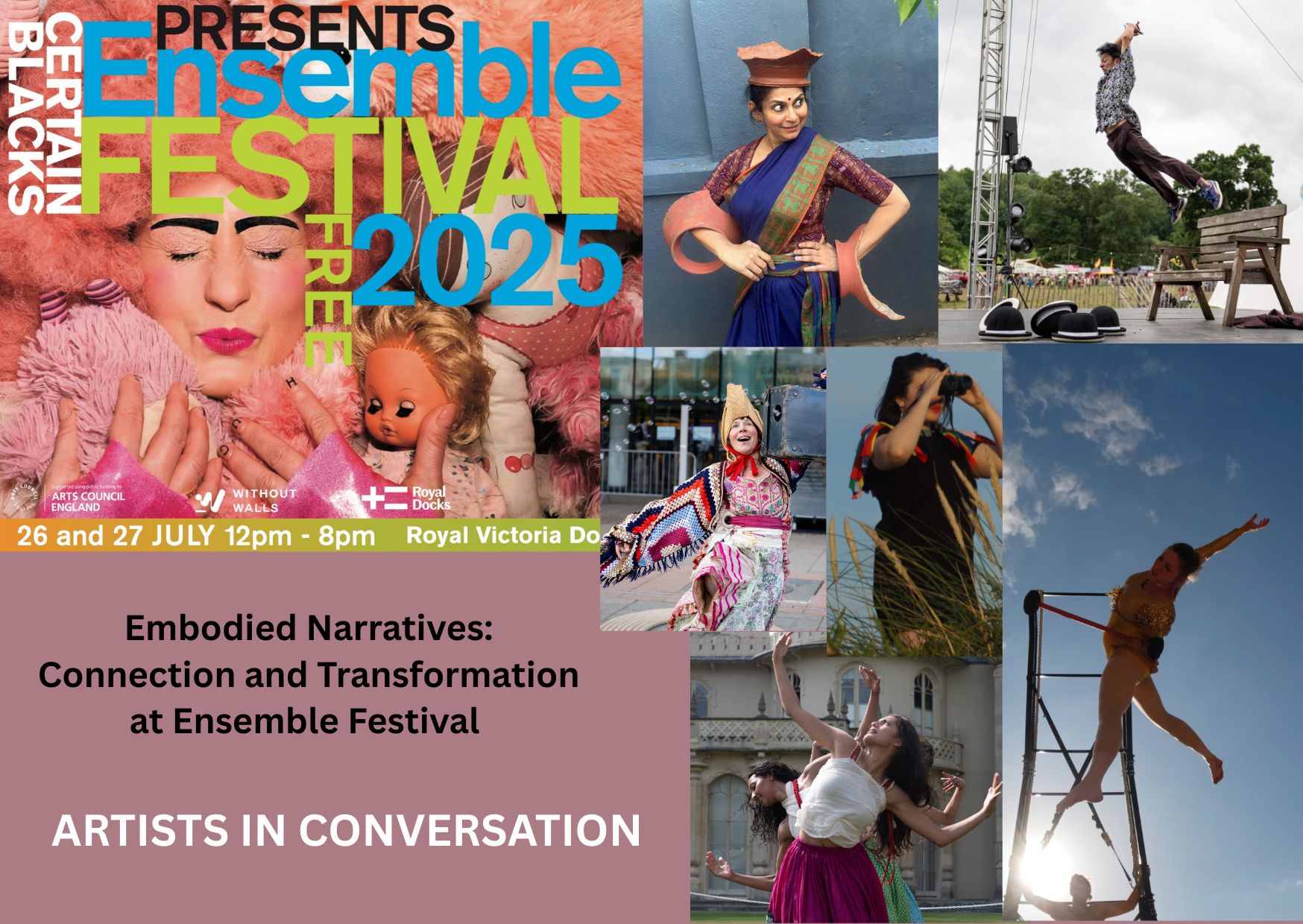
Ensemble Festival presented by Certain Blacks has grown into a vibrant platform for showcasing innovative and socially engaged performances. Over the years, it has become a space where artists and audiences come together to explore themes of connection, transformation, and storytelling. Speaking to some of the artists in the run-up to Ensemble Festival 2025, a recurring theme emerges: the profound power of physicality as a medium for connection and transformation.
As Mish Weaver reflects, “The body changes the meaning of words by shifting the physical context. Meaning is as fluid as the range of movement and gesture.” This idea resonated deeply with Nandita Shankardass, who describes how her body becomes a vessel for exploring journeys, both poetic and visceral: “My body grants me the possibility to explore, sense, and express the journey of moving from one place to another, on many levels, from the inside out.”
Vidya Thirunarayan brings a historical perspective, explaining how performers channel past struggles, triumphs, and rituals through each gesture and movement, drawing on the deep roots of Indian theatre and broader socio-political histories. Tilly Ingram offers a unique perspective on absence and presence, inviting audiences to explore their ideas of disability through the gaps her lack of physical presence creates. Tiago Fonseca describes his body as an instrument tuned to human emotion, capable of communicating complexities beyond words.
Ramshacklicious adds a playful yet profound dimension, emphasising the accessibility and interpretive freedom of performing without words: “Our bodies can be silly, funny, vulnerable, and bold, and we can take up space! Performing without words makes our work accessible to everyone, leaving the viewer welcome to interpret and recognize things in the work without us having to absolutely define them.”
The festival’s theme, The Body as Archive and Activator, highlights how physicality becomes a site for storytelling, transformation, and visibility. Through dance, circus, and theatre, artists unlock hidden narratives, challenge norms, and create emotional resonance.
Each artist also shared reflections on the work they’re bringing to Ensemble Festival 2025—revealing the inspirations, methods, and moments that shaped its creation:
Mish Weaver’s work in Waiting Song combines trapeze movements and live music to create a physical narrative of hope and anticipation. She explains, “There is something particularly engaging about watching someone do something strenuous and brave while also singing. Audiences appreciate the difficulty of that in itself. You can feel the voice affected by the actions of the body.”

Mish Weaver (Waiting Song) ©Image credit: Mark Morreau
Q: How do trapeze movements and live music create a physical narrative of hope and anticipation?
“There is something particularly engaging about watching someone do something strenuous and brave while also singing. Audiences appreciate the difficulty of that in itself. You can feel the voice affected by the actions of the body. By bringing the two together we create a visceral experience of the song. The song has been written so carefully, to offer hopefulness but not naivety. For me, the fact that two powerful women – who are also totally approachable – are loving what they are doing, makes the song land more effectively. We wrote the song to be catchy and easy in the hope that people could find themselves playing with the words in their heads. In this way I want to celebrate our resilience.”
Q: What challenges did you face in blending circus artistry with lyrical storytelling?
“That bit is not the challenge – it is everything else that is.”
Nandita Shankardass’s Roots to Rise blends Indian classical dance with contemporary movement to tell a story of resilience and connection.

Nandita Shankardass (Roots to Rise) ©Image credit: John Evans
Q: How does the physicality of Indian classical dance blend with contemporary movement to tell the story of Roots to Rise?
“In the creation of Roots to Rise, I have collaborated with dance artists trained in a range of styles from Indian classical dance forms of Kathak and Bharatnatyam, contemporary and ballet. The artists are all also exploring their own contemporary movement language and voice at this moment in their dance practice, which has leant itself well to the process where my movement vocabulary and theirs creates a new movement journey. Guided by prompts and reflecting and responding to questions offered through my research and which have arisen in our conversations, the dancers have accessed their toolbox of movement skills and storytelling, where classical form and contemporary exploration can meet, challenge and develop a dialogue between them. The range and dynamics of physicality within Kathak and Bharatnatyam dance, along with the innate sensitivity to music and approaching rhythm and storytelling has been a pleasure to witness in the studio whilst we create and explore ways to tell the story and bring research and individual experiences to life.”
Q: What do you hope audiences will feel through the embodied journey of the three women in the performance?
“As I created and developed the characters of the 3 women, I reflected on women I have known and met throughout my life so far, as well as those I have read and heard stories about. I reflected on the different challenges and wisdom which comes to women at different stages of our lives and which has shifted throughout history across the ages.
Upon reflection and towards the end of our creation time, I realised how much I see of myself in each of the characters, not only across different moments in my life but in fact all at once within me in the space of a day in flux and make up who I am today. This reminds me of the wonder and curiosity of youth, appreciation for the growth that comes with struggles and challenges in discovering who we are and the fulfilment of sharing wisdom with others.
I am curious about how audiences may see themselves in these three women and resonate with their individual journeys and evolution at varying points in the performance. Perhaps there is some healing in seeing a feeling they have experienced embodied before their eyes, to reflect and process during the show and beyond.”
Tiago Fonseca’s NoMo uses physical comedy to address the issue of screen addiction, blending humour with poignant social commentary.

Tiago Fonseca (NoMo) ©Image credit: Mary Wycherley
Q: How does physical comedy in NoMo address the issue of screen addiction?
“When we use a mobile phone, our body shifts into a state of both tension and relaxation, often without us realizing it. Our neck and shoulders hunch forward, eyes focus narrowly on the screen, causing physical strain. Our Fingers move in repetitive, small, mechanical motions, becoming stiff or numb with constant scrolling. Posture collapses. We go from a more open, engaged position to one of closed-off detachment. Our facial expressions flatten or become overly engaged (like a laugh when we scroll past a funny meme)—we lose the subtlety of real-life expressions and emotions.
I recreate these moments with my body and try to give it a funny twist. This exaggeration makes the addiction feel almost like a dance of dependence. But it also shows how we lose control of our own actions when sucked into a screen.”
Q: What do you find most challenging about using your body to convey a topical message?
“Screen addiction is a universal experience, but it manifests differently in each person. In the context of using my body, the clown needs to be relatable to a wide audience, while still maintaining the unique quirks and absurdities of a clown character. The challenge is ensuring my body transmits internal states of distraction, obsession, frustration, and longing into physical gestures that are both comprehensible and relatable.
For instance, how does my body express feeling disconnected from the world around you while still remaining engaged with your phone? The clown’s addiction feels real and personal, yet also universally understood. I have to be careful not to make the movement so extreme that the audience can’t see their own habits reflected. I should embody the paradox of connection and isolation that screen addiction creates a journey from frantic distraction to gradual awareness but in a way that doesn’t feel like a caricature.”
Vidya Thirunarayan’s HOLY DIRT combines Indian performance styles with modern theatre to explore themes of myth, earth, and movement.

Vidya Thirunarayan (HOLY DIRT) ©Image Credit: The Clay Connection
Q: How does HOLY DIRT use physical movement to combine Indian performance styles with modern theatre?
“Holy Dirt emerges from a Bharatanatyam-trained body that breaks open its codified technique to uncover a more instinctive, felt way of moving. In doing so, it paradoxically deepens its connection to the essence of Bharatanatyam— as expression born from presence and felt emotional truth.
This journey was shaped through an active exploration of European performance traditions including bouffon, melodrama, and physical improvisation—tools that helped destabilise formality, embrace risk, and rewild the body’s expressive range. The result is a hybrid language that is at once precise and unpredictable, devotional and irreverent—offering space for abstraction, satire, and transformation.”
Q: What role do the elements of earth, myth, and movement play in the physical storytelling of HOLY DIRT?
“In Holy Dirt, earth is alive and a collaborator in the performance. Clay, sand, and stones embody the shifting emotional landscapes of the performance-these materials chart the internal journeys of characters. Myth provides the deeper narrative spine drawing from the figures of Draupadi and Parashakthi to frame a journey through oppression, resilience and regeneration. Movement becomes the means through which these mythic forces are made tangible—invoking memory, ritual, and resistance through the live, expressive body. The global music—layered with percussion, ambient sound, and spoken languages—deepens this world.”
Tilly Ingram’s The Hide explores the theme of hidden disabilities through a unique interplay of presence and absence.

Tilly Ingram (The Hide) ©Image credit: TBA
Q: What inspired you to share your personal story through bodily engagement in this installation?
“I think the absence of my presence allows my story to be more universal and think about the numbers that come with invisible disability, there is estimated to be 10 million people with an invisible disability living in the UK. It is estimated that 1 in 5 in the population are disabled, and that 70-80% of disabilities are ‘hidden’.
In the show I share these numbers in the hope that along with my story that I am sharing, the audience can reflect on the amount of people who don’t ‘look disabled’. Using my physical story but without my physical presence I feel allows people to think about the wider community.”
Q: What role does physicality play in connecting with your audience?
“I am asking them to connect with the idea of me, before the physical version of me, and that means they can put as much of themselves they are willing to give. The Hide asks them to empathise with anyone who suffers an invisible disability and the sort of practical challenges that might come with that but I hope that the piece also allows time and space for people to reflect on how everyone has something going on beneath the surface, and first looks can’t allow you to see everything, even with a pair of binoculars!”
Ramshacklicious’s TRUTH uses clowning and physical theatre to challenge societal norms and celebrate difference.

Ramshacklicious (TRUTH) ©Image credit: TBA
Q: How does TRUTH use clowning and physical theatre to challenge societal norms?
“TRUTH! has an integrated cast of neurotypical and neurodivergent performers, and gently invites the audience to take part in the performance. The performance shows us all – performers and audience alike – as equals, and there is an underlying message that it takes all of us, whoever we are, coming together in public joy and acceptance to really make positive change in the world. We use quirky movement and striking styling to create an offbeat, surreal atmosphere where people can leave preconception behind and dream a better future.
TRUTH! uses the playful, chaotic nature of clown to reveal the absurdity of societal expectations, hierarchies, and prejudices. By putting an inclusive cast of performers at the heart of a radical, joyful street performance, we reclaim space and disrupt the norm, celebrating difference as a source of power and connection.”
Q: What do you hope audiences will take away from the physical and emotional impact of this street revolution?
“Together we can realise that perhaps real revolution needs a gentler approach – we need to come together in joy and not in conflict to build better times. And we all have that power. We want people to leave with their hearts a little more open, their assumptions gently challenged, and their spirits lifted by what it means to be human, together, in public space.”
The Ensemble Festival plays a vital role in bringing these visions to life, offering a platform for testing and refining new works. As Vidya Thirunarayan notes, “Holy Dirt premieres at this festival, offering space for feedback and deeper engagement with audiences.”
Reflecting on the artists’ insights, I was struck by the diversity of their approaches to connection and transformation. Tiago Fonseca hopes audiences will laugh at the absurdity of our phone habits, then feel the ache of disconnection underneath it all. Nandita Shankardass envisions moments of reflection, during and beyond experiencing the show, on how we spend time in nature and take care of the natural world and ourselves. Mish Weaver sees live performances as a space for transformation, offering audiences a moment to consider their own thoughts and feelings.
Ramshacklicious aims to inspire laughter, thought, and a sense of inclusion, leaving audiences with restored faith in humanity. Tilly Ingram hopes her work sparks conversations about disability and accessibility, encouraging audiences to rethink how they view these topics.
The Ensemble Festival also provides a unique opportunity for artists to connect with new audiences and refine their work. Mish Weaver appreciates the trust and patience the festival has shown in supporting her experimental project, Waiting Song. Nandita Shankardass values the opportunity to present Roots to Rise in an urban landscape, surrounded by a vibrant line-up of artists and shows. Vidya Thirunarayan highlights the festival’s role in shaping the future iterations of Holy Dirt through audience feedback and engagement. Tilly Ingram cherishes the opportunity to perform in Newham, a place deeply connected to her family’s history, and to share her story in a meaningful way. Tiago Fonseca sees the festival as a gateway to reaching diverse audiences and building industry visibility for his solo show, NoMo.
Through their performances, the artists hope to inspire audiences to reflect, connect, and transform, while the Ensemble Festival continues to champion innovative and socially engaged art that resonates with communities and challenges norms.
For full details of all the events, including performance times and precise locations, please visit www.certainblacks.com
Ensemble Festival is part of Without Walls, a network of organisations bringing innovative outdoor arts to towns and cities across England. Find out more on withouthwalls.uk.com
See Abundant Art’s latest features here Features | Abundant Art
Feature by Protima Chatterjee