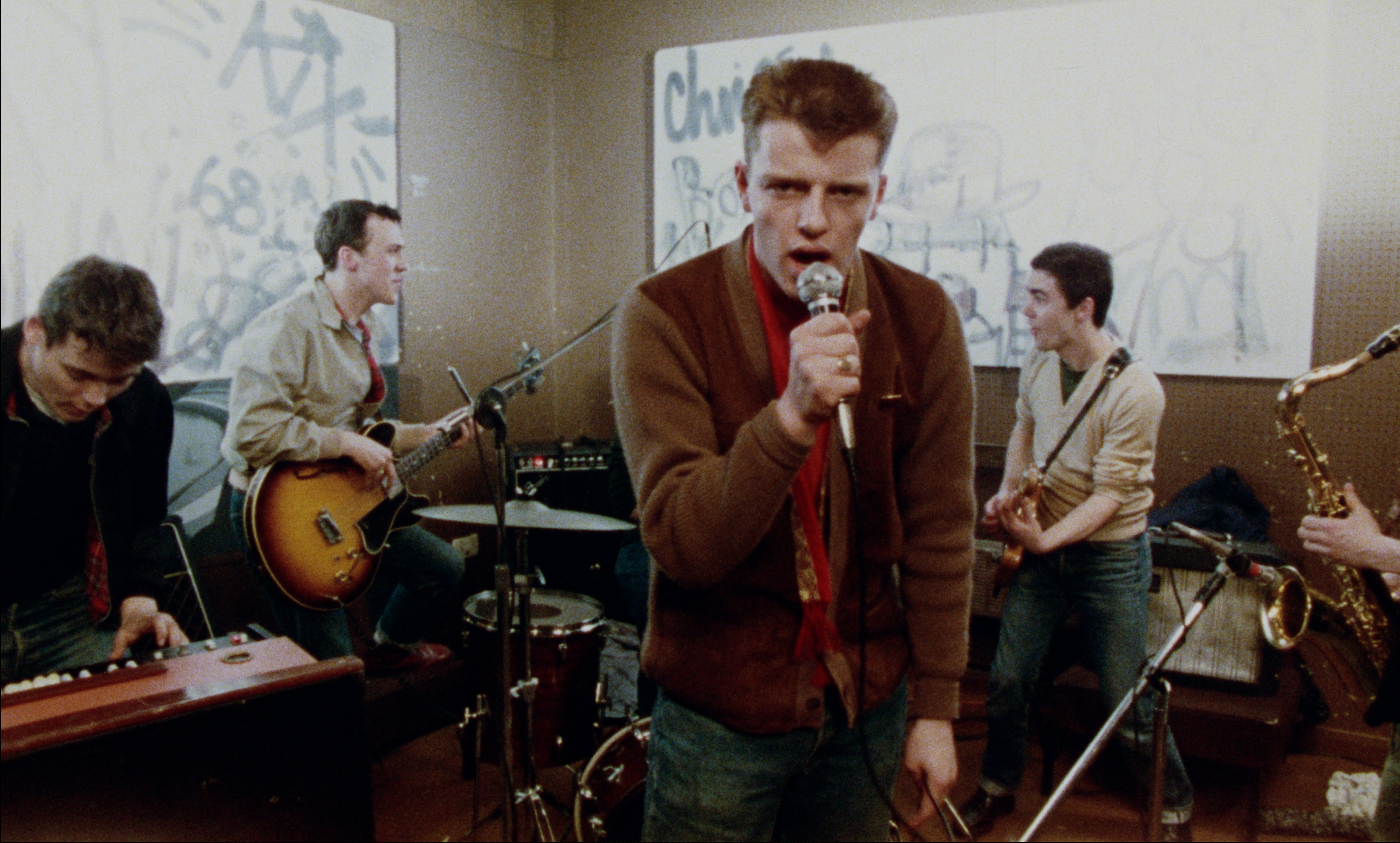
It’s easy to forget that Madness, the pop-ska princes of Camden Town, came from humble beginnings. Raised amid the malaise of an unforgiving, ungentrified North London in the 1960s and ’70s, they spent their youths prancing around its backstreets in baggy trousers, punctuating their days with petty crime to scrape enough shrapnel together for rock ’n’ roll records. And yet, somehow, these rapscallions would go on to skyrocket to international fame, becoming one of Britain’s biggest bands by the early ’80s.
‘Take It or Leave It’ (1981) is a pleasingly uncomplicated docufiction, made a few years into Madness’ successful career and self-funded by their first royalties cheque. Retelling the band’s pre-fame beginnings, the film stars Madness themselves, opening with a light-fingered Mike Barson perusing a record shop before his tilbury-hatted silhouette darts out with a brand-new wax tucked into his Harrington jacket, perambulating through Euston to band practice.
Conveniently, the film bows out just before their run of chart-topping singles kicks off, neatly dodging the usual rock-doc drama of overnight stardom and divisive creative decisions. Instead, what you get is something far more charming and naive: a snapshot of what it meant to be young, skint, working class and trying to scrape a new sound together.
The problems, as Madness themselves tell it, were constant lineup changes leading to punch-ups in the practice room, bouts of total lethargy and egoism, and — not least — a lack of musical capability. As such, the film becomes a lesson in the grit and authenticity behind friendship and early success, illustrated by postcode warring at gigs, carting equipment around in a knackered yellow Morris Minor and dripping, spray-painted flyposters promoting their first iteration as the North London Invaders.
Featuring all the early hits, including ‘The Prince’, ‘One Step Beyond’, ‘Baggy Trousers’ and ‘Night Boat to Cairo’, Graham McPherson, or ‘Suggs’, provides conversational London patter over colour-drained shots of Kilburn slums and smoky pubs with tired pool tables and wallpaper, flower-pinned barmaids and sticky floors.
What the film captures, almost by accident, is a kind of male friendship that feels foreign now. Today’s young men mostly live through screens that push isolating and fear-mongering content; to say they are community-starved would be an understatement. This is not to romanticise the ’70s: London was rife with its own problems, not least the skinhead subculture and Madness’ fraught relationship with it. But there is something in the film’s simplicity that is so joyful it occasionally turns saccharine — young men dancing together on tube platforms and staying out all night at parties — and feels starkly alien for a lot of today’s young people. The Madness boys were a community enjoying the frictions of youth, uncomplicated idleness and the privilege of doing it together; a band formed because there was nothing better to do.
Culminating in an infamous rowdy show at the Dublin Castle, which remains an icon of North London, the film concludes with Camden’s very own Magnificent Seven joshing around backstage, on the cusp of success.
Feeling like a fly on the wall for every decision made during the band’s early years, the film is an innocent, flawed but fascinating portrait of Madness before they became one of Britain’s biggest bands.
A world premiere of the restoration including a Q&A with band members will take place at BFI Southbank, before the film returns to cinemas nationwide on 2nd October.
Review by Florence Marling
Featured Image Credit : Take It Or Leave It (Dave Robinson, 1981)_A BFI release
Directed by Dave Robinson, Take It Or Leave It, newly restored in 4K by the BFI, screens in selected cinemas in the UK and Ireland from 2 October (previews start on 30 September) and is released on BFI Blu-ray/DVD on 19 October.
Madness ‘Take It Or Leave It’ 1981 Film – Restored By BFI – Madness
Read our latest Abundantart-Reviews