Hello

Review: New York City Ballet Debut at Sadler’s Wells, 7-10 March 2024

New York City Ballet celebrates its 75th season, returning to London, for the first time in 16 years. The company showcases a mixed bill ranging from 1972 to 2022. Versatility of curation is reflected through the presentation of new works by an emerging new generation of performers, alongside a classic piece by George Balanchine.

In the first performance, ‘Rotunda’, Justin Peck’s dynamic choreography captures the essence of cheerful play and curiosity, as the dancers seamlessly transition from position to position, spreading apart like liquid on material, before drawing together into satisfying geometric formations. The choreographer, celebrated for his contribution to Spielberg’s recent remake of ‘The West Side Story’, seems to depart from the conventional synchronicity of ballet, as he incorporates chaotic and seemingly random motions, punctuated by moments of order, continuously engaging the viewer. The dancers’ expressions and perpetual movement convey a gentle, childlike excitement, with groups dividing and forming audiences to crouching figures, engaging in animated conversation. Enhancing the atmosphere of relaxed playfulness, Reid Bartelme and Harriet Jung’s costumes of casual pastel create the impression that the dancers could be immersed within a studio practice session.

Choreographed by one of the most influential figures in the 20th century world of dance, Balanchine’s ‘Duo Concertant’ portrays a neoclassical duet in which the performers and musicians interact and inspire each other. Igor Stavinsky is played live on piano and violin. Ronald Bates’ masterful lighting is strategically used to accentuate and elevate the performance. At times, the use of spotlight, as the sole light source, captivates audience into intense moments of physical contact between the pair. 

The following original post-modern piece, first premiered in 2019, ‘Gustave le Gray No. 1’, is choreographed by the New York based Pam Tanowitz. Portraying four dancers, in bright crimson unitards dancing sharp and spontaneous, create an enigmatic visual experience. Similar to the previous performance, the captivating relationship between movement and sound converges, with performers infusing the underscore with their physicality. Moreover, the choreographer’s choice to direct dancers to push the piano across the space, amongst other such gestures, reiterates the symbiosis.

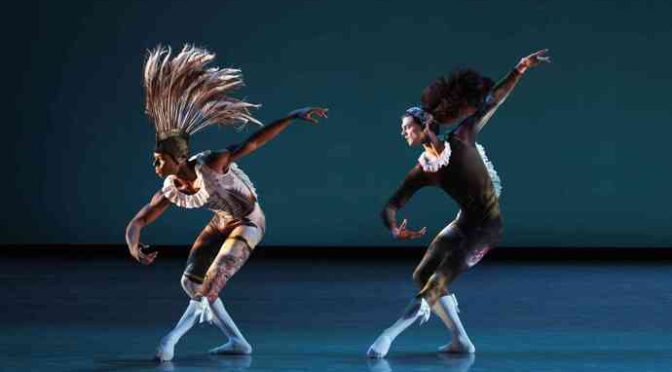
The final performance, rounding out the programme, is Kyle Abram’s ‘Love Letter(on shuffle)’, described in the programme as “ a mixtape of life”. Here London-born musician James Blake’s music is used to complement the fast paced contemporary choreography. The underscore used is a harmonious blend of piano and rap embodying the company’s progressive approach to ballet. With a pair of male dancers engaged in a romantic duet, the performance introduces aspects of modern day life whilst still paying tribute to the classical art, as seen in Giles Deacon’s costumes. Here elements of the past and present blend, with costumes made of lycra embellished with ruffles, bows and tutus: reference the evolution of ballet costume.

New York City Ballet presents a fascinating repertoire through a contemporary presentation of ballet, pushing boundaries and challenging conventions, whilst also honouring the rich heritage of the form. 

Featured Image: Christopher Grant and Peter Walker of New York City Ballet in Kyle Abraham’sLove Letter (on shuffle).Photo credit Erin Baiano

Review by Teodora Wollny

Teodora is a recent A-level graduate, having studied Art History, Drama, Philosophy and English Literature. Being both a performer and an avid writer,  she enjoys attending a range of entertainment, including theatre performances and art exhibitions. Whilst currently on a gap year, she intends on pursuing Visual Art and Film studies. 

Read Teodora’s latest Review: Nachtland – an unsettling discovery of a painting by Hitler in the attic; a comedic approach to a contemporary conundrum – Young Vic, until 20 April – Abundant Art

Visit Sadler’s Wells and New York City Ballet to know more about their upcoming programmes.
 

Review: Nachtland – an unsettling discovery of a painting by Hitler in the attic; a comedic approach to a contemporary conundrum – Young Vic, until 20 April

What would you do if you uncovered a potentially valuable painting made by Hitler in your loft? Is it an opportunity to cash in on or a troubling secret best kept hidden?

German Playwright Marius Von Mayenburg’s play ‘Nachtland’ grapples with this dilemma.

This contemporary comedic satire, translated by Maja Zade and directed by Patrick Merber, employs characters of varying backgrounds, each with conflicting opinions to initiate a conversation on what the most reasonable solution to the
situation would be. The audience is encouraged to contemplate how they would respond, whilst also considering the struggles of modern-day Germans in preserving history: burdened with the indelible guilt of their nation’s past.

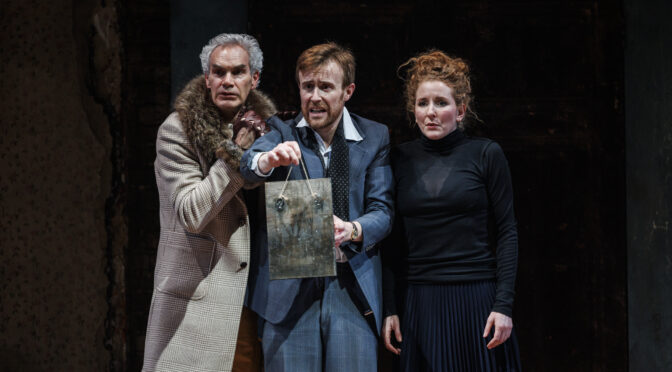
Siblings Philip (John Heffernan) and Nicola (Dorothea Myer-Bennett) make an unsettling discovery of a painting in their recently-deceased father’s attic, bearing a signature suggesting the artist to be the Fuhrer himself. Accompanied by both of their spouses, including Philip’s wife, Judith, nicknamed the “Jewess” (played by Jenna Augen) and Nicola’s husband, Fabian (Gunnar Cauthery), immediate discord ensues. Philip and Nicola’s eager attempts to inflate the value of the artwork lead them to admit their familial ties to the Nazi party.

As the play unfolds, it appears that the siblings’ performative disdain and distancing from their ancestry unravels. Elated by their finding of letters signed ‘ Heil Hitler’, their anti nazi stance is gradually diluted as they are increasingly drawn into their family’s nazi-sympathising past.  Initially described by Philip to be the ultimate reconciliation between Jew and German, his relationship “with the Jewess” takes a turbulent turn, perhaps symbolising that under the surface historical trauma remains largely unresolved. As the perceived origins of this painting are questioned, it seems that the characters’ moral compasses are compromised, as they desperately seek to establish some relation to Hitler, for the sake of financial gain.

The theatrical style, reminiscent of Brecht, seems to hinder any form
of strong emotional reaction to the performance, other than shock.
Despite the sensitive conversations, laughter arises. This is exemplified in scenes such as Judith’s spotlight lit monologue detailing her reaction to Nicola’s critical reflection on the ongoing Israel-Palestine conflict. Here, Angus Wright’s character, Kahl, the buyer, is seen bursting in, wearing racy underwear, oiled up and dancing in dazzling pink light. Richard Howell’s skillful use of lighting enhances the dynamic shifts in tone, immersing and surprising the audience, left in constant uncertainty as to what is going to happen next.

‘Nachtland’ invites viewers to adopt a more tolerant perspective,
employing humour and engagement with audience members to spark a reconsideration of society’s approach to historical taboo topics. Despite this, the correct stance towards the presented scenario remains elusive, as no clear antagonist or victim emerges.

In the play’s conclusion, the once-opposed siblings find themselves
aligning with a Hitler art collector and a nazi-sympathising art
expert, exposing their complicated relationship to their Nazi past.

Mayenburg suggests that an undercurrent of  antisemitism may linger within German culture. Despite the use of comedy and initially relatable characters, the performance remains unsettling, as it is suggested that the nazi past is not as distant as it seems. When confronted between a moral choice and personal gain what would individuals choose? The play probes and exposes points of unease and discomfort in contemporary western society.

Featured Image: Angus Wright, John Heffernan, Dorothea Myer-Bennett in Nachtland © Ellie Kurttz

For more information visit Nachtland | Young Vic website

Review by Teodora Wollny

Teodora is a recent A-level graduate, having studied Art History,Drama, Philosophy and English Literature. Being both a performer and an avid writer,  she enjoys attending a range of entertainment,including theatre performances and art exhibitions. Whilst currentlyon a gap year, she intends on pursuing Visual Art and Film studies. 

Read our latest review Review: Gamble – Touring until 28 March – Abundant Art


Review: Gamble – Touring until 28 March

Gamble – Presented by Hannah Walker and Co – A multi- media theatre production-an exploration of the online gambling industry based on conversations with experts and experience of being in love with a compulsive gambler.
Co-created by Hannah Walker & Rosa Postlethwaite


‘It is estimated that there are around 24 million people in the UK who participate in online gambling’, a paper waiting for us at our table reads. It includes some more statistics, plus numbers you can call if you need support, both as a gambler or as a family member/friend of a gambler. This piece of paper, and the setting we were just welcomed in – a dim, almost restaurant-like theatre space, where we are offered a small glass of prosecco or orange juice by the performers themselves on arrival – give us an insight on what we are about to see.

GAMBLE is an autobiographical multimedia theatre production about addiction and its impact on loved ones. Hannah Walker navigates her own life being in love with someone with a gambling addiction and deciding to stay and work it out with him. Throughout the show, with 2000s-vibe videos running in the background with a repertoire of mimicking songs,  Walker leads us from that starting point, when casinos were seen as glamorous and cool – behind the glittery curtain of jackpots and big wins – to the discovery after their first kid together, that her husband is addicted to online gambling, through rehab, to relapses and recovery.

Hannah Walker is personal in this show. She speaks out to the audience, including everyone in different ways – like asking an audience member to read a script for her ‘So I can be in the scene!’, Hannah says – in a cabaret-style show that’s fun, sweet, and very real. Always accompanied hand to hand by Faye Alvi, a wonderful BSL interpreter who is in this show more than that, but a performer – an intrinsic part of the act and, perhaps, one of the reasons why the show stands out. This is on point and provides momentum to the otherwise slow-paced cabaret form in an interesting way.

The Performance is followed by a post-show 45-minutes discussion with Dr Matthew Garkell – a professional in the topic, Clinical Lead and Consultant Psychologist for the NHS Northern Gambling Service – where the floor opens for a Q&A. ‘Gambling has the highest rate of suicide of all addiction’, he says to a wide-eyed audience. In this talk, Hannah Walker also expands on how the show was created, starting as therapy for her and her husband, and she hopes that, by presenting it to a wide audience across the country, it can initiate meaningful conversations to help those suffering from gambling addiction. An informal coffee and a chat ‘change making’ follows each performance on the following morning for those that might benefit from further discussion and support.

GAMBLE makes a statement and delves into a topic that isn’t well explored yet in UK theatres. Inclusivity takes its much-needed space in this initiative. Though the production may benefit from some further deepening – the chosen form of cabaret too light to hold the topic at times, Hannah Walker and team take a bold step here and succeed in establishing that gambling addiction is a real, substantial, dangerous challenge.

Image credit: Andrew Moore

Review by Eva Mateos Rodriguez

Eva  is an eclectic artist specialising in acting, writing and songwriting. She has been part of several performances, responses and exhibitions, and is now a student of the MA Creative Writing at Birkbeck University.

Gamble is touring – 15 February-28 March 2024 


8 March – Midlands Arts Centre, Birmingham Cannon Hill Park, Birmingham, B12 9QH/8pm | £12 macbirmingham.co.uk/| 01214463232

22 March – The Mercury Theatre, Colchester Balkerne Gate, Colchester CO1 1PT/8pm £12 mercurytheatre.co.uk/|01206573948

28 March – Exeter Phoenix, Exeter, Gandy Street, Exeter, Devon, EX4 3LS/7.30pm | £12-£10 exeterphoenix.org.uk/| 01392 667080

To learn more about the company visit thehannahwalker.com

Read our latest theatre review Women In Revolt! at Tate Britain until 7 April 2024


Kew Gardens’ Orchid Festival 2024 – a call for conservation of fragile ecosystems – until 3 March

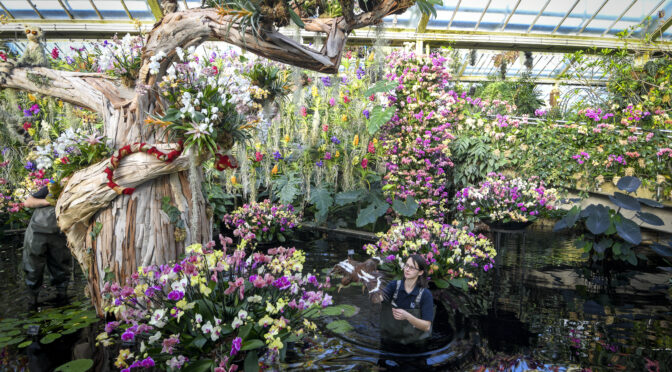
Kew Gardens’ Orchid Festival 2024 is a beautifully curated burst of amazing colours, inspired by the incredible island of Madagascar with spectacular horticultural displays.

Orchids remain a powerful vector of cultural symbology. In the western context in the past, orchids often represented the effete lives of the idle rich. In literature and in films in the 20th century they could be alluring exotic sometimes unobtainable yet dangerous. More recently orchids have come to symbolise the fragile beauty of nature’s ecosystem which need protecting. In other cultures, especially Asian cultures orchids have been part of symbiotic respectful relationship with nature. For example the moon orchid (Aphrodite’s phalaenopsis) derives its name from Indonesian ‘Anggrek Bulan’ where it is revered as the national flower. The boat orchid (Cymbidium orchid)  have symbolised morality, beauty, and love in many Asian cultures for centuries. Showcased at the festival, these extraordinary orchids even inspired Confucius  to mention them in his famous writings, naming them “the Kings of Fragrance.”

Kew Gardens’ Orchid festival is a sumptuous homage to these elegant rare beauties. This year the theme is around the island country of Madagascar with its unique flora and fauna. The Princess of Wales Conservatory is beautifully decorated with some water based orchid installations.  Several orchid arches festoon the path. The orchid collection is a colourful bunch covering species from across the globe. It includes the Clamshell Orchid (Prosthecea cochleata ) from Central America and West Indies, the Moon and Boat Orchids from South East Asia as well as the European and North African origin Sad Stock (Mathiola fruticulosa ). The slender and colourful aptly named lady Slipper Orchid ( Cypripedium calceolus) also hailing from Europe add some tender beauty to the decoration. We cannot have an orchid showcase without a reference to the Himalayas where many orchid species originate. The lightly scented pink and purple flowers of the Dendrobium Nobile is the state flower of the mist laden Himalayan Indian state of Sikkim. At the show they are juxtaposed with the beautiful orange blooms of the Dendrobium Lindeyi. 

The Orchid Festival heralds early spring in Kew where the cherry trees are budding and early crocus starting to appear in the grasslands. The festival is not only a colourful flower show but also a beautiful art installation. It showcases an ecology which has a powerful hold on human imagination across many cultures. The Orchid Festival is as much sense satisfying as it is effective  in delivering a message of responsibility-  for the urgent need of conserving all fragile ecosystems.

Festival ends on 3rd March, which leaves us with the weekend to visit. A not-to-miss family experience-make your way to Kew this weekend. More information HERE

Featured Image: Orchids at Kew Gardens, celebrating the remarkable biodiversity of Madagascar. (c) RBG Kew 

Review by Koushik Chatterjee – a generous volunteer supporting Abundant Art.

Read Koushik’s latest review Review: Qawwali Flamenco: a deeply emotional experience-Barbican, 15 Oct


Review: When Forms Come Alive “a rapturous exploration of sculpture” – Hayward Gallery, until 6 May

Restless, fluid, ever-changing: Hayward Gallery’s latest offering When Forms Come Alive is a rapturous exploration of sculpture spanning the last 60 years. 

When Forms Come Alive begins with two mesmerising installations. Firstly, DRIFT’s Shylight sees balls of light, veiled by delicate fabric, gracefully float and rise from the ceiling reminiscent of ethereal jellyfish dancing in the depths of the ocean. A little further in, large clouds of foam gradually overflow trays in Michel Blazy’s Bouquet Final. On both counts, visitors stand entranced by the hypnotic rhythms of the installations.

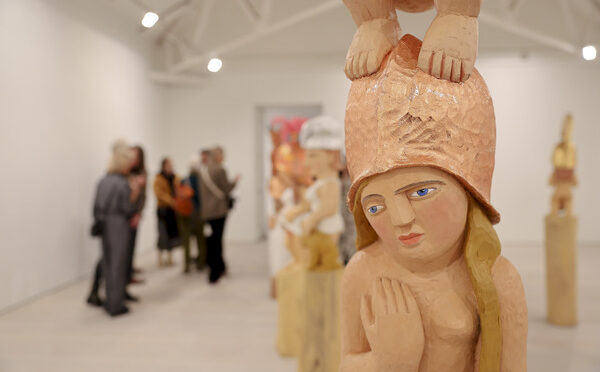
Moving further into the exhibition, viewers encounter the sculptures of Marguerite Humeau. Among her trio of sculptures stands The Holder of Wasp Venom, a mesmerising creation that both captivates and unnerves. As visitors approach the sculpture, they are greeted by the scent of beeswax and a faint humming noise that reverberates in the background, transporting them to a realm where the boundaries between the organic and the synthetic blur. Composed of layers of mushroom-like forms adorned with hexagonal patterns reminiscent of honeycomb, the sculpture exudes an otherworldly beauty. Yet, upon closer inspection, viewers are confronted with a vial of wasp venom adorning the top of the sculpture, a reminder of the fragility of existence and the precarious balance between creation and destruction.

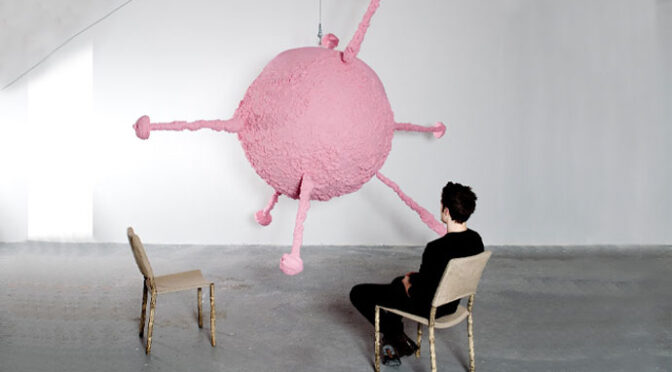
Finally, ascending to the upper galleries, visitors are greeted by a riot of pink hues, with works by artists Phyllida Barlow, Franz West, and Nairy Baghramian commanding attention. Among the highlights is Franz West’s Epiphanie an Stühlen (Epiphany on Chairs), a whimsical creation that challenges conventional notions of art and its transformative power. Two chairs invite viewers to contemplate a huge pink sphere adorned with spikes, suspended above them like a celestial body. Through its playful juxtaposition of mundane objects and fantastical elements, West’s work invites viewers to reconsider their preconceptions of art and its ability to provoke introspection and revelation and rather, just enjoy it. The perfect ending to such a jubilant exhibition.

When Forms Come Alive is a captivating exploration of the intersection between form and flux. Through a diverse array of immersive artworks, the exhibition invites viewers to contemplate the beauty and complexity of the world around them, challenging them to consider sculpture in a new light. When Forms Come Alive offers a glimpse into a world where the static becomes dynamic and the mundane becomes extraordinary.

When Forms Come Alive is showing at Hayward Gallery until 6th May. Further information and tickets are available here.

Featured Image: Franz West. Epiphany on Chairs, 2011. Photo: Michaela Obermair/Atelier Franz West © Archiv Franz West, © Estate Franz West.

Review by Amy Melling

Amy is a Curator and Creative Producer whose practice is centred around community-led arts projects. Her current research is focused on curatorial methods for exhibiting artworks outside. Amy has a keen interest in the arts and recently completed an MA in Curating and Collections at Chelsea College of Arts, UAL.

Read Amy’s latest review Women in Revolt at Tate Britain

Review: Women in Revolt! – “recognises the indomitable spirit of women who, through art, have defied conventions!” Tate Britain, until 7th April

A daring and transformative exhibition, Women in Revolt! at Tate Britain is a powerful testament to the resilience, creativity and audacity of women who, throughout history, have rebelled against societal norms. The exhibition unearths a host of artistic expression, capturing a spirit of defiance that reverberates through the works of women artists across generations.

The curation is both careful and chaotic. With works arranged chronologically, Women in Revolt! unfolds as a narrative of resistance. The exhibition is a visual tapestry that weaves together the stories of women who have defied conventions, shattered glass ceilings and left an indelible mark on the art world.

The selection of works is diverse, with over 100 contributors working across painting, drawing, photography, textiles, printmaking, film, sculpture and the archive. Women in Revolt! celebrates established artists like Sonia Boyce, Linder and Chila Kumari Singh Burman alongside those previously left outside the artistic narrative, such as Poulomi Desai and Shirley Cameron. This thoughtful juxtaposition creates a dialogue that resonates with the ever-changing landscape of feminist discourse.

One, of many, standout works is Marlene Smith’s Good Housekeeping III (1985, remade 2023). The work is a painted portrait of Dorothy ‘Cherry’ Groce, with an accompanying text painted directly on the wall stating ‘it is 7am and I am not bullet proof’. The work tells the story of Groce who was shot by police during a raid of her home in Brixton, London in 1985. The event led to a number of uprisings, with an eventual apology from the Metropolitan Police in 2014. Smith’s work was originally shown in the monumental exhibition The Thin Black Line, curated by Lubaina Himid at the ICA in 1985. The remade piece, showcased once more today, reaffirms the significance of art in political discourse and its enduring impact.

Women in Revolt! leaves you with a renewed sense of the power of art as a catalyst for change. The exhibition is a celebration, an affirmation, and a challenge. It challenges us to revisit our understanding of art history, to question the narratives that have shaped our perceptions and to recognise the indomitable spirit of women who, through art, have revolted! 

Women in Revolt! is open at Tate Britain until 7th April 2024, further information and tickets are available here.

Review by Amy Melling 

Amy is a Curator and Creative Producer whose practice is centred around community-led arts projects. Her current research is focused on curatorial methods for exhibiting artworks outside. Amy has a keen interest in the arts and recently completed an MA in Curating and Collections at Chelsea College of Arts, UAL.

Read Amy’s latest Review: If Not Now, When? “is a call to engage, to question, to act” – Saatchi Gallery, until 22 January 2024 – Abundant Art

Review: Co Westerik Centenary showcases paintings and works on paper from 1972 to 2016 – Sadie Coles HQ, until 13 January 2024

An interior life capsulated, Centenary at Sadie Coles marks 100 years from Co Westerik’s birth. An encounter with the body, own and otherwise takes us away from a spring in a haze, with the blades of grass left uncut, and red tape swam through. This presentation delves beyond the mere descriptors, walking through Westerik’s fruitful later period as an artist, showcasing paintings and works on paper from 1972 to 2016.

New declarations breathe out in Contact [2014], a child extends a finger to the sky, and a translucent ephemera above lingers as the main attraction. This white mist refuses to offer anything back. Whether it is real or not, the entity remains a mystery, this is no dreamer’s magic and the boy is left to seek no wonder.

Throughout the exhibition, nothing rises too fast instead a slow mediative flow leads us, and we are invited to participate as a voyeur as we travel around the show. The lone bodies are considered in multitudes among Westerik’s paintings, and we as the audience are left to fill in the gaps of how the intimacy was left off.

A tale true in Portrait of a Young Woman [2013], this painting is unwavering, as the young woman wears empathetic eyes, with an otherwise invariably muted expression. Backgrounds brushed in, her stoking and tentative fingers stroking the table as she was left waiting for a response, from us, the seemingly blind-sighted viewers. The internal logic of working through the self and all its encounters arrives at this conclusion: the works are given to us from the perspective of people Westerik must have known, or at least imagined to have shared space with in thoughts deep down.

The bonds shared of the relationships we have forged with one another are plain to see, and the narratives have been built upon to create whole landscapes for the shared secrets between two.

All of it changed like a new sun in the sky, Intense Summer Event [1998], is body and landscape as they appear to miss one another. The scene depicts two molten bodily forms on spikes, the backs of which face us. Any translucent shading does not mute the feelings, with both heads of misshapen form tilted away from the sky above. Is this a picturesque view, the sky is filled with puffy clouds that mirror in shape the supposed man and woman’s bodily existence, tailored to every curve and extrusion. Feelings are unremedied as new growths bring new truths and worlds, the connections between people, the known and the stranger are like Spring and Autumn. All that can be known is between the changing of the seasons.

Wide-eyed blighted and washed up, Draftsman [2015], is bloated and ironically slightly out of proportion. Scale and perspective are folly to play with, never to be trusted or held upon too strongly in Westerik’s paintings. A petal left a flower about to bloom, the simple in the universally known, Westerik long-yearning dedication with a colour palette consistency spans many decades it seems. Westerik dares never to fall into a game of aesthetics, or any decorative commitment, instead pivoting to conversing well with realism. This mottled paintwork which features as a trademark to Westerik’s painting style, the once-in-a-while complacent line, and caustic brushwork grounds the work in gratitude to the propensities of the interior life, the truth in the domestic and the so-called ordinary self. The painter’s treatment may differ from painting to painting, in Debarked Tree [2009], the paint is wiped away, with the swipes left to dry, and bare canvas is never laboured over to hide a stippling brush. While figuration in a plant outdoors [1974] has a waxy finish, the gloss coat acts as a protection overcoat over a humble scene.

Most paintings are branded with the year of completion and with his surname, Westerik, this continues also with the works on paper. The works on paper of Grand Val [2000] and Nude Outside [1972], were personal favourites. These delicate storyboarding scenes are romantic, endowed with the transparency of washed currish lines and expressions never to be painted over.

Of the final two paintings we encounter, the first is Doctor and Patient [2014], which is such a probing image. Chalky skin, and a gaze to be averted from. Confusion and conflict of bodies from the patient’s gown to the doctor’s uniform, – where does it ever begin or end from one to another? Any hard-won confidentiality is gone, it feels rather inflexible and uncomfortable as to where we the audience may be located within the space. The final arresting image is the Hairdressing girl [2016], she misses her reflection, an eye barely there to look back. It gave it all, so I stay a little longer, staring at the wide front glass, beyond which the heavy pencilled-in lines carve out detail like fingernails down a board, is a bleary portrait. Text is scrawled on the top section of the painting, translating to a mere descriptor, something Westerik’s work never falls into the category of.

Westerik is devout to the interior monologue and has paid it forward, delivering a prolific catalogue, filled with feelings of self-othering, and holding ground in self-examination. Centenary is on view for our self-reflections at Sadie Coles right until the 13th of January.

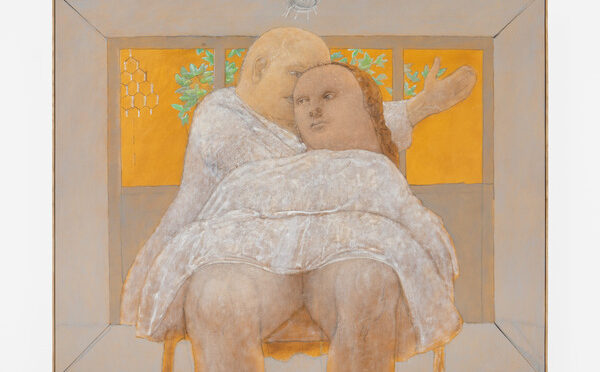
Image: Co Westerik, Doctor and Patient 2014, tempera, alkyd, oil paint on canvas, 100 x 125 cm / 39 x 49 in
Credit: © Westerik Foundation. Courtesy the Artist, Westerik Foundation and Sadie Coles HQ, London

For more information visit Co Westerik: Centenary | Sadie Coles HQ

Review by Devika Pararasasinghe

Devika lives and works in London, by trade as an artist and snake oil salesperson. Devika graduated last September with a research MFA at Ruskin School of Art, University of Oxford.

Read Devika’s latest Review: Petrichor by Mat Collishaw “forges a blossoming relationship between Artificial Intelligence (AI) and nature”-Shirley Sherwood Gallery, Kew Gardens – until 7 April 2024 – Abundant Art


Review: If Not Now, When? “is a call to engage, to question, to act” – Saatchi Gallery, until 22 January 2024

A powerful and contemplative exploration – If Not Now, When? sees 29 female makers present work from the 1960s to the present day. The exhibition at Saatchi Gallery offers an array of artworks that challenge viewers to confront the complexities of feminist sculpture in the present moment and question the trajectory of its future.

If Not Now, When? is the outcome of a two-year research project, Hepworth’s Progeny. The project was initiated in the late 1980’s by Lorna Green in her M.Phil thesis which explored women artists working in the expanded field of sculpture. Here, the research is revisited and developed by Green alongside an advisory board and co-curated by Dr Anna Douglas and Dr Kerry Harker.

Douglas and Harker’s curatorial approach is thoughtful, with artworks carefully positioned to create a visual and conceptual interchange that unfolds as visitors navigate the space. Organised thematically, the various spaces allow for a nuanced exploration of contemporary issues – motherhood, discrimination, climate crisis, care, social justice. Further, this leads to unexpected connections between disparate artworks, sparking a dialogue that encourages viewers to consider the interconnectedness of the issues at hand.

The exhibition sees established artists positioned alongside emerging artists, without hierarchy – Phyllida Barlow, Helen Chadwick, Cornelia Parker, Kara Lyons, Permindar Kaur, to name but a few. The variety of works, voices and perspectives creates a rich and interesting offering. However, the exhibition is unified by the shared commitment of the artists to use their work as a tool for social and political reflection.

If Not Now, When? at Saatchi Gallery centres and reflects on the challenges and opportunities of the present moment. The exhibition invites viewers to consider their role in shaping the future. It is a call to engage, to question, to act. 

If Not Now, When? is open at Saatchi Gallery until 22nd January 2024, tickets and further information is available here.

Featured image credit: Installation view, IF NOT NOW, WHEN? © Matt Chung, 2023 Image courtesy of the Saatchi Gallery, London

Review by Amy Melling

Amy is a Curator and Creative Producer whose practice is centred around community-led arts projects. Her current research is focused on curatorial methods for exhibiting artworks outside. Amy has a keen interest in the arts and recently completed an MA in Curating and Collections at Chelsea College of Arts, UAL.

Read Amy’s latest Review: Marina Abramović opens at the Royal Academy of Arts, first solo exhibition from a woman artist across their main galleries – until 1 Jan 2024 – Abundant Art


Review: The Ocean at the End of the Lane – “creates a sense of wonder and renewed appreciation for the art of storytelling”, National Theatre, until 25 Nov

Based on Neil Gaiman’s novel, “The Ocean at the End of the Lane”, is a captivating, fantastical performance. Adapted by Joel Horwood, this is a story about magic, memory and mystery; it explores the past and dives into a realm where reality and magic coexist.

The story centres around an unnamed man who returns to his childhood home in rural England for his father’s funeral. He drives to the nearby Hempstock Farm, where he once played as a child. There, he meets with the older Mrs Hempstock, and is transported to the past, where he rediscovers his mystical adventures with Lettie Hempstock, the young girl who once lived there. The Hempstock women (Lettie, her mother and grandmother), present an air of mystery, warmth and wisdom, as they come together to confront a supernatural force from invading the lives of the boy and his family.

The enchanting set design transforms the stage into an otherworldly landscape, capturing the essence of the novel’s themes. The visual and sound effects are extraordinary and create a phenomenal theatrical experience, seamlessly transitioning between the real and supernatural. Creatures and forces come to life and immerse the audience into the story.

The cast delivers a stellar performance, each character has their own unique personality and relationship with the boy, which adds layers to the story. Whilst the play explores the boy’s childhood curiosities, and the world of fantasy, there are deeper emotions such as grief, trauma and abuse, which we witness through the boy’s journey. However, what is most striking, is the dynamic between the two young characters – Lettie Hempstock (Millie Hikasa) and the ‘Boy’ (Keir Ogilvy), which develops throughout the play. Their friendship is touching, as we watch their connection flourish while they lend support to each other.

“The Ocean at the End of the Lane” stage adaptation is a spellbinding journey that captures the essence of Neil Gaiman’s novel while offering a unique and unforgettable theatrical experience. It’s a testament to the magic of storytelling, the power of live theatre, and the enduring appeal of a well-crafted tale. Whether you’re a fan of the book or new to the story, this production is a must-see, and it will leave you with a sense of wonder and renewed appreciation for the art of storytelling.

Until 25 November 2023 – get tickets here: https://www.nationaltheatre.org.uk/productions/ocean-at-the-end-of-the-lane/

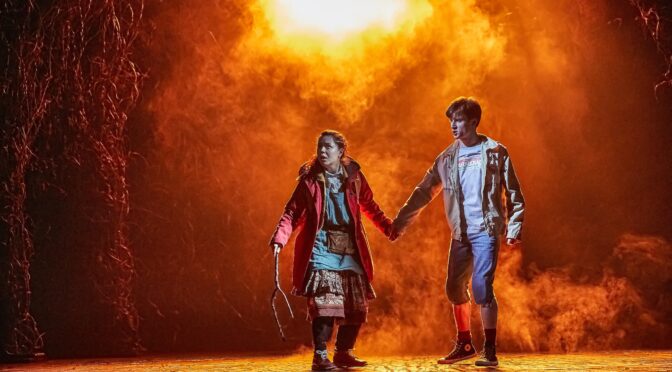
Featured image: Millie Hikasa (Lettie) and Keir Ogilvy (Boy) in The Ocean at the End of the Lane.-c.-Brinkhoff Moegenburg

Reviewed by Ridha Sheikh

Ridha is a volunteer writer for Abundant Art. She is currently studying a Masters in International Public Policy at Queen Mary’s University of London. Ridha has a strong passion for art and is excited to explore London’s art scene.

Ridha’s latest review here The Effect – Are our feelings determined by our hearts or are they simply a matter of chemicals in the brain? (abundantart.net)


Review: Petrichor by Mat Collishaw “forges a blossoming relationship between Artificial Intelligence (AI) and nature”-Shirley Sherwood Gallery, Kew Gardens – until 7 April 2024

Petrichor by Mat Collishaw is a Vanitas made not real. An exhibition that endeavours to make falsehoods to forge a blossoming relationship between Artificial Intelligence (AI) and nature. The supposed brethren of AI and nature converse over a multitude of diverse and engaging mediums, from video to installation, simulation, NFTs, and sculpture.

We are first brought to light with the 3D simulations of Albrecht Dűrer’s botanical drawings. Dűrer, a German 16th-century artist was a true radical of his time, and who invariably took great pride in the humble documentation of Botanics. Albrecht Dűrer was daring in a time when eyes were drawn to the majestic portraits of curated opulence and new exoticisms, with his sincere interest being geared towards the most supposedly insignificant plants.

Collishaw’s subtle 3D simulation attempts to give the breath of viable life to Durer’s drawings. Columbine [2018] and Whispering Weeds [2011] sway gently in the breeze on LCD screens as digital works. Single-minded these once humbly drawn plants are given their dues for their persistent presence despite their lack of cultivation. AI is the beholden here, as nature’s best transcriber, yet no final wonder is sought or deemed found, – after all, none of it is alive.

A growth upon a hunk of mistreated soil grows a muse. The petals seem fleshy and obtuse, with scars and unmistakable tears on their skin. These sculpture works are petalled muses encased in glass as if to prevent the escape of a potentially visceral odour. The Venal Muse [2012] does not go amiss in the decay process being explored. Going beyond the wilt of the rose, the sentimental pull of the flora is eradicated in favour of pistil and stamen. The vanitas tradition is roped in to take centre stage in the performance of the flora, corpulent and almost mid-metamorphosis. These so-called muses are stuck in the staggered still of their new transformation. Will they ever be able to break glass and thereby their destined form?

A castaway mediation on nature, and our self-destructive relationship with our World: Even to the End [2023], is a nine-minute film, journeying through our planet’s current relationship with its ecology. This fabricated nature is under Collishaw’s hand and draws from dawn to dusk, as we voyage from the glass box germinal set upon a vast ocean to the sprawling jungle, where we are laid out to lavish, all the way to the destination of the end of the landscape. This desolate landscape transversed is unsalvageable and unliveable for all and any life forms. An invariable wasteland, – we are left with an empty expression of the current natural world, a message that feels somewhat ambivalent about what is to come.

Hybridisation aims to find new ground with Alluvion [2023] for pulling magic realism and AI together. That Incomprehensible Clarification, [2023] is an oil painting and is one part of the Alluvion series, and like the other parts is made from still-life paintings and images of insects and butterflies being fed into an AI application. What is then regurgitated and digested out is returned to familiar ground, by the resulting stretched-out flora evolution painted in a Dutch Masters-styled font. An emboldened replica made the shoe fit for the contemporary audience.

This magic realism and AI continue to stay pulled together, with the parallels of the NFT boom in 2021 with the Tulip fever of 1667, cementing the backdrop of the work Heterosis [2023]. This hybrid tulip collection is a series of non-fungible tokens [NFTs] which use genetic algorithms and blockchain technology, to the desired effect of varying bloom patterns scaling in exoticisms and personal intrigue. The collection of NFTs is user-dispensed by dealers, collectors, or collaborating artists depending on your chosen definition, each with its own apparent catered algorithm and genetic code. We the audience decide when we become masters in the style of our craft.

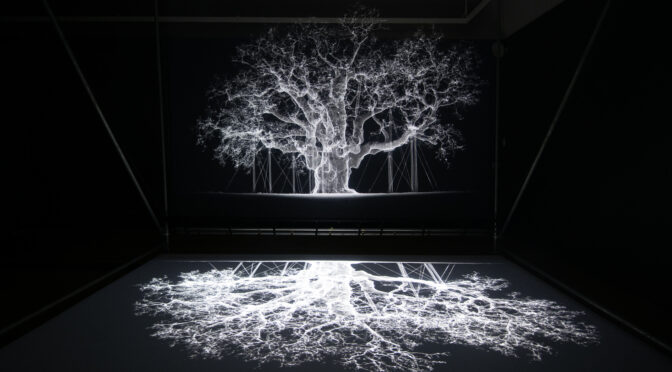
In this exhibition, we are directed to move swiftly on to a new exposure. Here there is no fallen tree as Albion [2017], is a forever oak tree. A growth never gone asunder, light assumes no darkness here, as this apparent tree of life casts no shadows. Peaking on almost life-size, this giant oak illusion and animation finds itself copy-rendered in a reflection pool. A trick on the gaze, a fevered game on actualisation, this full-body scanned oak tree disappears when confronted at the side profile. This imposing oak of Sherwood Forest rigged up with scaffolding is held up in perpetuity as a seeming reminder, – a ghost-like spirit of a supposed past Robin Hood England lost forever and only to be reminisced upon in old English folk tales.

A seething flicker prevails, The Centrifugal Soul [2016] is the final vision we are met with in Petrichor. This contemporary zoetrope, [a Victorian precursor to modern film-making] transpires the story of an ecological courtship, as these birds of paradise perform their mating rituals in an apparent evolutionarily-driven eternity. Boundless, these down bad paramours swirl and flutter viciously, utterly inescapable from our notice. A self-promotion in forever bloom.

This exhibition thoroughly reckons with itself, not to dare even to be alive. You may wish Petrichor would leave the frames of the hard drive but it becomes increasingly apparent as you linger that Petrichor is but a Vanitas not made real.

This flickering bounty of this exhibition, Petrichor is on display for your dared-upon viewership until the 7th of April 2024.

More information Mat Collishaw: Petrichor | Kew

Featured Image:  Albion-by-Mat-Collishaw.-c-RBG-Kew

Review by Devika Pararasasinghe

Devika lives and works in London, by trade as an artist and snake oil salesperson. Devika graduated last September with a research MFA at Ruskin School of Art, University of Oxford.

Read Devika’s latest review here Review: Van Gogh House presents The Living House – celebrating 150 years since Van Gogh lived inLondon, artists Do Ho Suh, Eva Gold, Olivia Plender and Godai Sahara – until 17th Dec – Abundant Art