Hello

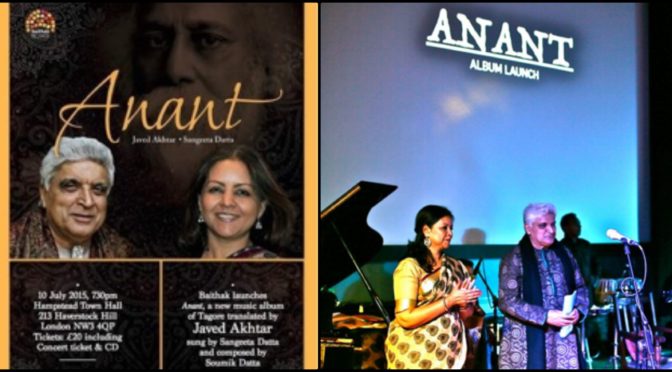
Baithak launches Anant-a new music album of Tagore translated by Javed Akhtar, sung by Sangeeta Datta, music composed by Soumik Datta. Friday 10 July, Hampstead Town Hall

Poetry is essentially intranslable. Poems carry with them words which are rooted in a culture, language and history. Rabindra Nath’s Nobel prize winning “song offering” (Geetanjali) was more of a transcreation and not a translation as the poet himself modestly admitted to the limitations of transposing his deeply Indian spiritual work into a foreign language.

Bengalis have drunk deep from the bottomless fountain that is Tagore, but are very often at a loss to describe to a non bengali speaker how this superhuman’s body of work can pervade every aspect of a people’s thinking, dreaming, living, loving and dying.

Hindi is spoken by the vast majority of people in the Indian sub continent but it is perhaps safe to say that till date Tagore’s poems have not been able to capture their imagination.

Sangeeta Datta with the masterstroke of collaborating with Javed Akhtar, one of India’s most talented contemporary poet, lyricist and script writer has taken a few bold steps in the direction of opening up Tagore to a large section of the Hindi speaking population.

Anant is a music album of 8 Tagore songs transcreated into Hindi by the phenomenal Indian poet, Javed Akhtar. These are well known songs often heard in cultural programmes and preferred by leading exponents of Rabindra Sangeet and Tagore lovers.

Akhtar has done an impossible job, placing hindi words which capture very nearly the same emotion and evokes memories in most of the songs.

For instance the love lorn  storm tossed spirit in ” Aji jhorer ratay tomar abhishaar” (“my dearest friend, for your tryst you have chosen this stormy night”) is rendered in Hindi as “Ghan ghor Barkha ki hai yeh Raina”

For the launch event Akhtar read his poems and talked about the process of translation. Sangeeta Datta sang with a live band including some of the musicians who feature on the album. At a point during the course of the evening when Akhtar read his lines I closed my eyes and soaked myself in the words that flowed, the music that blanket them, the melody which drifted along and vocals that preceded and followed-totally immersed in the transcendental moment that it created.

While the transcreation was beautiful, the songs were set to music compositions by Soumik Datta in  his unique signature style- a rich fusion of Indian and western instruments joining together with the melodious Rabindra Sangeet renditions of Sangeeta Datta and Chiranjeeb Chakraborty into a harmonious whole

Soumik stays true to the soul of the original melody of the songs while bringing in a fresh and revitalizing perspective into his compositions which is a welcome change to the sometimes dour and doctrinaire interpretations that Rabindra Sangeet listeners are subjected to.

It is amazing how the master’s work in a different language, how the master’s melody in contemporary compositions and how the conventional songs sung with a different touch could effortlessly mingle and play to create a soundscape that is rooted and fresh. An approach that can attract younger generations to take greater interest in Tagore.

Making his music more accessible to today’s generation is arduous. The task of making Tagore available in Hindi is vast and even more challenging. Baithak has taken on this dual challenge and succeeded. We wish to see more such collaborations in the future with equally beautiful results.

                                                                                                            Reviewed by Protima Chatterjee
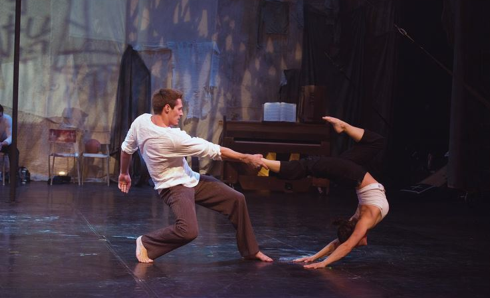
Traces by The 7 Fingers The Peacock Theatre 9 June-12 July 2015

The 7 fingers from Quebec is one of the world’s most inventive contemporary circus companies. After success with its previous show Sequence 8, the company returns to the Peacock Theatre with the critically acclaimed TRACES

Performances: Tue – Sat at 7.30pm, Sat Mat at 2.30pm, Sun at 2pm & 6pm

Tickets: £15 – £38, Under 16s half price

Ticket Office: 0844 412 4322 or www.sadlerswells.com

This is a show that certainly packs a punch. In the two hour show (including an interval) you will absolutely be taken on an intense adrenaline ride. It had the audience making audible gasps, and spontaneous applause erupted after almost every segment.

The talent on display alone was enough to win me over; these 7 performers are extraordinarily gifted. They made their acrobatic accomplishments look easy and effortless. There were so many moments of excellence, it is hard to pull out highlights, however, a tender dance duet performed by Anne- Marie and Harley took the idea of contact work to a whole new level. They had the focused dynamics, they told the story of their relationship through good choreographic decisions, however they also added ‘hand to hand’ technique, which was bolder and braver than any lift work I had seen before.

The end of the first act was another breathtaking section. This piece used Chinese poles and was accompanied by the beautiful soundtrack of Radiohead’s Talk Show Host. Words and even pictures can not accurately describe the gravity defying, courageous, yet beautiful imagery that was created on stage. I almost apologised to the person sat next to me as I sat with my jaw open (literally) and uncontrollable sounds escaped my mouth. Incredible.

It was not the actions alone that stood out and made an impression. The audience were allowed to get to know the performers on stage. They spoke, had names and shared personal stories with the audience. You felt that you knew them.

This genre of modern circus seems to be very current in the dance circuit.  Traces is an excellent example of how all these art forms can work in harmony together and enhance the other. I love the way Dance as an art form is constantly changing and evolving. If this signals the new chapter for the direction of dance, I am sold and for me, it is very welcome. Traces needs to be seen to be believed, and even during the interval I was contacting people to go and see it!

                                                                                                                  Reviewd by Sara Daniels

                                                   (Sara is a freelance dance teacher and lecturer in dance education)

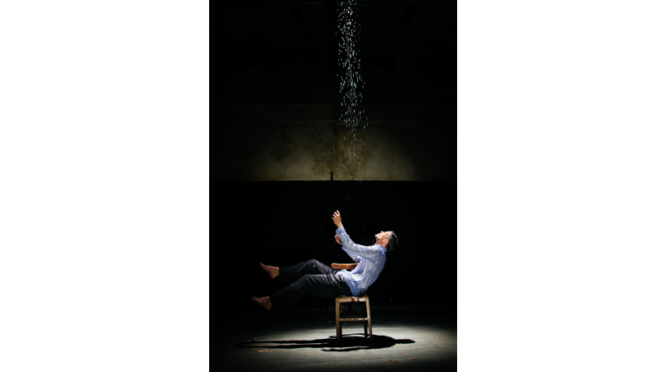
Lost Dog presents: Paradise Lost (lies unopened beside me) Battersea Arts Centre Wednesday 27th May 2015

Tens of characters and tens of thousands of lines of poetry relayed in one hour by one man who promises to dance the complicated bits

Created, devised and performed by Ben Duke |

Based on the book by John Milton       

Light and set design by Jackie Shemesh                     

Artistic Collaborator Raquel Meseguer 


I am not going to lie. The prospect of an 80 minute dance solo based on the epic John Milton poem did not have my heart pounding in anticipation.  Dance solos are hard for me to adore at the best of times, and the idea of one depicting the huge themes and grand ideas that Milton discusses throughout Paradise Lost was not a promising one. How does one even start to imagine it?

I can however, categorically state, that I was wrong to judge!

I was thoroughly impressed, entertained and engaged from beginning to end. I am not entirely convinced how Ben Duke managed to do it. The moment he entered the stage I was engaged, his casual sense of performance was intoxicating. You did not quite know whether he had started the piece or was just having a chat with the audience, but you felt safe and secure in his company. He had the audience in the palm of his hand and within 5 minutes laughter had erupted around the performance space.

Duke managed to skillfully portray the bold and significant characters of God, Lucifer, and Adam, but the most endearing and enchanting character was of Ben himself.  He allowed small personal moments enter into the narrative; his vulnerability was touching and intimate.

This piece was inventive, creative and thoroughly entertaining. There were unfortunately only two nights of performance (rumor has it that this will be showing at the Edinburgh Fringe Festival in the summer) but I will be on the look out for Ben Duke and Lost Dog in the future. If Duke can make an inspiring solo from Paradise Lost then there is surely no end to his talent! One to watch!

                                                                                             Reviewd by Sara Daniels

                                                   (Sara is a freelance dance teacher and lecturer in dance education)

King of Ghosts Soumik Datta with London Philharmonic Orchestra 19th May-Queen Elizabeth Hall

A live film score composed by Soumik Datta,Johannes Berauer and Cormac Byrne.

Conductor: Johannes Berauer

Sarod:Soumik Datta

Bodhran and percussion: Cormac Byrne


Alchemy returned to the Southbank Centre for its sixth year, playing host to a plethora of UK and South Asian music, dance, theatre, literature, fashion, design and comedy. (15th -25th May 2015)

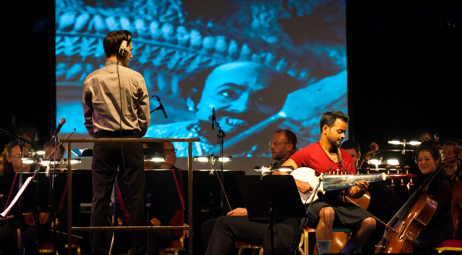
Tipped as one of the UK’s biggest new music talents, Soumik Datta captivated the audience of the Queen Elizabeth Hall during King of Ghosts (originally commissioned and toured by the Edinburgh Mela) with the sounds of his beautifully enchanting sarod on a rainy Tuesday night. Datta’s music sang out playfully and he was joined by members of the London Philharmonic Orchestra, percussionist Cormac Byrne and conductor Johannes Berauer. Datta composed the contemporary score, with Byrne and Berauer as co-composers, in homage to one of Oscar-winner Satyajit Ray’s classic films he watched as a boy.

The score was set to the 1969 black and white Indian arthouse film ‘Goopy Gayen Bagha Bayen’, a jovial fairy tale of two musicians (Goopy who wants to sing and Bagha who plays the dhol (drum)) banished by the King from their village who cross paths in the jungle. By chance they meet King of Ghosts, who grants them three boons (a benefit bestowed in response to a request), the first boon ‘they will get food whenever they want’; the second boon: ‘they can go anywhere they want’; and the third boon: ‘they will master the art of music and everybody will be spellbound and motionless while they sing’. The two musicians go on their way and find all three boons to come true, they chance upon a music competition to be court musicians to the King of Shundi and they hypnotise anyone who hears their sound thus winning food and shelter at the palace. The Kings long lost brother declares war on Shundi and after no solution is found the musicians volunteer to resolve the conflict themselves…

Datta’s contemporary rendition to this classical Indian film, it’s music and message has much to do with the turbulent living today. In the story the two musicians go to different countries and become an emissary of peace- a message perhaps especially resonant today. Goopi and Bagha are commoners but they follow their dreams and succeed. An aspirational triumph made possible by the sheer power of music.

Datta reaches into childhood memories and the retelling of a well known bengali folk tale

to create an enchanting music scape. He draws from the original score, from classical and folk Indian music and in collaboration with Johannes Berauer produces a high quality original work.

Listening to the sarod and blending sound of the tabor drum was enchanting. It transfixed the audience to Goopy and Bagha’s playful journey through time and space to eventually find happiness. Safe to say we all left the performance in high spirits and awe of the performers. Soumik Datta with his fresh approach to Indian classical music and appreciation of traditions does not need a boon from the king of ghosts!

                                                                                    Reviewed by Lauren Austen

                    Lauren is a music blogger, currently working in film production and talent management

Rojas and Rodriguez, Titanium The Peacock, 5-23 May

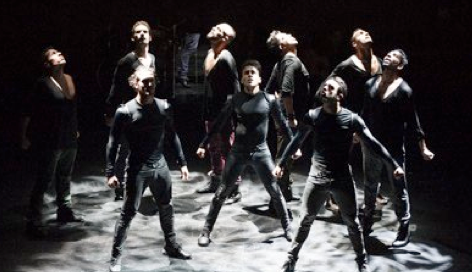
Flamenco duo Ángel Rojas and Carlos Rodríguez present the UK premiere of an unprecedented fusion between flamenco and street dance. A troop of 13 men take to the stage, dancers and musicians, fusing the rich dance heritage of flamenco with the rawness of hip hop and break dance culture. The show has won a National Dance Award in Spain and received high praise in a tour across Europe.

Titanium features a multi-talented dance cast of three flamenco dancers, three hip hop dancers and three break dancers including Elihú Vázquez; Vázquez is the nine-fold winner of the b-boy championship of Andalucía, and was part of Spain’s winning team in Battle of the Year 2005, the most important annual international b-boy competition. The dancers are accompanied by a live band of four, mixing flamenco with hip hop beats.

Titanium had me intrigued and interested from the outset. Dance styles that would not normally be said in the same sentence (hip-hop, break dance and flamenco), thrown together on stage and compelled to battle it out against the sound of live musicians. Who wouldn’t be even slightly interested?

This male-only cast of thirteen had the task of fusing these three styles together, their argument for smooth exchanges between them being that all three styles ‘were born in the streets, and when their dancers dance, they are filled with a burning need to express themselves’.

There was definitely passion observed from all three styles on stage, the flamenco dancers worked slightly better against the traditional Spanish music, and for a flamenco novice as I am, it was a thrilling display of musicality and fervor.

The b-boys were absolutely incredible, demonstrating with jaw-dropping ease the most gravity -defying actions, whilst still managing to play around with the syncopation in the music. Every time they entered the stage, they created thrill and awe.

Although the style of music did not suit all of the genres of dance on display, the live music did add to the spectacle. The musicians and dancers were in a constant battle of rhythms, their personal passion and joy was tangible.

It would have been preferable if they stayed on the stage at all times, instead they would come in and out of vision, blocked by a moving backdrop; the poor guitarist who had to take on and off a chair every time.

The use of many props was again, slightly distracting. A piece of mirrored metal, a gigantic billowing skirt, boxes as well as an elastic cord was all thrown into the mix. The dancers were of strong enough technique that these items were unnecessary and felt more like ‘fillers’ than essential to the choreography.

The audience were completely thrilled by the performance, giving the entertainers a standing ovation at the end, a very rare sight in London! I did enjoy the piece, some moments were breath- taking, others, for me, were slightly indulgent and over dramatic. Take out the props and the ‘fillers’ and you would not only have a thrilling performance, but you would also have a more powerful, insightful choreographic work.

                                                                                                                Reviewd by Sara Daniels

                                                   (Sara is a freelance dance teacher and lecturer in dance education)

Hofesh Shechter World Premier:Untouchables Mixed Bill – The Four Temperments/Song of the Earth Royal Opera House, 27/30 March, 8/10/14 April 2015

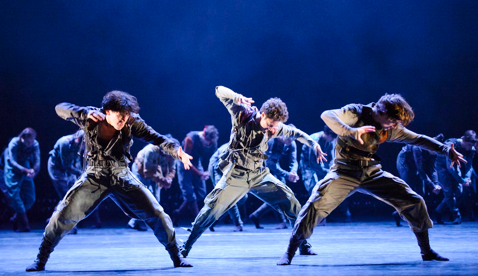
There is something about Shechter…Even harden Ballet fans in the audience, who had not seen any previous Shechter work, had to admit that his work has its own energy that whips you up along for the ride.

I really enjoyed the juxtapositions throughout the evening, the first and most obvious being that Shechter was sandwiched between the more traditional works by Balanchine and MacMillan. I spent some of the performance sneaking looks at members of the audience trying to gauge their reaction to this unusual interruption to their normal classical narrative. I saw some nervously glancing around, but others completely enthralled by the earthy actions and thumping heartbeat.

The evening was a treat, to be honest, I am not sure there are better places to spend a Friday night!

The Four Temperaments was thoroughly enjoyable with its strong women powering across the stage; legs high, pelvis thrust forward. The awkward body shapes highlighted by the plain practice clothes as costumes. Song of the Earth, by Kenneth MacMillan was a platform to  showcase the three huge talents of Carlos Acosta, Thiago Soares and Marianela Nuñez. Nuñez in particular was stunning to watch in her depiction of the role ‘Woman’. She embodied the character with such sensitive emotion and expression it was breathtaking.

However, it is Shechter’s work that made the biggest impression on me. I can’t quite put my finger on what it is about his work that I like. His use of music, the percussion in particular is intelligent as it awakens and draws in the audience. His dancers physically demonstrate this joint heartbeat; their timing is incredible, the large cast of  twenty moved and breathed as one. At times they looked like a shoal of fish, twisting and moving around the stage in complete sync with one another. Then suddenly, this group would disperse and complete contrasting actions would be juxtaposed across the stage. The transitions were so smooth that it felt like the dancers were playing tricks on the audience.

There was a lot of repetition for just thirty minutes of choreography, but the ‘dancing like no one is watching’, lack of inhibitions and dancing from the inside out – the very Shechter –esque movement vocabulary that can be seen throughout his work never fail to draw you in and make you smile.  Untouchable was no different.

                                                                                                                Reviewd by Sara Daniels

                                                   (Sara is a freelance dance teacher and lecturer in dance education)

All the Things You Said You Never Said Before You Thought You Could Ever Say. Oval House,17 – 28 March

Collaborating Artist Vivien Wood  Written by Anthony Nikolchev          

Music composed by Guillaumarc Froidevaux and Bradley Creswick  

Lighting Design by Nathan Reynard

Performed by: Guillaumarc Froidevaux, Gema Galiana, Zuzana Kakalíkova, Anthony Nikolchev


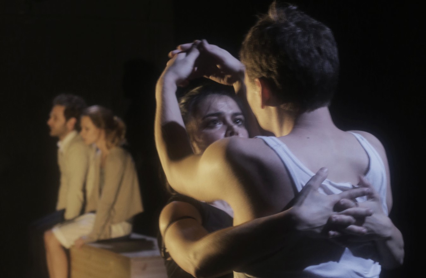
There are two types of people in relationships, those that hold their tongue and do not speak their minds, and those that do not hold back. This piece of physical theatre explores these two realities of expression and plays around with the question ‘what would happen if I reacted differently’?

As the four performers are introduced to the audience, it becomes clear that they are not playing two separate couples, but instead play the same couple but from different perspectives. Conversations are repeated and replayed by the performers allowing the scenarios to be reworked and relived. The locations for these exchanges are often mundane settings such as doing the laundry, or making breakfast. These commonplace scenes add a light, comic flavour as every person in the audience can relate to these unassuming battlegrounds. The females become more and more vocal and frustrated with each relived scene, and the males respond accordingly. The dispute that takes place over making coffee in the morning stands out, as the text (written by performer Anthony Nikolchev) and enactment build up so skillfully, it is almost funny from an audience member’s perspective, as you watch how easily misunderstandings and miscommunications can bubble up into an explosion, or thunderous silence.

Conversations are interrupted by moments of passion and love shown through well-executed contact work. Small intimate connections grow and build into complex lifts and exaggerated motifs. Considering that none of the performers are strictly from a dance background, these moments are performed smoothly and with ease. It is clear to see here, the influence from Vivien Wood, a dancer who has worked with Michael Clark and DV8, as she spent some with the company as rehearsal director.

Despite there being pockets of text and storyline that were unclear, the clever interplay between the performers was successful. I did however leave feeling slightly confused, as after an hour of this question being posed and explored by the performers, there was no resolution or conclusion offered.

                                                                                     Reviewd by Sara Daniels

                                           (Sara is a freelance dance teacher and lecturer in dance education)

Rasta Thomas’ Romeo and Juliet The Peacock, 3-29 March 2015

If you have ever wondered how important technology has become to dance productions, then you should have been in the audience for Rasta Thomas’ production of Romeo and Juliet, at 7.30pm sharp. It was evident as soon as the production started there was a technical fault. The dancers bravely made it through the first two scenes before the performance was stopped and restarted 30 minutes later.

The difference between the two versions was incredible. Audible sounds from the audience were heard, as they actually understood the context of the dance actions. A particular moment that stood out, was Mercutio and Benvolio entering the stage dancing around with wooden sticks, first time around this was an odd image. As it turned out the projector was meant to display an image of a snooker table; the meaning was suddenly apparent, the props suddenly had a purpose.

As much as I am a huge fan of technology and welcome bringing dance into the modern world, it concerns me as to just how much of an impact it can make. Should the choreography have been able to stand alone? In my opinion, yes.

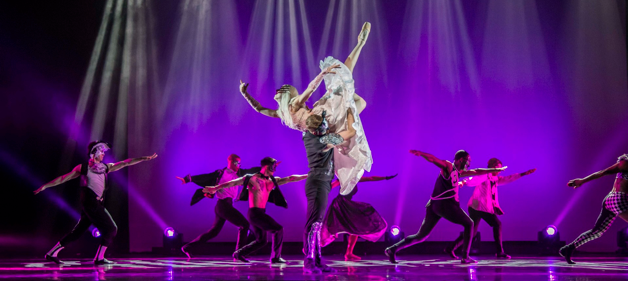
The choreography is actually created by Adrienne Canterna, not Rasta Thomas, she also plays Juliet in the production.  Her creation of Romeo and Juliet has a modern twist, in that she wants the audience to see the story from the eyes of the teenagers at the forefront of the narrative. She also brings new dance styles to the traditional Ballet as well as mixing the Prokofiev score with pop artists such as Lady Gaga, My Chemical Romance and Katy Perry. The result is an exciting and entertaining performance piece, but it lacks in choreographic flare and finesse. The dance styles are very generic with not much fusing of the different techniques; one moment you are watching Juliet en pointe delicately dancing with the Nurse, the next you suddenly feel like you are in a nightclub with loud music, flashing lights and rather raunchy dance actions. The transitions between these constant extremes are clumsy and they highlight the cliché choreography in each section.

The performance quality on the other hand is outstanding. Every one of the ten dancers are superb in their execution of all dance styles. An impressive feat. The dancer who play Tybalt (Ryan Carlson) is particularly impressive. Every scene he performs in is heightened by his electric performance and flawless execution. The fight scene between Tybalt and Romeo in Act two in which Tybalt ultimately dies is exceptionally good.

This is a fun and entertaining production and one that a group of teenagers would adore. For me there was too much of a disparity between the serious, emotional, evocative scenes, and the scenes that played for laughs from the audience. I have watched versions of Romeo and Juliet, (and West Side Story) that have had me sobbing watching the moment Mercutio dies. For me this is such a poignant moment, highlighting that 400 years after the words are written, similar scenes are visible in society today. Canterna instead chose to use this moment to look for laughs in the audience. But, if you are looking for a masterclass in dance technique and captivating performance, don’t miss it!

                                                                                                        Reviewd by Sara Daniels

                                           (Sara is a freelance dance teacher and lecturer in dance education)

Cirque Eloize – Cirkopolis The Peacock, 17-28 February 2015

Cirkopolis is an exhilarating and explosive brew of juggling, acrobatics, comedy, dance and music. It sweeps the audience off the mundane just like Ashley -the clown character in the show. It’s a solid one and a half hour of exuberant journey through a parallel colourful world.

The clown character Ashley played by Ashley Carr is not the conventional red nosed clown. He is a modern man in formal wear who tries to keep his fun life at the circus aside and get his mind to a heap of paperwork on his office desk in the opening scene. In a throwback to Chaplin’s modern times, colossal projections of giant machines convey an office worker’s reality where all happiness is sucked out of life. A satire on modern day living as frequently the scene around switch to towering images of bleak sky scrappers.

Ashley is saved from his monotonous drudgery of a life by his friends from the circus. They step in to remind Ashley of the life that he had once tasted. The fun, the colours, the applause. The plot hinges on the device of Ashley going on a flash back journey through which an inspiring re-invented circus show is presented.

The second act is serene in contrast to the opening scene. Lea Toran Jenner glides in her Cyr Wheel beautifully flowing in her red short dress. Nostalgia and yearning are churned around the space creating a whirlwind of memories for Ashley. Maria Combarros performs a breathtaking balancing act as she walks on the palms of a group of male dancers. Combarros can certainly trust on the fitness of the group of men to lend support when she is balancing on their palms, finishing on the highest point on a single palm being held up as a winning trophy.

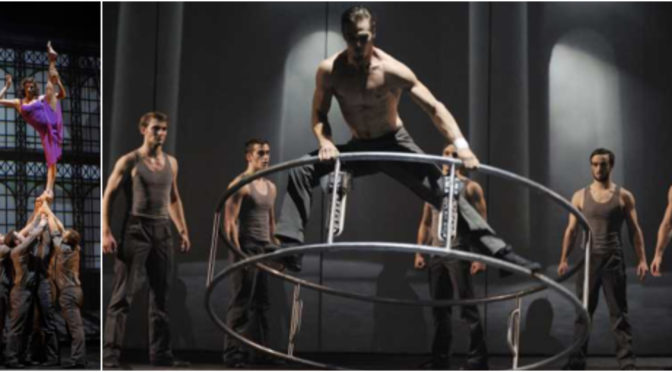
The show builds up and by this point the audience is already high on adrenaline as Frederic Lemieux-Cormier and his mates come in on his German Wheel. This Act is a display of strength, control and focus. Strong and muscular male performers with Cormier in the lead hang, jump, attack, lean on and balance on this huge wheel setting the space in a dynamic motion. Through lighter scenes of comic relief Ashley inter weaves these acts. Jerome Sordillon’s aerial act on straps continue with the display of masculine physicality, balance and strength. A lighter air is brought in by the final act on Chinese pole bringing together great choreography with dance and acrobatics Three of the performers brilliantly use the pole while the ramaining performers cheer them in the choreography.

The final scene is a joyous dance where stacks of papers that were neatly piled up on the office desk are now thrown in the air and they rain upon Ashley as he celebrates his new found freedom with his friends and a bottle of Champagne.

Cirkopolis expertly juxtaposes contemporary circus against the grey melancholy of modern urban living. Directrs Dave St-Pierre and Jeannot Painchaud deftly combine circus acts with music, theatre and dance creating a hugely entertaining and uplifting experience.

                                                                                                          Reviewed by Protima Chatterjee
Tango Fire- Flames of Desire The Peacock Theatre – 27Jan-14Feb 2015

The Tango Fire Company of Buenos Aires is in London this time of the year with it’s Flames of Desire, setting the stage ablaze. Much in time in the run up to Valentine’s day, the show celebrates passion, desire, romance and sensuality with the essence of male female bonding at it’s core.

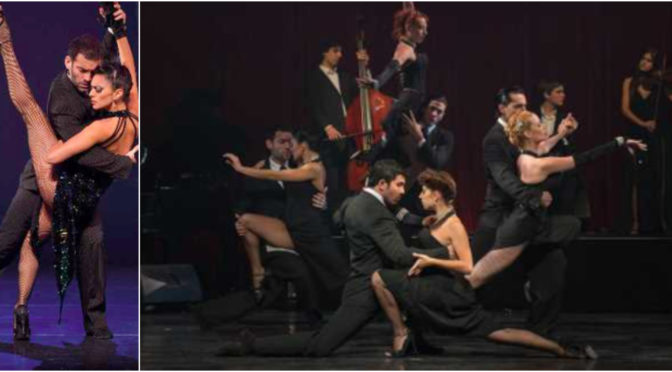
Tango in its modern incarnation, as we see today in the Strictly Come Dancing series, is much to do with quick steps in ladies stilettos and sparkling pointed male shoes. Tango fire picks up and builds on the modern vocabulary of the tango. Its dancers storm across the floor in vigorous taps with occasional low leg flicks which are perfectly timed, precise leg movements , placing their free foot between the partner’s legs in the form of ‘quick kicks’, twirling female dancers finishing in the arms of their male counterparts at the end of a routine, frozen to a sculpted perfection. All this and more set Tango Fire a brand apart from any other company.

The show is evenly distributed between slower and faster numbers. The more laidback and stretchy softer sequences danced to a soulful Piazzola pulls at heartstrings. An undercurrent of melancholy runs through these numbers, connecting desire with a pang of separation and unrequited love.  Along with the sensuous, a spiritual connection is established between the performers and the audience. The dance partners hold each other in close embraces like intertwined souls, occasionally caressing each other, hair brushing past the male partners’ faces. The ladies swing a free leg around their partners in sharp movements released swiftly, or gently stroking their partner’s leg before performing the mandatory pirouette into their partners arms.

The compositions are sophisticated, yet playful and flamboyant at times, showing much of Choreographer German Cornejo’s dexterity to play with the dance form. The five couples performing exhibit their finesse and mastery with the craft. Their effortless movements and intense attitude keep it oscillating between layers of erotic emotion. The performance has rhythm flowing not just through movement and music but also through live vocals and light design that focus much on the mood of the show. The lady dancers are dressed in sheer flowing costumes which add to their sensuous movements. The costumes in their mellowed shimmer with mostly body hugging fabric are exquisitely designed. They complement and reinforce the female shape.

As the title  “Flames of desire” indicates it’s a show about romantic love, about the sensuous as well spiritual connection between man and woman. The audience needn’t delve deep to unravel the untold as it is all on the top layer. Flames of desire give you an easy and enjoyable evening, to which you don’t return with expectations of something massively different each time. It is enjoying the same pleasurable flavour each time you see the show.

                                                                            Reviewed by Protima Chatterjee