Hello

IF: Milton Keynes International Festival- 18 -27 July 2014 In conversation with Monica Ferguson, Chief Executive of The Stables and Festival Director

IF: Milton Keynes International Festival returns for its third edition from 18 to 27 July. The Festival will take place in locations across Central Milton Keynes exploring the cityscape and parklands, the built environment and the great outdoors.

From large-scale spectaculars to intimate experiences,international performance and dance, contemporary circus, installations, live music, comedy, cabaret, talks and many free events. IF: Family Focus, a special programme of family-friendly shows and experiences for children and grown-ups.

Produced by The Stables, developed with support of Arts Council England and Milton Keynes Council.

What’s the inspiration behind the Milton Keynes International Festival?

Milton Keynes is one of the fastest growing cities in Europe. There is an acknowledgment in the city that investment in cultural infrastructure and not just physical infrastructure is vital to ensure Milton Keynes grows as a vibrant and exciting place to live, work and visit.

Milton Keynes has always had a great community spirit. There are lots of local artists working on a range of projects, though IF provides a showcase for extraordinary artists working nationally and internationally that can help to drive inspiration and ambition.  By asking artists and companies to work in unusual spaces, it also shines a spotlight on the lesser known and often really special places in Milton Keynes, as well as breaking down traditional barriers between audiences and artists.

What is the key focus of the festival?

The Stables is one of the UK’s leading music organisations and we set out to engage people with music and sound in all its diversity. By commissioning work with a live music element or a soundscape that is integral to a piece of dance, visual art or even contemporary circus, the Festival gives us the opportunity to reach and engage with audiences in new ways.

While choosing the line up does the festival also look at providing a platform to upcoming talents besides presenting established artistes?

We absolutely do try and look to the next generation of artists when putting the programme mix together, looking for quality and ambition, and for artists who can benefit from working alongside established artists. We also try and work with and mentor producers at various stages to help support their development.

Is there a possibility that in future The Stables could tie up with other music organisations outside Milton Keynes to extend the limits of the festival?

Of course. We are always open to partnerships and we have successfully teamed up with organisations such as the National Theatre and The Southbank Centre in previous editions.  We are also part of a commissioning consortium of other Festivals called Small Wonders which specifically supports the development of new outdoor touring work aimed at the under 5s.

What are the highlights of this year’s festival?

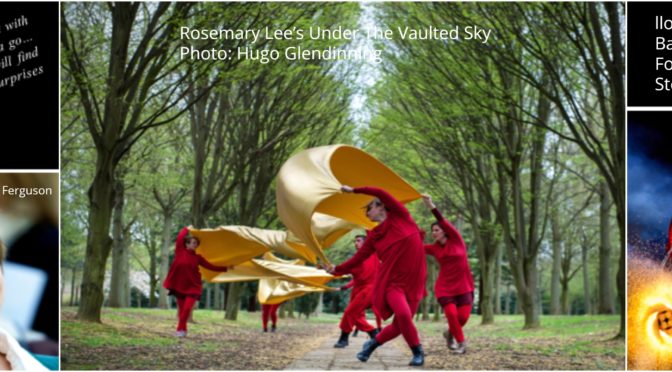
Always a difficult question as it’s a matter of perspective. Our new commissions are always exciting ventures and this year Under The Vaulted Sky is the result of 2 years work by our Artist-in-Residence, choreographer Rosemary Lee. It features live music by composer Terry Mann and 100 dancers in a new promenade performance for the Cathedral of Trees.  The Cathedral of Tress was planted over 30 years ago and modeled on the architectural footprint of Norwich Cathedral with different species of trees and plants to represent different elements of the building.

We are also pleased to have the Brisbane-based contemporary circus company Casus presenting the brilliant Knee Deep as the anchor show in the beautiful Belgian Spiegeltent  over the first 4 days. It’s an exquisitely beautiful show with breathtaking skill and really traverses the ground between circus and contemporary dance. And of course the opening spectacular Fous de Bassin (Water Fools) by the French company Ilotopie is promising to transform Willen Lake with fire, pyrotechnics and floating cars so it’s proving a hot ticket already!

What are your expectations with regards to community involvement?

I think our goal with community involvement is to try and make the interaction between our artists and audiences meaningful. Whether you are a participant in a project, an audience member or a passer-by who happens across something, we want it to be a memorable experience.  Around 50% of our programme is free to attend and in addition some projects involve more direct engagement with the community over longer-periods than others.

For example, Under The Vaulted Sky has required significant rehearsal commitment from community participants working with trained professionals over a number of months. However, even the more fleeting moments should still be special and make a difference.  Kaffe Matthews’ sound installation The lock shift songs – a new commission – saw her walk from London to Milton Keynes along the Grand Union Canal, recording sounds from above and below the water. She also drew together a small pop-up choir of interested singers who came together for just a couple of rehearsals to record work that will be woven into the sound track hear in the installation. The resulting composition will be played in ‘sonic beds’ which audiences will lie in to not just listen to but experience the physicality of the sound through their whole bodies. Kaffe’s interaction with the choir was important at the rehearsals and her description of her journey and her vision vital in helping to inspire the participants.

Special features that according you would attract audience?  

Hopefully there is something in the diversity of the programme that everyone can relate to and enjoy, and we have a special focus on work for children and families this year.

Surprisingly though, it can be the most contemporary and experimental work that attracts audiences and I expect that Kaffe’s sonic beds in an empty retail unit along with the colourful luminarium by Architects of Air – both presented inside centre:mk – will be hugely popular with audiences.

Your message or an invitation to the community on behalf of The Stables and the festival.

If you fancy a day out with a difference, give IF a go… we guarantee you will find something that surprises and inspires you.

                                                                                                        Protima Chatterjee
CRACKz – Bruno Beltrao Sadler’s Wells- 3&4 June 2014

Bruno Beltrao’s CRACKz is an out and out contemporary work. A bridge between conventional stage presentation and modern day digital technology that is fast engulfing human life. Beltrao allows his dancers to capture images from the web space and transpose the memory through the physical medium of their body and movement.13 dancers randomly pick 28 video clips. They study them over a year and copy them to produce what we see on stage as CRACKz. A stunning idea that breaks the bounds of a conventional performance or any set pattern. Beltrao’s concept of the production comes to life through a series of movements, danced and re danced- an allegory for the relentless monotony of contemporary technological life!

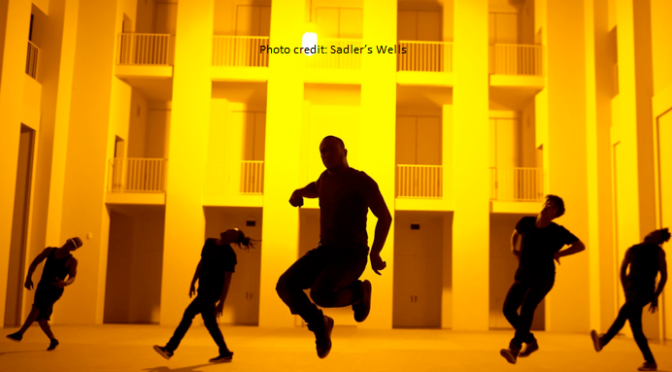
The stage opens wide with side wings removed to create the illusion of massive ‘space’ personifying the web with its terrabytes of data.. and producing more.. and more!! This space is not attractive and lacks aesthetics. It is presented as a grey vista wrapped in a play of light and shadow. Shades of mustard and orange, a light bulb illuminating and then dim, dimmer to dark. Thats exactly the feel on stage, but magnified. This alternates with a stunning play of shadow in which the dancers are dark cut outs against a misty grey. Though Beltrao’s style is hip hop, for CRACKz he has used the medium of contemporary technique. The base is a thin layer of hip hop, but completely devoid of the feel good celebratory party mood of its conventional presentations. The choreography is intense with mostly powerful spins, turns, breaks and jerks. Movements more towards gravity have been predominantly used. All 13 dancers take the stage to storm with their physicality and precision through brilliant sets of choreographic moments. Light design and background score in the show set the mood just right. Besides direction and choreography, Beltrao also has a hand in the lighting design with Tiedo Wilschut. A uniquely talented artist that Beltrao is, has created a unique and intense presentation in CRACKz, swirling the audience into ‘space’, after a mesmerising journey through a dark tunnel.

                                                                                                Protima Chatterjee

Havana Rakatan Sadler’s Wells and Blancon Productions Peacock Theatre, 6-24 May 2014

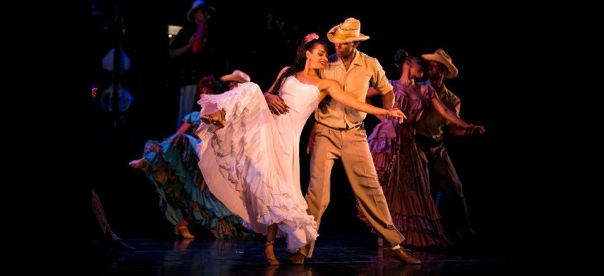
Havana Rakatan is one of those pulsating high voltage Cuban dance shows that showcases the unique dance and music history of the island nation. The show charts a 500 year long journey starting with the Spanish arrival on the island, that sparks the evolution to the most recognisable and popular Cuban dance forms of today –the Salsa, Mambo and the Cha Cha Cha. It is hip swaying, passionate, electrifying dancing with the most brilliant display of Afro dance techniques. Dance is integral to ordinary Cuban life, as the Cuban people’s love of anything musical make even simple movements dancelike.

The essence of the show is its people. From the time of slavery and sugar plantations when dance and music were the only means to keep them going through a life of hardship and poverty, to a gradual intermingling of forms.The fusion is beautifully presented through a simultaneous rendition of Yoruba dance with Flamenco rendition. While Yoruba represents raw animal energy of the slaves, the Flamenco represents the interference of the colonists.

Zapateo, Zumba Antonio, Caringa and Changui are used by dancers to improvise scenes of rural folk culture. Director and Choreographer Nilda Guerra brings the characters to life on stage through her remarkable choreography. The cast excel in spontaneity and perfection. These are some of the most joyous and lively scenes on stage that would transport you to Havana, on the sunny beaches by the vast ocean.

Dance and music of the production perfectly complement each other. The accompaniment by a very talented ensemble of live musicians and singers take the show to a higher plane. Both the male (Michael Pacheco) and female (Geidy Chapman) vocalists are mind blowing in their high octaves. Sections where the creole folklore comes to life through their songs transport you to the early 20th century.

The second segment of the show starts off with the shoulder shaking Mambo- a dance form which had its golden age in the 1940s when Havana gains its popularity for its nightlife and club culture. This is followed by Bolero which is more lyrical and soothing in contrast. The beautiful sequence flows with elegance with an undercurrent of strong passion. Dance numbers based on Cha Cha, Rumba and Salsa wrap up Havana Rakatan deeply rooted in the Afro Carribean culture. They are sensuous, dynamic, bold and challenging bringing the audience to its feet.

The presentation is packaged for family entertainment with a happy young bunch dancing to the closing number alongside its usual adult crowd.

Object Of My Affection- MurleyDance. Shaw Theatre, London, 27th April 2014

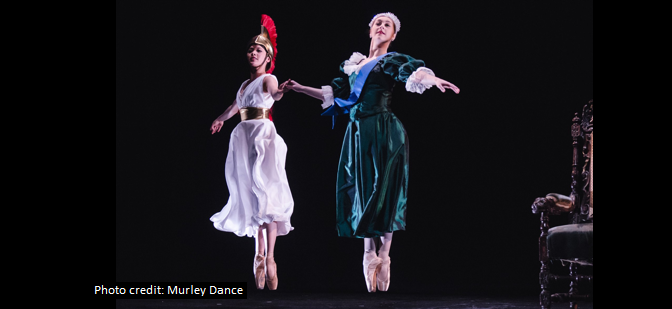
Object of my Affection, a compilation of three dance pieces Seated, A Une Passante and Into Decay, brings together the work of three fresh choreographic talents David Murley, Anthony Kurt-Gabel and Richard Chappell resectively. Presented by MurleyDance, Object of my Affection introduces the generation next of dancers and choreographers through their  first line of work in their career.

The evening revolves around affection. Affection for an object, as in the section Seated or with a stranger who we might never meet, lyrically presented in the second piece A Une Passante (To a woman passing by), or our attachment with our very own gadgets in today’s gizmo world as shown in Into Decay. With a simplistic approach the choreographers establish the essence of the theme. It examines those situations, interactions and emotions of life that have been presented over the years through different creative mediums. The work constantly show us what we are rather than probing into the depths of the unknown, keeping the content light and realistic.

Seated is presented through 5 pieces exploring human connection with an object of daily use, a piece of furniture, a chair. An interpretation of behavioral changes through the generations morphed from power to possession. From the 19th century throne exuding power to today’s self assemble flat pack furniture. The interim sections are snapshots of youngsters fighting over the chair in front of the television and a bar stool where a couple might have their first drink together and fall in love. The depiction is primitive with dancers yet to hit the target.

A Une Passante is inspired by Charles Baudelaire’s synonymous poem. The unfulfilled desire and the yearning of the travellers who see each other from afar but never meet is portrayed through a dream couple. Kurt-Gabel establishes the romantic desire through an explicit array of romantic movements of the dream couple at the expense of keeping the man traveller almost immobile through out the choreography. Contrasts can work wonders but more thought could go into establishing all four dancers on stage.

The concluding piece Into Decay kicks off with dance and slide projections showing a toy bunny, speakers, a power extension cord and then the bare window sill on which these items were kept. The question is if we had to put one of these items back on, which would it be. Our favourite toy bunny thats been with us through the years or our sound systems that we think we cannot exist without? The dancers are agile and sharp, a piece full of energy from Chappell. What could be improved on this otherwise captivating dance piece is the accompanying soundtrack. A combination of  classical piano and original electronic – the abrupt transition between sections is a bit jarring.

Overall its a competent performance considering the young new choreographic talent. The show being perhaps too much theme oriented stops short of being thought provoking. It showcases predicaments from our contemporary lives rather than raising new questions.

                                                                                             Protima Chatterjee

Tabac Rouge James Thierree Sadler’s Wells, 25-29 March 2014

James Thierree  and  his  Compagnie du Hanneton returns to London after four years with the UK premiere of his production-Tabac Rouge. Thierree is also the performing central character in this dance theatre piece, besides being the director and choreographer. A multi- talented artiste, Thierree has his roots in the circus. He earned his spurs through his close association with big names like Peter Greenaway, Robert Wilson and Tony Gatlif to name a few. He made his mark  as a director with his award winning production La Symphonie du Hanneton in 1998. It was a large scale theatrical production that combined mime, circus and dance.Tabac Rouge is a spectacle Thierree style, where he expertly mixes different art forms.

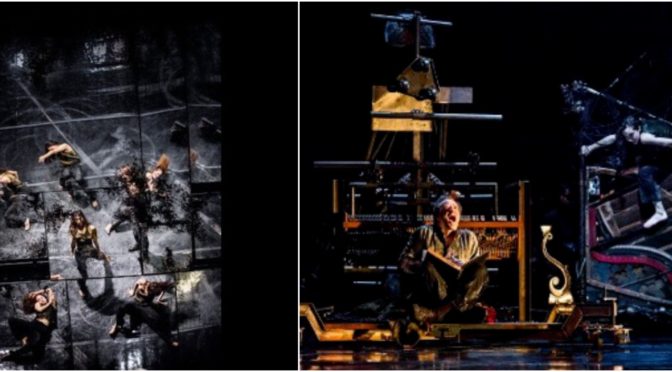
Tabac Rouge has an epic stage design with a huge frame of scaffolding on wheels with sheets of rusty mirror where one can see convoluted reflections.The stage wings have been removed to provide a bigger canvas to his dancers. They speed across the stage sometimes lying on their chest on skateboards, or sitting on wheeled chairs. A brilliant  use of space is an essential element of the choreography. Stacks of books and papers pile up on a massive work table which is also on wheels. It is often moved from one end to the other by a dancer who probably hooks herself on the footboard. Period Furniture are wheeled in on the stage. Sometimes removed to create space for some wriggling, muscle twisting, joint breaking dance moves by a group of female dancers who perhaps personify the emotions of Thierree who plays the central character.

In Tabac Rouge Thierree is a haunted man living in the midst of crumbling ruins, constantly visited by memories of his past grandeur. It’s almost a throwback to his Grandfather’s (Charlie Chaplin) memorable rendition of Calvero in Limelight, only much darker and troubled. Tabac Rouge creates a setting of a rundown space which was once vibrant. It has seen many springs but is now covered in the dark winter slumber. Its a ghost of its past glory. Dark shadows occupy the space which was once lit up. Mirrors that would sparkle is now a reflection of doom. Power crippled, pillars crumpled, its people and furniture both covered in a sheet of dust are nothing but junk.

For most of his choreography Thierree is motionless, seated on a huge dusty lounge chair which is as rundown and torn apart as him, contemplating his utter desolation. His expressive eyes and facial muscles convey an array of emotions. A deep sense of melancholy to resentment.The constant visitations by his dancers, the movement of the props, and the mechanism of the backdrop scaffolding is a metaphor of his cluttered mind unable to accept his grim reality, still rooted in past glory. It’s his invisible grip that makes everything on stage swirl, move, dance and sometimes agitate. As if to further drive home the abject despair of his character, his movements are extremely limited like that of a disabled person. He has restricted mobility in his arms and legs, with limbs sometimes hanging loose from joints. Thierree exhibits uncanny control over his muscles and his facial expressions speak more than actual speech.

Though Thierre’s performance is riveting the script lacks cohesion .This could be his intention to leave the audience a little bit confused. What does this mental turmoil lead to? Thierre leaves that unanswered! May be in this age of perishable consumption, all artists should be prepared for solitary reflection among the fading ruins of their forgotten creations.

                                                                                                                            Protima Chatterjee

Ballet Flamenco,Sara Baras La Pepa

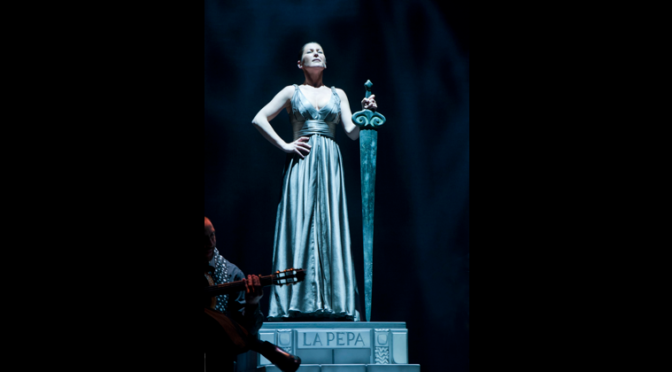
The annual flamenco festival is back this year with all its grandeur. After a magnificent celebration of a triumphant decade in 2013, the festival steps into its 11th year this March. Sara Baras, perhaps the biggest Flamenco superstar from Spain is a befitting choice for the opening. La Pepa is choreographed by Sara Baras and  her equally talented dancer-choreographer husband Jose Serrano.

The production is a celebration of the historical moment of La Pepa which was The nickname given to the first Spanish constitution of Cadiz. Cadiz born Baras celebrates that unique moment of the country and its women through her production.

Baras is an exquisite performer, whose footwork is comparable to the sound of raining hailBut what she tries to portray from that strong beginning through to the end dwindles with the loosely bound plot.

Through the 90 min duration of her show, Baras takes the audience on a journey of Flamenco  which has technique and texture but less drama. Its an exhibition of Baras’s perfection of the art, beautiful dance sequences and eye catching costumes. Loosely woven through snapshots of the nuances of human life La Pepa begins with a battle sequence where men and women all dressed in black are engaged in a duel. Neat choreography and precision of movements in this opening section defines what is to follow. The battle ends with death and destruction. Bodies lie scattered on stage.  – Baras’s makes her first appearance of the evening at this stage  She laments the death and destruction and questions the cause. She dances her grief and with her tears life spring back in the corpses who rise again into a better world. The village folks are joyous and they portray an enchanting Spanish village scene. The numbers that ensue bring in the fans, the long flamenco skirts, the laced scarves and couple dances. All the essential ingredients of a good Flamenco performance are lined up in the choreography. While the choreography and the dancing by the ensemble is top notch, somehow the narrative fails to evoke the same sense of excitement.

                                                                                                                                                    Protima Chatterjee

The Merchants of Bollywood Peacock Theatre, Sadler’s Wells, 28 January – 15 February 2014

In conversation with Toby Gough

It has been a long and successful career as a theatre/musical director. Where and how did you start?

I started as an actor with the National Youth Music Theatre at Edinburgh Festival. I fell in love with the festival. After that I worked in Africa in theatre  education. Then in Yugoslavia and Sri lanka using theatre for conflict transformation and commmunity rebuilding. At Edinburgh Festival I have presented shows for twenty years which has been my home ever since.

What has been your inspiration/motivation over the years?

Telling stories, changing lives, staying where the sun shines.

You have worked internationally with artists from different facets of the arts. Which form of art fascinates you most?

The power of stories, the act of theatre, the intangible power of taking people on a journey of the imagination. A voyage of the soul across frontiers, beyond language.

You have had a long working relation with Asian arts, specifically Indian. What in particular in that culture draws you again and again?

In India the culture is ancient, but contemporary, at the same time celebratory, respectful, religious and very rhythmic, full of stories, dance and music. A country that is fascinating, complex and full of contradictions, and a never ending source of inspiration; my father’s family have lived in India for over 300 years so the love for India is in the blood.

Please share with us a couple of your best experiences while working in India or with Indian/Asian artistes.

Children of the sea, a project using shakespeares play Pericles, working with child surivors of the tsunami in refugee camps across Sri Lanka.

Working with Vaibhavi Merchant and Shruti Merchant.

Writing The Spice Trail and performing with members of Tanusree Shankar’s talented company in the Royal Botanic Gardens in Edinburgh Festival lit by fire and lanterns at night.

What brought about Merchants of Bollywood?

The time was right. I was sitting in an Indian restaurant  in New Zealand with producer Mark Brady and we saw that the story of the Bollywood Industry was stll not  as well known in the western world but there was a fascination for its dance routines and its glamour and positive energy and spirit. Over a chicken tikka and a King Fisher lager, the idea for a Bollywood show was born.

What made you approach Vaibhavi Merchant?

I asked Tanusree who would be the right person for the Bollywood style and she told me that Vaibhavi was the upcoming star on the horizon. I tracked her down in Mumbai and finally persuaded her to meet with me. She then introduced me to Salim and Sulaiman Merchant the music composers and the rest is history.

What was it like working with Vaibhavi Merchant, one the  leading Bollywood choreographers?

Working with Vaibhavi is the easiest thing in the world. The show is the story of her life. Her background in Rajtasthan, her choreographies, her grandfather’s life. The show became a personal work for her and her family. Vaibhavi has a large company of dancers to work from and they are very disciplined. We created the show in film studios in Mumbai. What was difficult was for the dancers to learn a whole show as they normally proceed shot by shot, and for them to leave the country on tour. They prefer staying in Mumbai.

In the past you have worked with choreographer Tanusree Shankar from Kolkata and her company.The Spice Trail in 2001, Edinburgh Fringe Festival. Subsequently with Vaibhavi Merchant in Merchants of Bollywood. Both are icons in the Indian dance scene and excel in two different dance styles. What do you think of the two dance styles and how would you relate the experiences?

they are both unique, visionary,  prodigious and independent women and both have very different styles of working. Vaibhavi from Mumbai and Tanusree from Kolkata and you can contrast them in the same way you can compare the cities. I value them both. Vaibhavi is filmi desi masala and commercial while grounded in tradition and classical dance and Tanusree is narrative, spiritual and lyrical. Both women command huge respect and love for those who work for them.

Looking at your repertoire, you have also extensively worked with artistes from Cuba. Please share with us the essence of their arts that has given your audience a number of entertaining productions?

They are the melting pot of the Caribbean, born from the romance and passion of Spain and the

blood and rhythm of Africa. Surrounded by Jamaica New Orleans and Puerto Rico the music has kept evolving and this small island has kept creating the most amazing new music in the world. The people throw the best parties on the planet. They have stood up to the world on their own terms and are true survivors.

Lastly, what is your next big project?

I am on tour with the Irish Celtic show in France. Working on The 27 Club in Vienna, Hamburg and Berlin which is a Rock N Roll Show. I am touring with the Buena Vista Social Club and on a big new production from Brazil fusing Capoeira Sambada and Zouk Lambada.


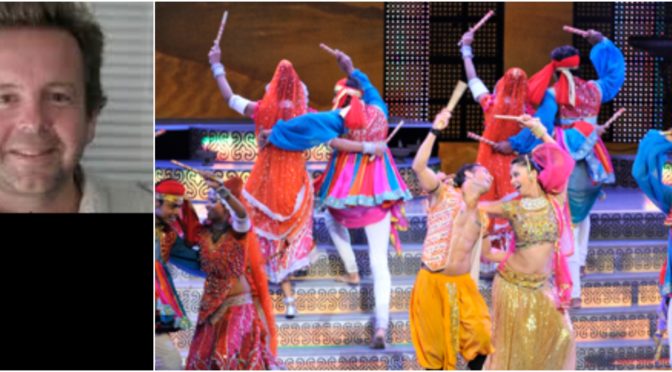
The Merchants of Bollywood is a spectacle of songs, dances and stories. In it avaricious modernity clashes with time tested traditions and in true Bollywood style love triumphs over differences. The musical theatre gushes out with high voltage energy and floor thumping rhythm. Writer/Director Toby Gough explores the cultures past and present – Of India, her cinema and dance heritage through the story of the Merchant family whose choreography in Bollywood spans 3 generations.

The story opens with the familiar struggle between hoary tradition and irreverent modernity. Ayesha Merchant (Carol Furtado), aspires to be a top Bollywood choreographer against the wishes of her grandfather Shantilal Merchant (Joy Fernandes). Her grandfather is her dance teacher whose brush with Bollywood causes him to reject its venality and return to the classical traditions. Differences arise. Ayesha leaves the family home in Rajasthan to pursue her dreams in Bollywood.

What comes about is a journey tracing Bollywood’s history. We travel back in time, starting with dance moves from the suggestive hip sways of today to the venerable golden oldies of yesteryears. A stretch in the first half with its overly glittered costumes, dwell on the verges of a Bollywood night club feel. But the intentions come clear with progression.

Actor Romi Jaspal plays Tony Bakshi, the slimy film director in Bollywood who has no moral qualms in his pursuit for mammon. There is the inevitable fallout with Ayesha who sees through his veneer of glitz. She returns home to Rajasthan to rediscover her roots.

The second half is awash with the garish colours of that most beautiful of Indian states. A profusion of festivals, kites, puppets, men in turbans and handlebar moustaches, bejewelled women carrying earthen pots jostle with each other creating delicious chaos. Melodious tunes set a contrast to the heavy beats and punchy numbers of the first half.

In this half  Gough’s sense of humour comes into play through his portrayal of Happy Singh played again by Romi Jaspal. He brings in a glee and a laugh every now and then. His comic lines mocking the many Indian festivals, the hefty moustaches that the men wear in Rajasthan and the whole thing about placing newspaper adverts to arrange marriages, lend relief to the otherwise continuous song and dance sequences. Its a good deviation in the form of dialogue, sharing some local tips instead of just Ayesha talking about her family and Bollywood.

Shantilal passes away and Ayesha vows on the flames of her grandfather’s funeral pier to never depart from her traditions. She sets out to make her name in Bollywood once again but this time her grandfather’s way. Ayesha finally makes it in Bollywood. The Merchants nail their place as top choreographers of Bollywood.

Director Toby Gough says that this idea of a Bollywood show came to him over a Chicken Tikka and Kingfisher lager. True to its conception, The Merchants of Bollywood is a chaat masala of a show, perfect to go with a curry night out!

                                                                                                   Protima Chatterjee

Boing! Travelling Light and Bristol Old Vic Lilian Baylis Studio, Sadler’s Wells 20 Dec 2013 – 5 Jan 2014

My 6 year old daughter was excited to be going to the new children’s show BOING! at Saddlers Wells on the last day of the school term. As we sat and waited for the show to start, the audience, comprising mostly of young children took a while to quieten as the anticipation grew. A large bed covered in childlike scribbles inviting them to jump on it.

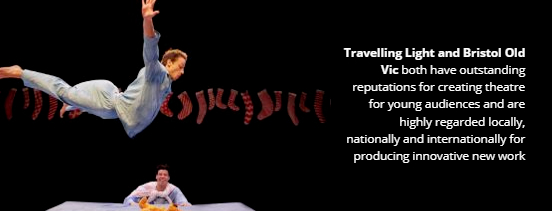
Out came Joêl Daniel and Wilkie Branson of street dance company Champloo who choreograph and star in the show. The pair play young brothers eagerly awaiting Santa on Christmas Eve. Reminding themselves that “If you want Santa to come, you must go to sleep” the two brothers constantly fail in their attempts to do just that.

The show starts with Branson and Daniel, dressed in pyjamas also covered in a childlike scribble, brushing their teeth with a comedy gurgle. The children in the audience were amused from the beginning and the show kept their attention for the entire 50 minutes.

The pair really got into the imagination of young children and we were taken along on a ride with them through joint games and brotherly scraps. Joêl’s highly expressive face showed off perfectly the range of emotions from disappointment as he found nothing in his stocking, to the joy of playing a trick on Wilkie.

My daughter was amazed at the comedy timings of their choregraphed dance fight. The bed was used to great advantage in their scuffles, enabling Joêl to outmanoeuvre his brother. We both agreed the highlight of the show was when the pair emerged from under the bed as robots, the lights dimmed and we were treated to a whirling acrobatic light show.

                                                                                            Nicola Thompson

Barbican Britten: Phaedra Richard Alston Dance Company & Britten Sinfonia (Lachrymae, Holderlin Fragments,Phaedra, Illuminations) Barbican Theatre, 6,7and 9 Nov 2013

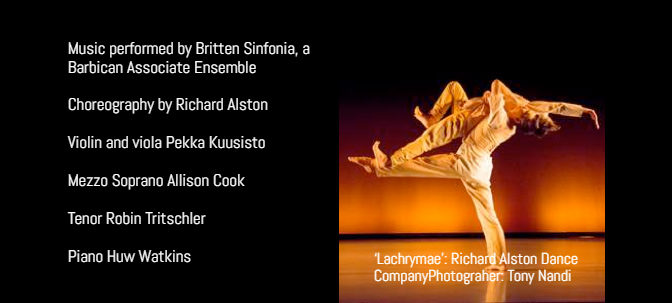
It is an enchanting experience to see, how music can also dance. Music of Barbican Britten came live on stage at  Barbican Theatre with choregraphies by Richard Alston. Alston who is overwhelmed by Britten’s music since his childhood days, made his choregraphies speak. They are as eloquent as the words in Britten’s music, played live on stage by Britten Sinfonia.

The show starts with ‘Lachrymae’, the dancers float and fly on stage with gracious movements .The mood subdued and melancholy. This dance was created for Aldeburgh festival in 1994-revived this year as part of Britten 100, a celebration of the composers’ centenary year.

Richard Alston’s tribute to Pytt Geddes , who pioneered the teaching of T’ai Chi Chuan in Britain is ‘Fragments’ , the next piece. There are six songs, fragments from the work of visionary poet Freidrich Holderlin. It’s the world premiere of this prformance and a remarkable experience for its audience.

Allison Cook is surely the star of the entire evening, with her breathtaking performance in the composition ‘Phaedra’. A world premier too, and a must see for all. Your heart will cry with Phaedra when she appears before her husband and confesses her crime. She takes poison and calmly ends her tortured existence. Ihsaan de Banya, James Muller, Nancy Nerantzi together with the entire cast brings the beautiful story vividly on stage. The depth of their performance connect the audience to the story and it feels heavy on the heart when Hippolyus ‘s chariot dash against the rock and he dies.

‘Illuminations’ the last piece of the evening brought together an imagination of an ideally happy couple initially and how pace of life separate them, beautifully portrayed by Liam Riddick and Nathan Goodman.

Designed by Fotini Dimou, the costumes deserve a special mention -the dancers elegant in the  subtle and pastel shades which comfortably embrace them. The evening sees the coming together of a fine creative team with choreographer Richard Alston and Britten Sinfonia. A true celebration of world class music and dance and an unmissable experience!

                                                                                                                                        Sharmi Roy

Sharmi , started her life as a professional dancer and now a Learning Solution Architect designing development  programs for people who want to learn and grow, loves to watch and write about  dance shows she sees across the globe, wherever she travels.

Milonga! Sidi Larbi Cherkaoui Sadler’s Wells, 6-10 Nov 2013

Sidi Larbi Cherkaoui’s Milonga is a homage to Tango and the city of Buenos Aires.

Milonga is his attempt to unravel the mystery of the dance which is as much about the spirit as the senses. He goes beyond the man-woman connection in a traditional Tango to add new narratives around human relationships. The result is beautiful and moving.

The show starts with a background projection of a party scene, or ‘Milonga’ where couples are locked in intimate Tango embraces. The man-woman dynamics of wooing, jealousy, heart break and the final coming together of the souls in ultimate submission. Cherkaoui then moves on to explore further. Keeping the cliches, for his audience to enjoy the usual and be intrigued to delve deeper, into the new Cherkaoui innovation.

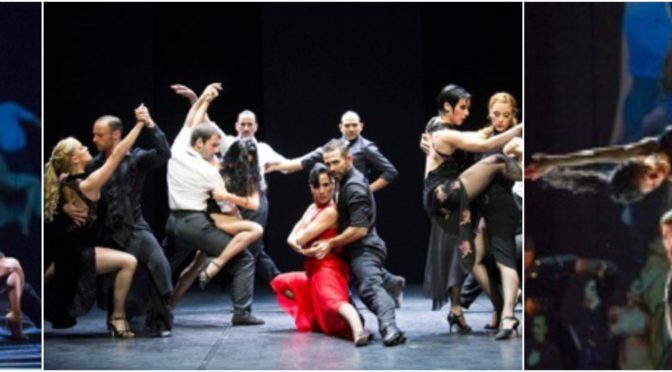
‘Milonga’ is also about woman to woman partnership, a trio of three men enjoying a joyous camaraderie, a woman’s dream of sharing a close relationship with a baby and also love triangles. But in all this he does not depart from the core essence of the dance form – intimacy, close embrace, support, touch and playful pleasure.There are also sharp contrasts of techniques displayed through the choreography. The use of 5 Tango dancer couples and 1 Contemporary dancer couple take ‘Milonga’ to a higher plane of stark contrasts in glorious harmony.

They twirl in each others arms eyes shut. Some are frozen in timeless gaze, lost in each others eyes when their breath reach out to brush past the audience. There are steaming scenes where the couples are chest to chest, hip to hip and thigh to thigh, as if their souls are fused in one. They emit sparks in their fiery, crisp and sharp Tango moves. Time and space evaporate. What remains is the mad dying need to be in each others arms. A complete surrender to the partner, tearing and destroying anything that might come in between. Even with closed eyes, one would feel the fierceness of the sensuous passion that flows through movement and music on the floor.

Men share a brief moment to challenge each other in a playful banter and good natured repartee. A masculine scene full of energy and spirit. Cherkaoui also brings in humour through the couple who following their unexpected rendezvous, flirt with each other. The coquettish tourist in the city goes all out to match up in Tago moves with the man who is a local. Her awkward moves are true to the character, and carried out with finesse.

The scenes flow through a collage of relationships. Tango -primarily the dance of connection between two people has also been treated as a mirror of relationships between two or more, in their various forms, shapes, colours and essence in Milonga!

The dance scenes are intercepted with melodious music sections with accompanying state of the art video design. Cut outs of dancing couples have been used with a variety of lighting designs. Sometimes they are living – as true as being physically present. Or they are snowy, white, blank paper skinned shapes with human outlines, carving out sensual dancing partners. Sometimes  they are colourful – reflecting the dancers that merge from the dark background, transposing into these shapes to get into their next sequence. Cherkaoui’s imagination of a thousand wonders merge to meet the expertise of Eugenio Szwarcer, set and video designer and Adam Carree, lighting designer. It is the phenomenal visual art that augments the Cherkaoui innovation in an evening of Tango.

Cherkaoui has proved to be the master of absorbing different styles and recreating them. Retaining their unique originality with touches from his own paint brush to draw a new design in movement. In creating Milonga, he travels deep into the roots of Tango and then journeys back up to the surface to refashion it in his own image. Milonga is a narrative of human relationships that touches the heart!