
Hello

Best of Enemies – Young Vic Theatre Review

The tempestuous American 1960s are currently being brought to stage in the new play “Best of Enemies”, at the Young Vic theatre. Written by James Graham and directed by Jeremy Herrin the story is based on the documentary of the same name by Norman Neville and Robert Gordon. It explores a historical televised debate at the heart of the explosive year 1968 in the USA.

The play opens with two exasperated men who seem to have lost all control as they insult each other with no retain, and slurs such as “queer” and “crypto-nazi” fly across the room. We are witnessing the aftermaths of the televised debate between the two intellectuals William F. Buckley Jr. and Gore Vidal, who both seem extenuated from their clash. Suddenly, the play rewinds to the beginning of the story to give us more context: we are in the US of 1968, where a wind of change and chaos is taking America by storm. The protests against the Vietnam war, the assassinations of Andy Warhol and President Kennedy, the open wound of segregation: all these crises are cleverly conveyed through a sequence of lights, audio and video projections of television broadcast, respectively designed by Parle Constable, Tom Gibbons and Luke Halls. We are transported to the studios of ABC TV News who, desperate about their low ratings, decide to air a discussion between two famous intellectuals about the feisty presidential debate of Frost against Nixon. They decide to invite the conservative William F Buckley and the liberal Gore Vidal, who both agree to participate out of personal interest to increase their fame. After all, “a man should never turn down two things. Sex, and appearing on television”. The debate is indeed set up from the start as being a product of greediness more than genuine concern about political issues, both from the television studios and from the two men.

As the debate begins, we start to identify the different characteristics of the two men, who are two opposite poles in every aspect. Buckley is an extreme-right conservative with extremely homophobic and racist opinions, whose passion and feistiness are depicted to perfection by British actor David Harewood. It would be easy for such a character to slip into the role of the “bad guy” of the story, and yet the script and Harewood’s performance manage to give him, if not likeability, some sort of relatability. His intellectual torment, the facial tics and physical insecurities that he portrays and the domestic scenes with his wife make him an extremely complex and full-fleshed man. Vidal (Charles Edwards), on the other side, is a more superficial character who seems less politically passionate than Buckley, but his quick wits and charms help him dominate the debate most of the time. His sense of superiority is quite unnerving but gives him a charisma that plays to his advantage.

Apart from snippets of the personal lives of the two protagonists, such as Vidal’s queer flings and Buckley’s conversations with his wife, the play revolves mostly around the debate. As such, it could have risked being an overly political two-hour conversation, no different from what one could find by tuning in on a typical political TV programme. However, Graham manages to craft a story that surpasses the debate and considers a much wider range of themes. In fact, the debate soon drifts away from politics to become a mere combat of peacocks, as the two men try to outwit the other and appear as the most brilliant one. As is often the case in politics, we tend to not root for the man with the best policies, but for the man that we like the most. We slowly see what is supposed to be an enriching exchange of opinions between intellectuals, become an arena where the combatants will face each other until death.

The play offers countless reflections on many different subjects, such as the transformation of the role of TV in society or the birth of polarisation between different parties and communities. These ambitious contemplations provide an intellectually rich aspect to the play, which is reinforced by the detailed historical accuracy. Every historical character is staged realistically, and actors Charles Edwards and David Harewood have clearly been studying every mimic and mannerism of their characters, which they both reproduce convincingly.

The play has unfortunately been suspended until January 3rd due to Covid but will be broadcasted online until then. Since the live play tries to reproduce the feeling of watching TV, watching it as a video can be an interesting experience that could enrich the narrative. Get your tickets at  https://www.youngvic.org/whats-on/best-of-enemies
Anna Karenina -Guildhall School of Music and Drama Review

The Guildhall School of Music and Drama takes on Marina Carr’s adaptation of author Leo Tolstoy’s classic tale ‘Anna Karenina’, a chaotic yet raw journey foregrounded in lust, love, loss and tragedy. ‘Anna Karenina’ is centered around the love lives of two women; Anna, who has grown tired of her tedious marriage to politician Karenin and enters an adulterous romance with army officer Vronsky and Kitty Anna’s sister-in-law and the courtship between her and landowner Levin. The story deals with a wide range of topics such as family troubles, mental health issues, addiction, gender, marital and relationship issues.

‘All happy families are the same. Each unhappy family is unhappy in its own way’ is the first line we hear in the play. It then opens with Anna walking into an argument between her brother and his wife that has been caused by her brother’s adultery – this seems to foreshadow the events that occur within her story throughout the play. Anna is tasked by her brother to use her in persuading his wife to forgive him (in which she succeeds). It is on this quest that she meets the charming Vronsky, and whilst she initially is reluctant, Anna and Vronsky soon enter into a lustful and passionate affair.

As the romance begins, the spiral into drama and tragedy surrounding it commences. One scene that stands out, occurs after Anna tells Vronsky that she is pregnant with his child at Vronsky’s horseracing event. After a vigorous race, he injures his horse, causing Anna extreme distress. This emotion from Anna is predominant throughout the play. Her intense stress causes her to confess her infidelity to her husband Karenin, whose biggest concern seems to be the reputation of their image and the gossip that may ensue more than anything else. However, as she persists with the affair Karenin eventually decides that it is time to file for divorce. From my perspective whilst watching this play, it was difficult to not feel sorry for both parties. Anna perhaps feels that there is something missing in her marriage and is suffering from mental health issues and Karenin is having to come to terms with his wife’s adultery. He has to deal with Anna being unable to deal with the guilt and running away with Vronsky leaving him to take care of their son alone. As the story develops, Anna begins to become more distressed and paranoid, constantly questioning whether Vronsky still loves her and if breaking her family apart (causing pain to those around her) was worth it.

The set design is quite simple – there is an iridescent rectangular box being present throughout most of the scenes. The costumes are typical of what you would expect aristocrats, army officers and people in their social network to wear during the 1800s. The motif of trains is present throughout the play and this is featured where Anna and Vronsky first encounter each other. The use of trains is perhaps to signify the derailing of Anna’s life after beginning her affair with Vronsky.

Anna Karenina is a story that for years has divided people, and the Guildhall theatre’s production is no different. Some see her as a loving mother who also wanted to look out for herself and others see her as selfish and egotistical. The actors do a fantastic job at portraying Tolstoy’s characters as complex and interesting, allowing the audience to leave the theatre having much to think about after their unforgettable performances.

Reviewed by Lian Lakhope. Lian is a MA Global Media and Communications student at SOAS and a volunteer writer for Abundant Art. Lian has written for a number of different publications, mostly about music, culture and film and she is enthusiastic about expressing her passion for creating art and media.


2:22 A Ghost Story – Gielgud Theatre Review

Amid all the blinking and colourful signs of Piccadilly’s theatre venues, the Gielgud Theatre has recently put up its own intriguing seasonal title: 2:22 A Ghost Story, back by popular demand. Written by Danny Robins and directed by Matthew Dunster, this record-breaking play is a must-see of the London scene this Winter. This terrifying and yet meaningful experience with an unexpected twist will be loved by thrill-seekers as well as psychological drama enthusiasts.

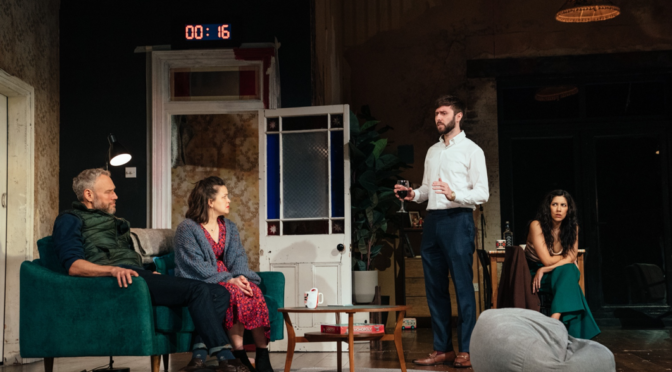
The tone is set from the first few minutes of the play: a panicked woman enters the stage as a baby’s deformed cry emanates from a baby monitor. Behind her, a gigantic red digital clock shows the time. The woman runs out of the stage, and as the clock strikes the fateful time of 2:22, a loud inhuman scream fills the room and the stage turns bright red. This introductory scene has the public collectively jumping up in terror, leaving them with a dreadful feeling of fright that will haunt them for the rest of the play. The show doesn’t only rely on ear-bursting screams to scare the audience. In fact, its first purpose is not even to scare, but to reflect the tormented domestic lives of its four main characters within their deepest intimacy.

Jenny (Giovanna Fletcher) is throwing a housewarming party in her newly renovated house the night her husband Sam (Elliot Cowan) comes back from a mysterious trip. The couple invites Sam’s college friend Lauren (Stephanie Beatriz) and her current fling, bathroom renovator Ben (James Buckley). Throughout dinner, Jenny confesses that she believes that a ghost appears in the room of her baby Phoebe every night, exactly at 2:22 am. Seeing her friends’ disbelief, she dares them to stay until that hour to witness the ghost. As the friends wait, the night unveils in a succession of revelations, psychological drama, philosophical discussions and speculations. The play slowly shifts from focusing on the spirit to revealing the real ghosts of the story, the personal chimeras that haunt every character, going from regretted forbidden loves to tormented marriages.

The dynamics between the characters holds the play together, achieved by stellar performance of the cast. Emotions are conveyed impeccably, from Jenny’s hysterical outbursts to Sam’s obsession with finding a logical explanation for everything. Also, Lauren’s sarcastic bitterness and Ben’s ingenuity and humour are genuinely convincing. The lines flow by and come together as very natural conversations, and the occasional jokes and banter contribute to some much-needed light-heartedness. The dinner is casual, yet the play doesn’t let us forget that this is a ghost story: the big projection of the clock is a constant reminder of what is to come, and acts as an exasperating ticking bomb. Everything is designed to play with the nerves of the public: the macabre cry of the baby in the monitor, the lugubrious glass-doors that give into a foggy backyard, the horrific screams of the foxes in the garden… Even the set design (Anna Fleischle) of the unfinished house, still decorated with a half-ripped old wallpaper and unfinished half-painted walls, has an eerie vibe that will subtly make the public uncomfortable. The horror is never too “in your face”, which allows it to keep a veil of mystery that is a thousand times more terrifying than any prop or bad ghost costume.

2:22 A Ghost Story is a horror story full of humanity, that will have you jump on your seat more than once and leave you with more questions than answers. If you want a chilling alternative to the countless Christmas shows of the season, this is the show for you: https://222aghoststory.com.

Reviewed by Céline Galletti- Celine is a volunteer writer for Abundant Art. Originally from France and Italy, she follows her passion for writing and art by studying Comparative Literature at UCL, London. As an international student living in London, she is determined to fully experience and understand the city’s vibrant arts scene and be a part of its creative storm.

Ocean at the End of the Lane – Duke of York’s Theatre Review

From the very second of entering the auditorium the majestic atmosphere was felt throughout. ‘Ocean at the End of the Lane’ is presented through the set design of glistening lit up trees that frame the stage and make it appear as if we have stepped into a fantasy world. Originally a novel written by Neil Gaiman ‘Ocean at the End of the Lane’, adapted to a play by Joel Horwood and directed by Katy Rudd, is a fantasy tale that transports us into an entrancing magical world. It blends the realism of family relationships and their struggles with the fantastical images of nightmarish shapeshifting monsters. The play reminds me of a blend of both Narnia, which is referenced by the unnamed main character, played by James Bamford, as well as Netflix TV show Stranger Things, which both have boisterous energy and the premise of young teens on the pursuit to eradicate a terrifying monstrous villain.

Years after the events that occur during the major part of the play, the unknown main character is now an adult and he visits the spot in which he met his first love and best friend, Lettie. As he is perched upon a bench Lettie’s grandmother appears. As they talk, he reminisces about the events that occurred all those years ago, and we are transported to the past where he is now a young boy. The main story of the play begins in tragedy, a lodger who had been living with the protagonist and his family is found dead and it is ruled a suicide. In distress the protagonist’s father attempts to get his son away from the tragedy telling him to go home when a local young girl, Lettie, appears. The protagonist waits at Lettie’s home whilst his father speaks to the police. As he waits for his father the pair begin to get to know each other. The protagonist enters the fantastical world of Lettie and her family. They are quite mysterious and ambiguous, with a grandmother who has been alive ‘since before the moon was made’ and a mother who knows strange magical tricks. Lettie is far from normal too, also possessing these strange magical qualities as well as being obsessed with a pond which she insists is an ocean and telling the protagonist about a creature called ‘the flea’ that has entered the universe through a portal created because of the lodgers’ death. We soon find out that this flea is a grossly misleading name for a terrifying shapeshifting creature.

The chemistry between the protagonist and Lettie is wonderful and charming. Lettie acts as a confidant for the protagonist, helping him when he gets himself into difficult situations. The protagonist acts as a comfort for Lettie, being her first and only friend. These scenes that interact with one another are some of the best scenes throughout the play. Some of my other favourite scenes within the play arrive in the interactions between the protagonist and his family. The family dynamic is endearing and entertaining to watch, a goofy father who burns his toast every morning without fail and a loud bratty sister who is perhaps the funniest character in my opinion. However, when his father meets ‘the flea’ who has shapeshifted into a beautiful lady who calls herself Ursula, the protagonist becomes ostracised from his family and his relationship with his father suffers. As his father becomes infatuated with Ursula, he becomes frustrated and infuriated with his son’s disapproval of her, resulting in one of the hardest scenes to watch in the play.

Everything about the play’s set design, props and even the set changes are elegant and aesthetically pleasing. The scene in which the protagonist and Lettie encounter the flea for the first time is insanely engrossing as Lettie moves elegantly conducting magic to defeat the creature, which is large and hauntingly gorgeous, and moves almost in synchronisation with Lettie. The set changes are creative and rather than being awkward intervals of change they are graceful and make the play all the more beautiful.

Ocean at the End of the Lane is a hypnotically magical play, with strong performances from all the cast complimented by an ethereal set design and a mystical score by Jherek Bischoff. It encompasses themes of love, loss, tragedy, family life, money troubles, as well as providing us with plenty of laughs. Ocean at the End of the Lane is playing at the Duke of York Theatre until May 14th. Get your tickets here: https://www.thedukeofyorks.com/the-ocean-at-the-end-of-the-lane

Reviewed by Lian Lakhope. Lian is a MA Global Media and Communications student at SOAS and a volunteer writer for Abundant Art. Lian has written for a number of different publications, mostly about music, culture and film and she is enthusiastic about expressing her passion for creating art and media.


Dick Whittington – Phoenix Theatre Review

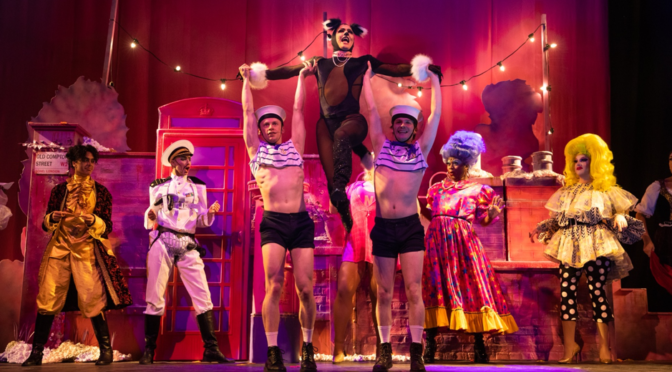
This Christmas, get ready for flamboyant costumes, glitter, and cheeky humour at the Phoenix theatre with the fabulous all-Drag Christmas Pantomime “Dick Whittington”. Written by Gareth Joyner and directed by Chris Clegg, the show puts on stage world-famous Drag Queens and Kings in a remake of the tale “Dick Whittington and his cat” for an extravagant and fun show that will add a dose of glee and sparks to your holidays.

The story is set in Soho where the evil Queen Rat (Choriza May) is threatening to unleash her army of rodents, to the sorrow of the magical Spirit of Soho (Kitty Scott Claus). Fortunately, the valorous Dick Whittington (Cheryl Hole) and his cynical cat (Elektra Fence) arrive in town not only to save the day, but also to discover new friendships and blooming love. However, as even the characters point out, the plot is the least interesting element of the play: the music, costumes, dance performances and most importantly the Queens and Kings are the real protagonists of the stage. The fame of the cast precedes them as everyone receives a loud cheer every single time they show up on stage. This was all at the amusement of Cheryl Hole, who asked the audience to calm down if they wanted to keep watching the story.

Occasionally breaking a scene for a laugh, or just pretending that they had forgotten their lines for some more humour, the cast manages to keep the audience on their side with their impressive talent of improvisation. They showcase a natural charisma that goes beyond the script. Cheryl Hole is a great protagonist as “a boy dressed as a girl dressed as a boy” and plays her character with confidence and magnetism. Elektra Fence the sarcastic Cat (my personal favourite) is incredibly hilarious and constantly breaks the fourth wall, despite forgetting her lines every so often. Kitty Scott Claus is also brilliant as the Spirit of Soho, as is her rivalry with Choriza May’s Queen Rat. Yshee Black as Dame Sarah is full of energy and glee for her first-ever theatre performance, and Karen has an exhilarating dynamic with Dick in their “heteronormative boy and girl love story”. The Drag Kings Beau Jangles and Richard Energy are also remarkable, and Beau Jangle’s theatrical performance of Cardi B’s “WAP” is as talented as it is absurd. Finally, Ophelia Love has the role of “Villager number 4”, a role so insignificant that she comically overplays every single one of her lines and interrupts the story to do some self-promotion.

The play is dominated by a dimension of self-irony and satire with over-the-top humour that has the audiences laugh from start to finish. The pop-culture references are endless and Drag fans will be satisfied no doubt. Musical bits such as Choriza May’s “My pussy is like a peach” and Ophelia love’s “My heart will go on” were both funny and spectacular. The most memorable one is the rendering of “12 days of Christmas”, where the cast has to run around and open boxes in an impossible choreography that has them slipping on the floor and banging into each other. The immersive dimension of spark and colourfulness is also perfectly conveyed through the extravagant costumes and the simple but effective set design (designed by Justin Williams). It all resulted in a perfect mix of Drag extravaganza and theatre with a cast that owned the room from start to finish.

Sprinkled with Drag magic, Dick Whittington is running throughout the holidays, get your tickets at https://www.thephoenixtheatre.co.uk/dick-whittington.

Reviewed by Céline Galletti- Celine is a volunteer writer for Abundant Art. Originally from France and Italy, she follows her passion for writing and art by studying Comparative Literature at UCL, London. As an international student living in London, she is determined to fully experience and understand the city’s vibrant arts scene, and be a part of its creative storm.

Hokusai, The Great Picture Book of Everything – British Museum Review

This week I discovered the impressive Japanese artist Hokusai in the British Museum. His specific technique and way of looking at things before drawing them are disclosed in The Great Picture Book of Everything exhibition, a specific type of encyclopedia including 103 drawings produced during the 1820s to 40s.

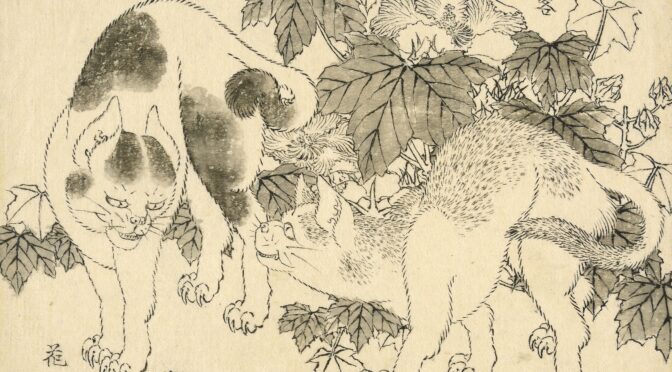
This exhibition shows the entirety of Hokusai’s talent. He is well known for his landscape prints and paintings. Hokusai was also an illustrator of picture books. He had been commissioned to illustrate around 270 books with scenes of daily life, warrior tales, anthologies of Chinese poetry and art manuals. The large number of subjects he had covered during his lifework is commendable. Ranging from animals to deity – every subject required him to learn a new technique. What struck me the most was the fineness of his lines and the infinite details in his work. He was very meticulous in his representation, which can be seen and particularly in his work about deities and traditional tales. These artworks relate to a whole culture and their cosmology and show how they explained world creation.

I discovered a very interesting artistic creation method: woodblock print. All of Hokusai’s prints are made with this specific technique. The final-stage drawing is pasted onto a particular block of wood, then a ‘block cutter’ has cut along the artist’s lines. The resulting outline block is inked and can be used to print the drawing on a piece of paper. The exhibition displays the tools used and explains the creation process in a clear video. There are other secrets disclosed in this exhibition about the Great Wave and I hope you will be able to discover Hokusai’s hidden secrets!

This original exhibition is an opportunity to discover the hidden truth of the Great Wave. It will run until 30 January 2022 at the British Museum, London. Learn more about it and get your tickets at https://www.britishmuseum.org/exhibitions/hokusai-great-picture-book-everything.

Photo image: ‘Cats and hibiscus’ A standoff between two cats with hibiscus (fuyo) behind.

Reviewed by Alix Berthelot–Moritz- Alix is a volunteer writer for Abundant Art. Originally from Normandy, France, she follows her passion for journalism and art by studying at the European Political and Social Sciences of UCL, London. As an international student living in London, she is determined to fully experience and discover the entirety of the city’s vibrant arts scene and share the beauty of it through her writing.

The Snowman – Peacock Theatre Review

The Snowman is back at the Peacock Theatre on its annual run marking its 23rd year. A magical precursor to the festive season, it is a fantastic adaptation of the children’s book by Raymond Briggs and the film directed by Dianne Jackson. The show is a feast for both children and adults, who together can enjoy interacting with all the Christmas characters. Along with the little boy, there is, of course the Snowman with a whole bunch of other snowmen and snow-women, a very flamboyant Father Christmas in his glistening red attire, and there are penguins, reindeers and the snow princess. There are other animals like the cat, squirrel, badger, rabbit and fruits too, popping out of a gigantic refrigerator- all in their brightly coloured costumes, creating a bright and playful ambience. Everyone on stage is simply happy! They reflect pure joy, lifting the spirit and swooshing the audience off to a magical world where life is all sparkling and fun.

As the show is about to start the children in the auditorium drift into silence. From a quick glance around I could see a very eager young audience, almost counting down to the stage brightening up – 3,2,1-and the show begins! With its snow-covered Christmas trees standing tall on either side, the stage is a world covered in a white blanket of snow. The boy is still in bed, while Mum and Dad are busy with their daily chores in the living room. He wakes up to this beautiful snow-filled morning and goes out to play.  He makes his customary snowman who comes to life that night when the whole world is asleep. The boy sneaks out of his bed and goes out to check on his Snowman. Magically the Snowman comes to life. He takes a bow and shakes hands with him. The awe and wonder of the boy at this sudden surprise reflect on the junior members in the audience! The boy and the snowman bond and the journey of experiencing each other’s worlds begin. Martin Fenton’s performance as the Snowman is eerily like that of a snowman. His movements mimic the soft weightless glide of an actual ball of snow. They are frictionless with no sign of conscious effort.

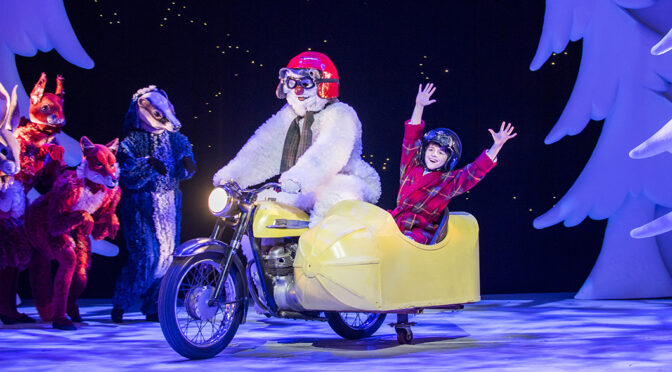
Throughout the first half of the show, the boy takes the Snowman around his house where he is amazed at his discoveries in a human household. The Snowman’s explorations have been wonderfully portrayed through the choreographies and theatrical elements of the show. The humour in the story is perfectly wrapped in choreographic sequences when the audience cracks into laughter – the Snowman lazes on the sofa next to a fireplace and he almost begins to melt. The boy rushes to switch it off and restores the Snowman back to shape. The boy leads him in front of the kitchen fridge. Opening it brings a cool breeze of relief for the Snowman and out comes a giant banana, coconut and pineapple. The dance of the three fruits is one of the highlights of the evening. The Snowman meets the household pet cat and ends up ruffling him out of his cosy corner.  He then goes on to ride a motorbike with the boy seated on the side carrier. This untimely night ride drives out a squirrel, a fox and a rabbit from their slumber. This leads to another memorable dance sequence under a starlit night sky.

Ready for a rest after their exploration, the Snowman gets in the freezer -and what happens now is jaw-dropping for our little spectators. The snowman starts to fly! And he also whisks James with him, finally landing in the North Pole! A real flight across the stage – can it really get any more magical! The children follow the gentle, dreamy take-off without a blink. The very little ones arch and drop their heads back, almost touching the roof with their chin. There is a unified gasp across the house and waving of hands at the Snowman and his little friend. The Snowman introduces his friend to his other snowmen and snow-women friends who have gathered from around the world to party. Guess who is also at the party- Father Christmas himself! There is a cheer from the audience as he enters in his sledge. Beautiful dance sequences unfurl in this section as there are more characters adding in, typical to the land of Father Christmas. The reindeers, penguins, the Snow Princess and the wicked Jack Frost. What ensues is a fun-filled second half with more dance numbers, mime and drama to the original score by Howard Blake.

Birmingham Repertory Theatre’s recreation of The Snowman is a beautiful translation of the book into this stage presentation. The format is simple yet catching. Very colourful and bright, even when it’s all white. The use of bright colours, crisp direction, flawless performance by the cast and the magical bond between the snowman and his little friend, together, creates the ideal treat for all in the build-up to Christmas. The snowfall on the audience at the end when James is tucked back in bed by his buddy, adds in a winter wonderland feel to the show. He wakes up the next morning only to find his Snowman is all but melted, leaving behind his hat and scarf lying on the snow. Our young audience would have been sad at this ending but there is the finale dance to cheer all up. The entire cast gushes in on stage along with the Snowman and the boy and Father Christmas. They dance under the light shower of snowflakes. It’s a party! It’s a joyous festive finish to the show sending smiling faces back home!!

Running at Sadler’s Wells until 2 January 2022! For tickets visit The Snowman – Peacock Theatre – Sadler’s Wells (sadlerswells.com)

Written by Protima Chatterjee who is the Founder and Creative Director of Abundant Art


Kehinde Wiley: Prelude at the National Gallery Review

Strolling along the main collection at the National Gallery, I admired a thousand masterpieces displaying the most well-known European artists. In a room full of portraits of wealthy elites representing their greatness and wealth, I was amazed to discover a section of work on display by Kehinde Wiley.

Kehinde Wiley is a Black American artist who reproduces well-known masterpieces. His objective is to highlight the absence of Black figures within European art. His aim is successfully achieved. Wiley’s paintings are in contrast to the other works on display in the rest of the gallery, pointing out the lack of diversity within European galleries. The exhibition displays five of his works, in which he refers to artists of European Romanticism such as Caspar David Friedrich and Winslow Homer. In those paintings, he questions our link with nature and race by giving a large place to the landscape in which he only represents one or two human figures. His realistic style bears an uncanny resemblance with the original work, such as Caspar David Friedrich’s ‘The traveler contemplating a sea of clouds’.

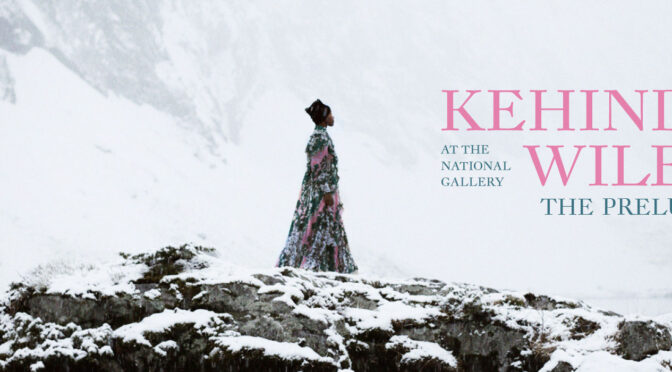
The masterpiece of this exhibition is The Prelude, a film Wiley made this year featuring Black Londoners he met in the streets around the National Gallery. The fact that he sets them in a powerful backdrop of the Norwegian landscape of the fjord, shows the depths of his imagination. It also forges a realistic connection with the existence of societal disparities across ages, to the current times. Kehinde Wiley plays with the contrast created by the whiteness of the snow, generating a beautiful metaphor concerning race and identity. The interesting choice for the setting across the film is one of the key factors of its success. At the National Gallery the film is being shown on six screens displaying different scenes, immersing us into this awe-inspiring landscape. Though set in an inhospitable environment, the sheer strength of the people in the film, walking and bonding with each other, stands out, and is thought-provoking. The classical music used as background score adds a layer of grandeur and enhances the impression, that they are the survivors of the world.

This powerful exhibition is an amazing opportunity to discover Kehinde Wiley’s work and to approach the question of racial diversity within art. It will run until 18 April 2022 at the National Gallery, London. Learn more about it and get your free tickets at https://www.nationalgallery.org.uk/exhibitions/kehinde-wiley.

Reviewed by Alix Berthelot–Moritz- Alix is a volunteer writer for Abundant Art. Originally from Normandy, France, she follows her passion for journalism and art by studying at the European Political and Social Sciences of UCL, London. As an international student living in London, she is determined to fully experience and discover the entirety of the city’s vibrant arts scene and share the beauty of it through her writing.


Sleeping Beauty and the Beast – Battersea Arts Centre Review

Throughout the Christmas holidays, the Battersea Arts Centre is hosting the new Holidays Pantomime “Sleeping Beauty and the Beast”, directed by Kerry Frampton. The play is a feel-good family show that puts on stage everyone’s favourite characters from our childhood fairy tales, adding on a pinch of humour, parody and Christmas spirit.

The beloved trio Sleeping Trees (James Dunnel-Smith, John Woodburn and Joshua George Smith) are back on stage, accompanied by Juliana Lisk and Jamal Franklin who are ready to embark on a new adventure. The five friends are having a slumber party when James realises that someone stole the script of their play. In order to change his mood, his friends improvise a story that they invent as they play along. They start acting the story of Goodie-versity, a university presided by Beauty and The Beast for recovering bad guys who want to become good. One day, the school receives a surprise visit from an inspector who menaces to close the school if their graduation doesn’t go smoothly. However, everything turns to catastrophe when the Beast is put to sleep by a sleeping potion, which highjacks the graduation. Belle turns to her friend detective Sleeping Beauty to solve the case of who poisoned her husband, and to bring him back from Dreamland.

The play offers a hilarious situation of meta-theatre where the story of Sleeping Beauty and The Beast is constantly interrupted by the actors coming back to reality and adding other elements to their adventure. Their tale starts to become more and more extravagant as the friends decide to add random characters such as a scary ghost, a flying lobster, a talking box of cereal or even Santa Claus (“to make it more Christmassy!”). The set of characters who follow each other on stage are all priceless and showcase the range of the actors, who are able to change characters with extreme fluidity. We meet Captain Hook, Gaston, The King of Rats, a mummy, the big bad wolf, the dwarf Sleepy, and many more. And in typical pantomime fashion, the stage (designed by Emily Bestow) is as colourful and bizarre as the story.

The audience is enthusiastically engaged, as they are drawn in by the actors to participate in helping detective Sleeping Beauty find clues.  It was heart-warming to see the investment of the younger public, who exulted at every discovery, gasped at every plot twist and laughed at every joke. In an age where kids are likely to be desensitised to theatre and other forms of art, it is more important than ever to provide a sensibilisation to art from a young age, and the children in the audience seemed delighted to be there. Everything in this play, from the charismatic quintet of actors to the fun storytelling aspect will charm kids, families, or even fun-loving adults. Get your tickets at https://bac.org.uk/whats-on/sleeping-beauty-the-beast/

Reviewed by Céline Galletti- Celine is a volunteer writer for Abundant Art. Originally from France and Italy, she follows her passion for writing and art by studying Comparative Literature at UCL, London. As an international student living in London, she is determined to fully experience and understand the citys vibrant arts scene, and be a part of its creative storm.

Redemption – The Big House Review

The Big House is without a doubt Islington’s hidden gem: the former frame factory hidden in a residential side street is currently hosting Redemption, a play directed by artistic director Maggie Norris about the everyday struggles of London’s abandoned youth. Music becomes their only way of expression, an aspect which is perfectly conveyed through the musical score composed by The Last Skeptik and written by James Meteyard. Norris paints a landscape of the harsh reality of these precarious lives who, at the brim of adulthood, are lost in a quest for a brighter path where redemption seems impossible.

We follow the story of Maz (Renaya Dennis), a young woman who uses her tough exterior and a constant mean frown to hide her deep vulnerability. As she flees her dangerous care home, she tries to find success as a singer in a recording studio where she meets Tayo (Shaquille Jack), a shy young man with an angelic singing voice. Together, the pair navigates a world of bitterness, violence and grief in a desperate search for identity and hope.

The Big House’s uniqueness as a theatre company is that it offers opportunities and mentoring to young people from difficult backgrounds. It gives them a space for artistic expression allowing talents to bloom. The portrayal of underprivileged environments isn’t always represented so accurately in the media, but “Redemption” offers a totally natural rendering of the slang, attitudes and relationships typical of rural areas. The more emotional moments are also very well expressed, as one can imagine that they hit familiar buttons for the actors. Ranaya Dennis is spectacular, and gives her character the perfect balance of likable vulnerability and bitter toughness, like a wounded stray animal that defends itself by growling at anyone who approaches it. The story entirely revolves around her character and her internal monologues, and yet her performance was flawless and strong enough to carry the whole play. A rather arduous task for such a young talent, but she manages to execute it perfectly. Similarly, Shaquille Jack gives a very touching performance despite the quiet nature of his character, and his singing moments are incredibly moving. The supporting cast is also extremely believable and genuine, offering very natural performances and flowing dialogue.

The immersive aspect of the play is also primarily due to the creative use of space: each scene is set in a different room of The Big House, and the public is invited to walk to the next room every time a scene ends. One discovers the recording studio, Maz’s friend’s house, the care home, Tayo’s favourite bridge, and many other places that all hold the same slightly abandoned and neglected look. The absence of a proper stage has the actors play a few centimetres away from the public, which gives an impression of being part of the conversations between the characters. Whilst classical theatre estranges the audience from the stage, Redemption plunges you into the action, thus stimulating and engaging thoughts on the social problems that are being represented.

In their brutally harsh world, music seems like the only window of hope for Maz and Tayo, an interesting analogy on the role of art in difficult times, which is particularly relevant today. The music of the play has range, going from rap to club music. Maz’s and Tayo’s duet on the bridge was hauntingly beautiful, and many audience members were still humming the tune whilst leaving the venue.

Overall, the play offers a raw and emotionally charged insight into the reality of London’s struggling youth. Maz’s struggle for survival and her attempt to find a purpose in a system that is constantly trying to crush her leaves us with a hanging question: is there any chance for redemption? Or is everything just part of an endless loop that is impossible to break?

Have a look at The Big House and Redemption at https://thebighouse.uk.com/#!/.

Reviewed by Céline Galletti- Celine is a volunteer writer for Abundant Art. Originally from France and Italy, she follows her passion for writing and art by studying Comparative Literature at UCL, London. As an international student living in London, she is determined to fully experience and understand the citys vibrant arts scene, and be a part of its creative storm.