Hello

In The Black Fantastic – Hayward Gallery Review

Light installations, emotive paintings and intricate sculptural costumes – Hayward’s latest offering showcases eleven contemporary artists from the African diaspora. In The Black Fantastic exhibits multidisciplinary works exploring science fiction, spirituality, myth and Afrofuturism. The works imagine new futures, free from racial injustice and inequality. 

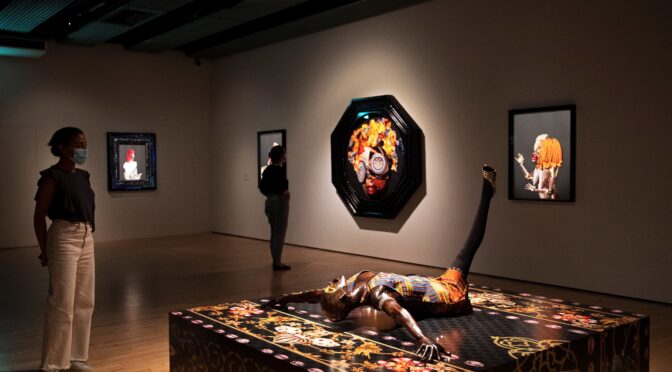
The exhibition is varied and visually impactful. Many of the artworks take over entire spaces, affecting the viewer’s senses as they weave between the works. In Rachaad Newsome’s space, a heavy bass reverberates around the room, a video flashes in the corner and frames of collaged figures are lit by harsh spotlights along the wall. This environment removes the viewer from the traditional, stuffy preconceptions of the gallery and allows them to connect with the works in a different way.

Upstairs this continues – Cauleen Smith’s mixed-media installation stops you in your tracks. Epistrophy, 2018 is composed of a large central round table containing a jumble of wires, monitors, CCTV cameras, tiny figurines and house plants. The walls opposite the table are covered with bright projections – imagery created from the intimate scenes on the table, magnified and saturated. Smith’s work is often concerned with the everyday possibilities of the imagination and this piece is no exception. Here, Smith creates a space where time and place cannot be identified, where there is no space for familiar narratives. The work is immersive and dream-like. 

In The Black Fantastic is curated with care and precision by the writer-journalist-curator, Ekow Eshun. Eshun’s chosen layout allows each artist just the right amount of space to reveal their individual perspectives, whilst still maintaining cohesion in the show. Eshun ruminates the show as “a way of acknowledging, a way of looking at the racialised everyday beyond the constraints that the Western imaginary has put around Black beings, Black personhood and Black experiences”

In The Black Fantastic is absorbing and powerful – one not to be missed.

Installation view of Rachaad Newsome works, In the Black Fantastic at Hayward Gallery, 2022. Photography by Zeinab Batchelor, courtesy of the Hayward Gallery.

In The Black Fantastic is supported by the US Embassy London, Gagosian, Cockayne – Grants for the Arts and The London Community Foundation, Victoria Miro, David Zwirner, Pilar Corrias and Sprüth Magers. In The Black Fantastic is showing at Hayward Gallery until 18th September 2022. Tickets are available to purchase here.

Reviewed by Amy Melling – Amy is a Curator and Creative Producer whose practice is centred around community-led arts projects. Her current research is focused on curatorial methods for exhibiting artworks outside. Amy has a keen interest in the arts and recently completed an MA in Curating and Collections at Chelsea College of Arts, UAL.


Grimeborn: Siegfried & Götterdämerung – Hackney Empire Review

If you didn’t fancy an outing to the Glyndebourne country house in East Sussex, or paying up to £270 for a ticket to the opera (!), the artsy London type might find themselves instead at Grimeborn. Grimeborn is held at around the same time as the famous Glyndebourne festival each year, but is borne out of the grimy, urban backdrop of East London. One may wonder if this meant grime adaptations of classic operas (JME as Don Giovanni, anyone?) but in fact it’s just a slightly tasteless pun on and evidence of the hyper-gentrification of Hackney.

It was conceived of by Arcola Theatre’s artistic director Mehmet Ergen, and its first performances commenced in 2007. A far cry from the dominant pop cultural view of opera, this year it is showing ‘thirteen operas, four new works and ten female directors from a variety of traditional favourites and new tales from across the globe.’ The most expensive tickets to the final two parts of Wagner’s Ring cycle would set you back £60 each – with the cheapest being only £17 – yet not even two-figure ticket prices can keep the wealthy socialites of yesterday (and the day before yesterday) away from their beloved Wagner. One couldn’t even resist tapping my girlfriend’s shoulder to tell us to turn our phones off before the lights had gone down.

Arcola referred to the double bill as a ‘reduction’, directed by Julia Burbach and conducted by Peter Selwyn. Ordinarily, both operas would be much longer than they currently stand. Siegfried lasts two hours without an interval, and Götterdämerung (‘The Twilight of the Gods’) two hours and 45 with a 20-minute interval. Add to this a two-hour break between the two operas, and you have a day and evening out.

For those who don’t know, The Ring is a four-part epic cycle of opera written by Wagner over more than two decades. It borrows heavily from Germanic and Nordic legend and mythology, and is rife with elves, dwarves, and swords, as well as a ring that grants you world domination. I’m sure Tolkien took plenty of notes, but supposedly he said, ‘Both rings were round, and there the resemblance ceased.’ Whatever you say.

The vocal and instrumental performances of both operas were superb. The eponymous Siegfried was a captivating and indignant lost boy as he slew the dragon Fafner and chased after Brünnhilde on a mountaintop surrounded by flames. The scheming blacksmith Mime was fidgety and anxious; the god Wotan, disguised as ‘The Wanderer’, was austere and looming. Very Gandalf-ish. Götterdämerung is a tale of deception and betrayal: Hagen, wanting the ring from Siegfried, convinces his half-brother, the king Gunther, to seek Brünnhilde’s hand in marriage. So they give Siegfried a drink which makes him fall in love with Gunther’s unmarried sister so that they would arrange a swap of sorts.

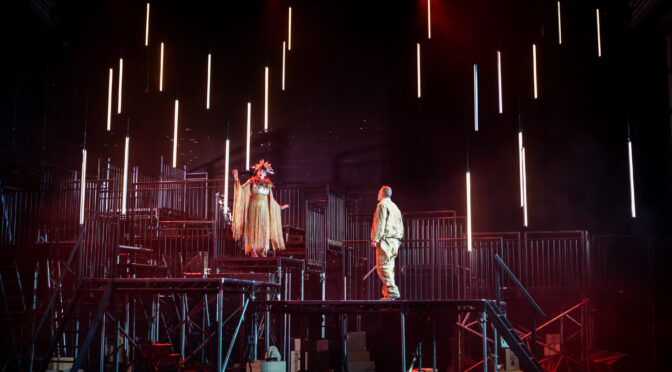
The second half of The Ring works well as a pair because the first is so action-driven and the second so dialogue-driven. Every actor was well-cast and was in atemporal dress, as so often is the fashion in contemporary theatre; the set was bare yet potent, but didn’t subtract from the epic fantasy ambience of The Ring. Rods hung from the ceiling on ropes, changing colour as appropriate to the various settings – e.g. fire or a forest.

The name of Grimeborn may reek of Hackney’s ironic self-flagellation, and The Ring may have attracted the typical Wagnerites, but as a cultural and social force it bodes well for opera. While the Young ROH scheme is designed to get young people hooked before hitting them with £100+ prices when they hit 26, Grimeborn indiscriminately delivers powerful and reasonably priced performances. Whether the less affluent of Hackney will take to it is an immanent question in its own right, but I would call it objectively fantastic that the opportunity is there.

For more info: www.arcolatheatre.com

Photography by Alex Brenner

Reviewed by Cian Kinsella-Cian is a Classics teacher and part-time pub quizmaster living in London who is primarily interested in music but is also interested in theatre, literature, and visual arts. He is particularly intrigued by the relationship between art, criticism, and the capital forces always at play. Furthermore, he believes that subjectivity – which is ultimately at the heart of all artistic and cultural criticism – should not be concealed, but probed and perhaps even celebrated. Who decides what we like? How do they construct widely held beliefs about what is good? These are two of the questions Cian looks to address.

Rodgers and Hammerstein’s South Pacific – Sadler’s Wells Review

Based on the book titled ‘Tales from the South Pacific’, South Pacific was first adapted into a play by Rodgers and Hammerstein who first brought it to Broadway in 1949. South Pacific was unlike any other play of its time; it actively attempted to challenge racist norms during the time, subverting ideas that segregated white people and people of colour.  Daniel Evans’ musical revival of South Pacific does a great service to Rodgers and Hammerstein, combining an outstanding score with theatre classics such as “Gotta Wash Him Out of My Hair”, simple yet effective staging and lighting, and clearly portraying the messages Rodgers and Hammerstein intended to present in their original play.

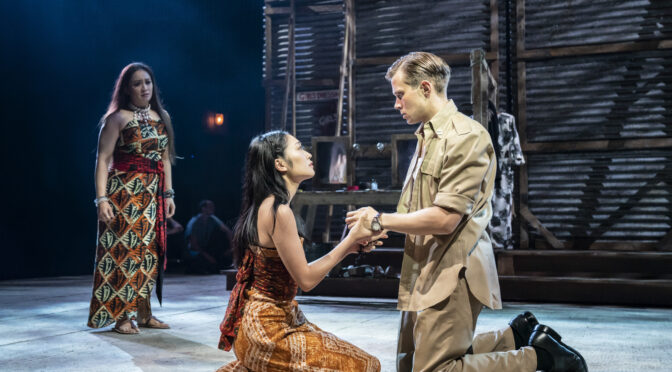
The story of ‘South Pacific’ follows Nellie Forbush (played by Gina Beck) who is working as a navy nurse on an island in the South Pacific during the Second World War, many miles away from her hometown in Arkansas. Nellie finds solace in French plantation owner Emile de Becque (played by Julian Ovenden) and the pair are quickly deeply enthralled and infatuated with one another entering a whirlwind love-at-first-sight romance. The pairs’ voices compliment each other perfectly during their duets; Beck’s high-pitched theatrical vocals and Ovenden’s unique low-toned tenor fusing together and making the audience feel their immense love for each other and their compatibility as a couple. Everything is seemingly perfect for the pair – they are deeply in love with each other and wish to spend the rest of their lives in the presence of one another. However, when Emile introduces his children from his previous marriage to a Polynesian young lady to Nellie, she is stunned by the fact that they are mixed race and feels as if she naturally can’t accept his mixed-race children or the fact that he had been with a woman of a different race.

Following this revelation follows two of the most memorable, musical numbers from Ovenden, “You’ve Got to Be Carefully Taught” a number  featuring Navy Lieutenant Cable (played by Rob Houchen)  highlighting that racism is not just naturally ingrained into individuals, rather it is something which is taught to them by the people they are surrounded by as he sings “You’ve got to be taught / to hate and fear / it’s got to be drummed / in your dear little ear.”  When it was first brought to Broadway the number was seen as brave and daring by Rodgers and Hammerstein, in a society that was building itself upon anti-communist and racist sentiments. Following this comes the standout musical number “This Was Nearly Mine” Ovenden fills the auditorium with pure and raw anguish, we feel our hearts shatter for him as he comes to terms with the woman he loves slipping through his fingertips.

A secondary romance is also introduced to the audience between Lieutenant Cable and Liat, (played by Sera Maehara) a Polynesian local and the daughter of Bloody Mary (played by Joanna Ampil) who works for the US navy servicemen.  Bloody Mary seeks to provide a better life for her daughter, in the number “Happy Talk” she encourages Cable to set aside their differences in class and race and pursue the blooming romance between himself and Liat. Rather than allowing her to settle for local farmers who will treat their marriage like a contract instead of truly loving her for who she is.

Love seems to triumph all as Nellie comes to terms with her ingrained hatred however more attention could be given to Nellie’s redemption and realisation of her prejudice. This could elevate the play a bit more and make the message more meaningful. Nevertheless, South Pacific still manages to hit the mark. The play’s revival is so important as its topics are still very relevant today, and it effectively presents these issues in a way which are engaging and yet encourages introspection.

South Pacific is showing at Sadlers Wells Theatre until 28th August. Book tickets here: www.sadlerswells.com

Photography by Johen Persson

Reviewed by Lian Lakhope. Lian is a MA Global Media and Communications student at SOAS and a volunteer writer for Abundant Art. Lian has written for a number of different publications, mostly about music, culture and film and she is enthusiastic about expressing her passion for creating art and media.

Briefs: Bite Club, live at Queen Elizabeth Hall, Southbank Centre – Review

After a three-year absence, Briefs, a cabaret company based in Brisbane, has come to The Southbank Centre’s Queen Elizabeth Hall in the wake of a headline slot at The Circus Tent at Glastonbury and in advance of a run at Edinburgh’s Fringe. Compèred by co-creator Fez Faanana under the guise of gender-bending Shivannah, the provocatively named Bite Club is the latest instalment of their flagship show, soundtracked by vocalist Sahara Beck and a live band performing entirely original music.

One factor that is partially out of control in every cabaret show is the enthusiasm of the audience. Some of that enthusiasm is down to the quality of the performers and the strength of the performances, but to some degree, it is down to the assortment of individual bums in chairs. Fortunately, the crowd was great, and the performances and performers were excellent. Shivannah is a captivating host, who drags you into the act almost instantly. The only unfortunate fault was the acoustics of the hall – it was often hard to hear what she was saying.

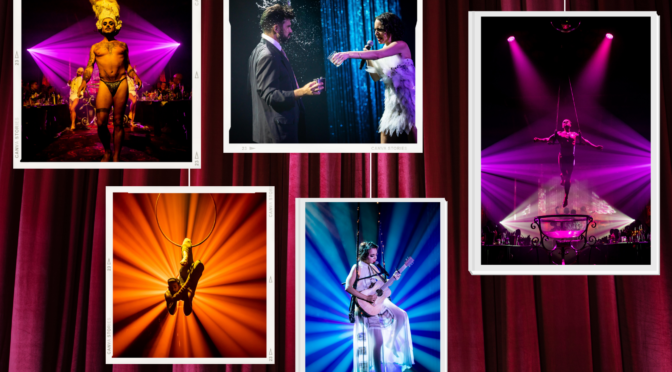
Bite Club is, of course, very camp, and many of the segments were simply but ingeniously devised. In one, a man in various garish outfits does all he can to grab the attention of Beck, who repeatedly bats him off as she sings. He slowly strips until he’s covered only by a towel, which doesn’t take long to fall. In another, Mark ‘Captain Kidd’ Winmill – 2011’s Las Vegas King of Burlesque, they’ll have you know – delivers an exceptional show on a swing with a birdbath. He’s also utterly ripped and has great outfits.

When practicing an art form like cabaret, which sits at the intersection of the carnal and the carnivalesque, the executive choice on whether to mention COVID-19 can be a tough one. On the one hand, the escapism can feel blunted without the eponymous sense of escape; on the other, trying to escape the pandemic feels slightly futile. It would be a bit like walking around any naval town in June 1945, pointing to the beauty of the sea and knowing that behind you stand ruins. But Shivannah navigated this well, acknowledging the elephant in the room sparingly as a necessary evil.

On one occasion, though, Shivannah ushered in a more sombre moment with reference to the pandemic, and the stage cleared for a solo performance by Beck. A segment dedicated wholly to singing is welcome but is less impactful when no one knows the songs. Ironically, in all other instances, the original music marked out the cabaret. Beck is both a fantastic vocalist and a versatile songwriter, in addition to being a natural showperson.

Perhaps at The Southbank Centre’s Queen Elizabeth Hall at 7:30pm, it wasn’t best placed to shine as it should. Furthermore, Winmill, Faanana, and Beck could reconsider a mix of original songs which sit in the background and camp classics to take centre stage. But Briefs: Bite Club is a great show, and it will no doubt see some success at the Fringe—preferably later in the evening after a few more drinks.

Photography by Lachlan Douglas

Reviewed by Cian Kinsella-Cian is a Classics teacher and part-time pub quizmaster living in London who is primarily interested in music but is also interested in theatre, literature, and visual arts. He is particularly intrigued by the relationship between art, criticism, and the capital forces always at play. Furthermore, he believes that subjectivity – which is ultimately at the heart of all artistic and cultural criticism – should not be concealed, but probed and perhaps even celebrated. Who decides what we like? How do they construct widely held beliefs about what is good? These are two of the questions Cian looks to address.

International Busking Day at Wembley Park – Review

I’d been hanging around Wembley Park for some time when I decided to head to Wembley Park’s Hive Building, a hyper-modern office building on the porch of the Stadium. This was the press hub for the day and where several of the team behind the action were therefore based. Someone said something to one of the team along the lines of ‘I can’t believe how much this area has changed. I haven’t been here in about 15 years.’ The Wembley Park representative nodded in agreement, and I’m handed the first issue of Park Life, ‘a new magazine for the people of Wembley Park’.

Let me not pretend to know much about Wembley Park history, nor that I’d ever been there before International Busking Day. But you can smell regeneration in the air. There’s the largest Boxpark to date, a huge designer outlet village, several modern high-rise apartment blocks, some independent businesses, and – most tellingly – street food vendors.

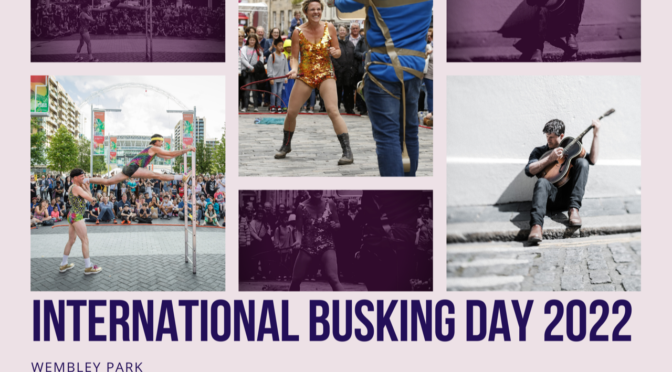
International Busking Day is a great concept, in terms as objective as possible. It started in 2015 as a hashtag campaign by Busk In London and moved from its original location in Trafalgar Square to Wembley Park in 2018. It’s entirely free, it caters to all ages, and there are all types of entertainment. There are wandering performers, musicians on stages, and a few people actually busking by the station. Particularly heart-warming were performances by children from Wembley Academy.

The local community make up the crowds, whether they went intentionally or were just passing through; the gaps were often filled by ambient roller skaters lending their energy to the space. The stages were remarkable in themselves too – the Sound Shell was a particular wonder. It was a stage covered by a round sloping object reminiscent somewhat of a (you guessed it) sea shell, angled diagonally in such a way that the larger end forms a canopy over the performer.

The day was programmed that as it went on, fewer stages were open. This presumably ensures the crowd’s gradual concentration on the main stage. It makes sense, but leaves little room to explore an alternative if, say, Seth Lakeman is not someone you’re particularly interested in. Luckily, I think the mercury award-nominated folk stalwart is great, so this posed no problems. He played a dynamic set without his usual band and prefaced almost every song with some story about how it is linked to Devon or Cornwall. Aside from the wealthy people who own many of the nicer houses in those counties, they couldn’t be much less similar to London. But Lakeman’s chat highlighted how busking is often conceptually bundled with transience; it is a way for travelling musicians to keep themselves on the road and share their own stories.

Following Lakeman were British country duo The Shires. They delivered a set mostly of ballads that appealed to many in the crowd; some were fans and sang along with the band. They mentioned, though, how in 2019 they had played but a few hundred metres away at the Wembley Arena supporting Carrie Underwood. And if you look at this Facebook post, it looks pretty jammed. But on this visitation to Wembley Park, there could only have been a generous 100 in attendance for an intimate, stripped-back set.

International Busking Day was enjoyable and is definitely a force for net good in the world, but it feels slightly overshadowed by the wider regeneration programme of Wembley Park. The company behind much of this regeneration is Quintain, which has built many of the commercial and residential spaces in the area. And judging by much of their advertisement, the idea is to attract young professionals to the area and increase its social cachet (and then house prices). Does this beg a millennia-old question: cui bono? Quintain presumably stands to gain much from this, but what benefit do locals receive from a Nike outlet and a Frankie & Benny’s? It’s a matter of perspectives to accept this as a progressive regeneration of Wembley Park.

In much the same vein, part of organising an event and constructing stages to celebrate busking seems sometimes counterintuitive. The extent to which it can still be called busking at this point is questionable, although the profile boost for its performers is not. Some intimacy is preserved, but involving private companies, booking acts and scheduling a programme goes against the apparent ideals of busking: spontaneity; independence; the mutual ‘unknown-ness’ between the performer and the audience; arguably even the transgression of choosing a public place to superimpose your music on whoever happens to pass by.

International Busking Day was great and enjoyable, and the performances were wonderful and inclusive. Perhaps, though, something of its authenticity and organicity could have been preserved.

For highlights and throwbacks click here: wembleypark.com 

Photography by Chris Winter

Reviewed by Cian Kinsella-Cian  is a Classics teacher and part-time pub quizmaster living in London who is primarily interested in music but is also interested in theatre, literature, and visual arts. He is particularly intrigued by the relationship between art, criticism, and the capital forces always at play. Furthermore, he believes that subjectivity – which is ultimately at the heart of all artistic and cultural criticism – should not be concealed, but probed and perhaps even celebrated. Who decides what we like? How do they construct widely held beliefs about what is good? These are two of the questions Cian looks to address.

The Oil Machine: The Reality of a World Run on Oil – Documentary Review

The Oil Machine directed by Emma Davie and produced by Sonja Henrici follows North Sea oil production from offshore rigs to every corner of our society. From high finance to cheap consumer goods, oil has shaped our world. The film raises the questions of how we can transition away from this dependency, how does this affect us, and what does the future hold?

“For decades, the world has been built on a hydrocarbon-based infrastructure. If you consider it, maybe a good analogy would be it’s almost like replacing all the veins in the human body. You can’t pull them all at once.” Emeka Emembolu, BP

This quote by Emeka Emembolu perfectly encompasses the predicament the world has found itself in. We desperately need to make drastic changes but it will be somewhat of a slow process and affect the Earth as a whole. The Oil Machine dives into this dilemma head first while presenting the multi-faceted issue from various points of view. The film begins with a child presenting many familiar objects: toys, stuffed animals and an iPhone. As each object is shown to the camera she repeatedly states, “This is made of oil.” This opening was eerily calm and innocent due to the presence of a child and her toys. It created an unsettling mood and encouraged the viewer to truly face reality with no tricks, no effects, just cold hard facts. The ugly truth about oil has tainted even the innocence of a child.

We all know that oil production is negatively affecting the environment. The obvious solution is to halt production and find more sustainable options, but there is a major roadblock to this plan. Throughout the film, a major point that was raised was the number of jobs North Sea oil production creates. This not only makes a higher quality of life for multiple communities but boosts the economy enormously. We have found ourselves desperately entangled with oil, a constant push and pull between economically prospering and environmentally decaying.

Films that tackle subjects such as the imminent destruction of the planet we call home can be conflicting for audience members. On one hand, it’s inspiring. Let’s all reduce, reuse and recycle! But deep down we know this isn’t enough. When consuming media that is meant to be an educational tool, as The Oil Machine is, it is difficult to not walk away feeling defeated because quite frankly the reality of it sucks. As an audience member being presented with these facts brings on an overwhelming feeling of guilt and fear. In simple terms learning the truth about our world is a tough pill to swallow, but The Oil Machine presented these facts clearly and eloquently.

The research behind this film is extremely thorough and providing multiple points of view from various age groups is a valuable way to engage a diverse audience. Although providing this substantial amount of information is beneficial it did get quite dense throughout the 82 minutes. Furthermore, the combination of technical language and the immense amount of information to process on such a distressing topic required a bit more attention and concentration from the audience. Despite this, The Oil Machine tackles a massive and pressing issue through various perspectives and really paints the whole picture. The only thing that was left unanswered is what the future holds for a planet completely dependent on oil.

Reviewed by Mia Goodman – Mia is currently finishing up her Art Direction degree at the University of the Arts London. Coming from an Italian-American background and living in both countries allowed her to explore her interests in traveling, cooking and the arts. Her passion for sustainability has led her to explore the intersectionality between the environment and creative industries.

Black Midi, live at Somerset House, Summer Series Gigs – 13 July 22-Review

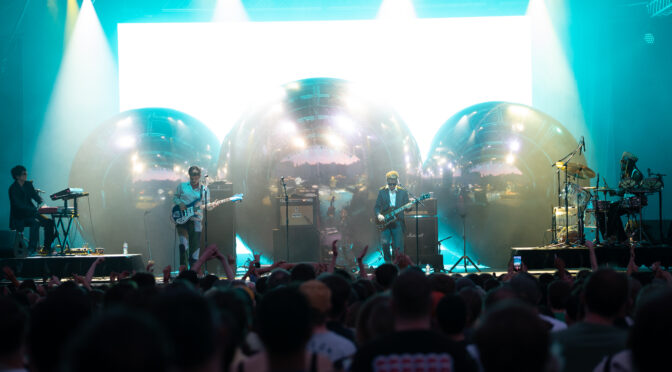
Check Wikipedia and look at the genres apparently exercised by London’s Black Midi: ‘Experimental rock; progressive rock; avant-prog; math rock; noise rock; post-punk; jazz fusion’. Cool—what does that mean? Originally formed at the BRIT school by four technically endowed teenage boys, their music on the whole is a postmodern collage of basically everything that came before it in the 20th century, sealed in wax with ironic vocals. (They’re ironic in both content and delivery: primary vocalist Geordie Greep’s voice is at the intersection between a northerner, Talking Heads, and Ronnie James Dio. I can’t really explain it – just listen to one of their records.) Another comparison I see bandied about the internet is to America’s not-so-cherished Primus, if for nothing but their sheer virtuosity. They’ve also been compared to Slint on occasion, but that is more often reserved for contemporaries Black Country, New Road.

Since being launched by Dan Carey’s Speedy Wunderground label, and championed by basically every BBC Radio 6 Music DJ, Black Midi have established a loyal following made up largely of two major cohorts: edgy people under 25 and edgy men over 45. Despite their apparent differences, both ostensibly have plenty of money to part with for merch and vinyl. And this couldn’t be more evident than at their headline at Somerset House for the Summer Series.

With three albums now under their belt since debut Schlagenheim in 2019, Black Midi have marched on in cavalcade – coincidentally the name of their most recent release, this year (badum-ch). I’ve seen Black Midi a few times now, and this is the first time since founding member Matt Kwasniewski-Kelvin took a break from the band in January 2021. In the meantime, Seth Evans has also been added as keyboard maestro.

Their performance at Somerset House was refined, to say the least. Bassist Cameron Picton has graduated from his bleached hair-era to a mullet and porn star-esque moustache; despite being technically egregious for several years, the group has settled even further into their virtuosity. As each member leans further into showing off, the mosh-pit gets even more and more hyped. It feels pretty epic.

What Black Midi might want to think about is the sheer irony of it all. Back in the 90s, Fredric Jameson wrote about something called the ‘waning of affect’, which referred to the emotionless aspect of highly pastiche-like art which emerged in the mid-20th century (e.g. Andy Warhol’s portrait of Marilyn Monroe). The band played quite a few covers – many of them good – but it largely felt like an in-joke, and the whole crowd patted themselves on the back for being in on it. Kate Bush, Tyler, The Creator, and Frank Ocean all found themselves parodied. The covers were funny, but that fruit hung not far from the floor. Seeing young, invigorated, talented musicians on stage are energising;  music fans congratulating themselves for ‘getting the reference’ less so.

Black Midi may be several years and three albums deep into their career now, but they prove that youth does not necessarily preclude experience. It’s entirely apparent that they are technically and creatively gifted, and that there is an ocean of ideas, references, and sounds flying around their heads. What occasionally is lacking is that they sound so distinctive yet so much like those very things they’ve mashed together. Apart from a short chuckle, the esoteric covers amounted to nothing more than their originals.

Credit: Black Midi at Somerset House Summer Series with American Express, Photographer: Richard Thompson

Reviewed by Cian Kinsella-Cian  is a Classics teacher and part-time pub quizmaster living in London who is primarily interested in music but is also interested in theatre, literature, and visual arts. He is particularly intrigued by the relationship between art, criticism, and the capital forces always at play. Furthermore, he believes that subjectivity – which is ultimately at the heart of all artistic and cultural criticism – should not be concealed, but probed and perhaps even celebrated. Who decides what we like? How do they construct widely held beliefs about what is good? These are two of the questions Cian looks to address.

Finding Kate – An Illustrated journey through five decades of the music of Kate Bush

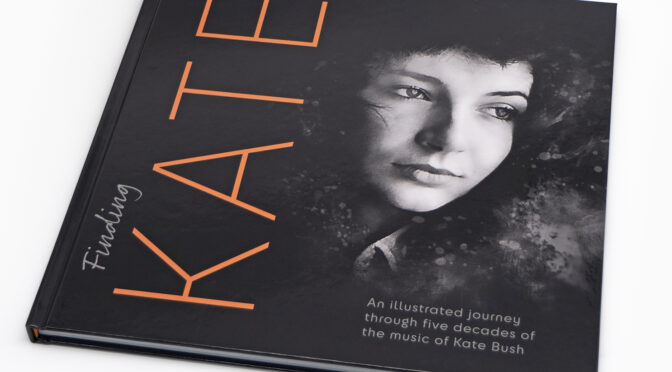
Finding Kate – An Illustrated journey through five decades of the music of Kate Bush, is a gorgeously glossy coffee-table book that gently takes the reader into the sonic-world of the enigmatic and illustrious songstress. Written by Michael Byrne and Marius Herbert, both devoted fans of Kate (as is this reviewer!). This self-published tome first published in late 2021 was Kickstarter funded with contributors spanning 25 countries.

Before I get into the review properly, it would be churlish not to mention that 2022 has been Kate Bush’s year in the most unexpected way. The meteoric rise of ‘Running Up That Hill’, her seminal 80s hit, featured prominently in the TV show ‘Stranger Things’, has given Kate a new-found popularity with a younger audience. As I write this, ‘Running Up That Hill’ is no.1 in the Global 200 Chart. Serendipitous as this must be for the authors of ‘Finding Kate’ (and I hope this boosts interest in their book), it is with a wry smile that I note some passages will need to be rewritten due to ‘Running Up That Hill’s current chart success.

Now onto the contents of the book itself, there are five sections covering the different eras of Kate’s music career and legacy including the late seventies, early eighties, ‘85 to ‘89, nineties to mid-noughties and 2011. The authors have done a fantastic job with the biographical material, it’s zippy and readable for serious and casual fans alike. Also, within the five musical eras, the writers have included in-depth descriptions of their favourite tracks (there is a full list of these further below, which I hope will encourage you, dear reader, to start on a joyous downloading journey). Interspersed throughout there are many dreamy images Kate and vivid illustrative scenes lifted from her songs. Great care has been taken to ensure the overall production of the book has a luxe feel.

Kate’s rise to fame is thoughtfully covered. I was struck by how remarkably young she was, at only 19, when she first burst onto the late seventies’ music scene with her self-penned no. 1 hit ‘Wuthering Heights’. Prior to this, she had been composing songs on the piano, learning to dance under the tutelage of mime artist Lindsey Kemp and honing her performance and singing skills gigging around South London pubs. Propelled into instant stardom at such a tender age, those early years moved at a break-neck speed. With two albums under her belt by 1979, she toured the UK and Europe with her live show ‘Tour of Life’. This Kate Bush fan was charmed that the book included a curious but little-known fact about our songstress. For the tour, Kate and her sound engineer invented the handless microphone so she could sing and dance at the same time, in 1979 this was highly innovative and eons ahead of what anyone else was doing.

Reading through the passages about how Kate approached and produced her albums, I was reminded of what a true auteur she is. Overseeing every aspect of her artistic output, from the writing and production of her music, as well as storyboarding and directing the music videos. It’s impressive to consider, that at 23, Kate cut her teeth self-producing 1982’s ‘The Dreaming’. Then just a few years later wrote and produced what is considered her magnus opus ‘Hounds of Love’ to critical acclaim and chart success. It’s an album that’s as fresh now as it was back in 1985. ‘Running Up That Hill’ (was the lead single) and is enjoying a second lease of life 37 years later, a testament to the longevity and appeal of Kate’s music.

‘Finding Kate’ tells the remainder of our heroine’s story with admiration and care. The hardships and challenges of her life are sympathetically portrayed without being cloying. Having had enough of scrutiny and fame, from the mid-90s onwards, she withdrew from public life to raise her son, Bertie, with her partner, Danny McIntosh. It’s around this time that album releases stalled. With no musical output for around a decade, Kate surprised her fans and the public alike by releasing ‘Aerial’ in 2005, to much fanfare and critical adulation. The final section of the book covers 2011, which was a bumper year for Kate’s fans used to her staggered approach, ‘Director’s Cut’, an album of reworked songs was released and later that year ’50 Words for Snow’.

It was a pleasure to read through the reflective pieces on Kate’s songs and be reminded of the weird and wonderful subjects she’s covered. There’s the ghost of Cathy Earnshaw pleading with Heathcliffe through the window to let her in (Wuthering Heights), a syphilitic elderly English composer shouting at his scribe (Delius), nuclear war from the perspective of an unborn child (Breathing), people smugglers on a risky mission (Night of the Swallow), a woman lost at sea desperately trying not to drown (The Ninth Wave), Molly Bloom’s soliloquy from Ulysses (The Sensual World), Kate mimicking blackbirds’ singing (Aerial Tal) and a woman making love with a snowman that’s come to life(!) (Misty), to name but a few.

Our authors, Michael Byrne, and Marius Herbert are Irish, and they emphasize how Kate’s Irish heritage (she is half-Irish from her mother’s side) have greatly influenced and shaped her music. This is evidenced on many of Kates’ songs particularly ‘Army Dreamers’, ‘Night of the Swallow’ and ‘Jig of Life’ – all are eulogised with their own pages in the book. I agree with the writer’s that Kate’s cover version of Irish rebel-song, ‘Mná na hÉireann’(meaning women of Ireland) emotively sung in Irish is aurally stunning. It’s fantastic to see its inclusion in the book and strongly urge anyone reading this to listen to ‘Mná na hÉireann’ now.

Throughout ‘Finding Kate’, the authors infuse their writing with their thoughts and feelings about Kate and her songs, which makes the reader feel like they’re joining in on a conversation with their music-obsessed, nerdy but cool friends. If you’re new to Kate or a long-time fan, perusing the pages of ‘Finding Kate’ is a real treat. Gift it to yourself and your loved ones! You won’t regret it!

Songs featured in ‘Finding Kate’ for some happy downloading:

Wuthering Heights (1978 or 1986)

The Man with the Child in his Eyes (1978)

Wow (1979)

Army Dreamers (1980)

Blow Away (For Bill) (1980)

Delius – Song of Summer (1980)

Breathing (1980)

Sat in Your Lap (1981)

Night of the Swallow (1982)

Hello Earth (1985)

The Big Sky (1985)

Jig of Life (1985)

This Woman’s Work (1989)

The Sensual World (1989)

Love and Anger (1989)

Reaching Out (1989)

Moments of Pleasure (1993)

Why Should I Love You? (1993)

The Man I Love (1994)

Mná na hÉireann (1996)

How to be Invisible (2005)

Sunset (2005)

Snowed in at Wheeler Street (2011)

Wild Man (2011)

50 Words for Snow (2011)

Misty (2011)

Independently published, Finding Kate is available in hardcover /casebound at €39.95 plus shipping, (including worldwide) from the authors website at: https://bit.ly/3QmOZal

Reviewed by Jane Ritchie – Jane is a volunteer writer for Abundant Art. A Generation X Londoner who still loves going to gigs, indie-clubs and vinyl shops. She discovered Kate Bush at the impressionable age of 10 and has been a die-hard fan ever since.

Living with Ghosts: Curated by Kojo Abudu – Pace Gallery, 8 July-5 Aug 2022

Pace Gallery is presenting a group exhibition, curated by Kojo Abudu, ‘Living with Ghosts’. The exhibition brings together the work of nine pioneering artists whose work explores the ways the unresolved traumas of Africa’s colonial past, and its unfulfilled project of decolonisation, continue to shape the present global order.

The exhibition showcases various types of media, from videos and installations, written work, and powerful images, to display the long-lasting effects of colonialism and provide insight into Africa’s violent past.  As a whole, it evokes a deeper understanding of the harsh realities faced by indigenous peoples both physically and psychologically in colonial times, and which still continue to reverberate through the continent.

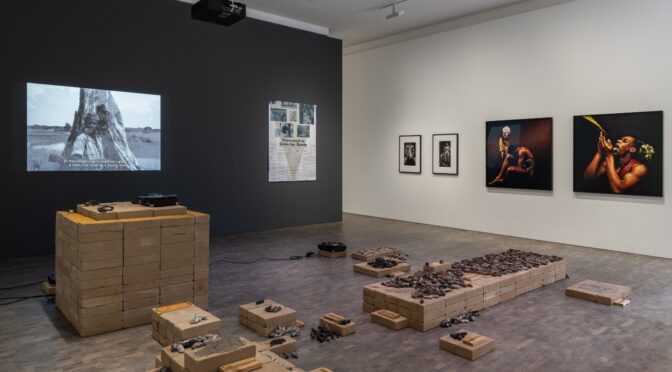
Walking into the exhibition space, I was drawn to the video playing, ‘Foreword to Guns for Banta’, by Mathieu Kleybe Abonnec. This is a video interview, relaying memories from the Guinea-Bissau War of Independence, 1963 – 1974. The video emphasised the struggles and sacrifices made for freedom against the oppressive hands of imperialists. What I found particularly insightful from this video, was the focus on daily life during the war, as it explored the roles that different people had in the struggle. Men would fight on the battlefield, whilst women and children would transport necessities, from food to weaponry, to them. This would mean walking hundreds of kilometres through brush, whilst avoiding ambushes from the Portuguese Army. The video emphasised the nature of comradery and sacrifice amongst the people as they all shared the same goal – liberation.

‘Constructed Realities’ by Abraham Oghobase consists of various texts printed on silk organza, which explored the authority of colonial powers upon the lands and peoples which they colonised. Upon reading the texts, it became clear how deeply institutionalised colonialism was in Africa, and how the Empires exploited both the lands and the people. For example, the print titled ‘Evils and Extenuations of Slavery’, states that “It is the most serious charge against Islam in Africa that it has encouraged and given religious sanction to slavery.”. The text reveals colonial attitudes towards slavery and how it was viewed as a system which was essential across the continent.

Bouchra Khalili’s work encompasses a mix of film, video, installation, photography, and printmaking. The video playing focuses more so on the post-colonial era and contemporary continuums of imperialism, as well as reflecting upon anti-colonial struggles and international solidarity movements. Khalili explores themes of self-representation, forms of resistance and communal solidarity.

This exhibition allows the viewer to both learn and reflect upon colonialism in Africa and how it continues to impact the current world order. The nature of this exhibition provides a variety of perspective and focus, enabling the viewer to see the effects of colonialism – in the past and present – through different lenses.

This exhibition is on at the Pace Gallery from July 8 – August 5, 2022. Click here to find out more: https://www.pacegallery.com/exhibitions/living-with-ghosts-london/

Photography by Saskia Flower, Pace.

Reviewed by Ridha Sheikh – Ridha is a volunteer writer for Abundant Art. She is a recent History and Politics graduate from Queen Mary – University of London. Ridha is excited to explore and share her strong passion for London’s art scene.

‘Fantasies on a Found Phone Dedicated to the Man Who Lost It’: A Dreamy, Meandering Evocation of Modern Living, 22 June-25 Sept 2022

A lost phone, left unlocked in a public bathroom, becomes the basis of Mahmoud Khaled’s first solo exhibition in the U.K. The texts and images stored on this iPhone paint an enigmatic dreamscape, moving between the mundane and the intimate, the erotic and the isolated. Screenshots evoke the banality of endless scrolling and swiping; and yet the presence of mindfulness apps aimed at insomniacs constitutes a cry for respite from a fast-paced, digitized world. The sheer volume of unfiltered information retained by this mobile device symptomizes the endless consumption of media intrinsic to modern life; whilst notes of dissonance – sleeplessness, anxiety, isolation – suggest that the contemporary world manifests perennial forms of human suffering in manners new.

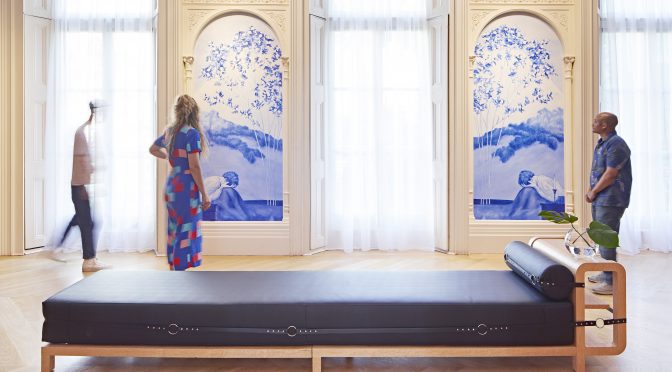
The exhibition itself is an immersive experience that has The Mosaic Rooms transformed into an imaginary home for an imaginary stranger. The period architecture and décor of the gallery are subversively infused with modern references to queerness and social media. Khaled plays with the antique grandeur of the gallery space, once an upper-middle class family home, by injecting it with notes of dissonance. One room takes a day-bed – a symbol of leisure and luxury – but upon recognition of the distorted, disproportionate size of the sofa, any sense of ease is undermined. Leather straps recall sexuality; and whilst the mindfulness track played on speaker is initially calming, the endless looping of the audio suggests that serenity is never achieved. The downstairs room, dominated by a bizarrely circular bed, is windowless, dark and claustrophobic; this, too, is no place of rest. Close inspection of the wall-paper reveals the presence of a desktop ‘loading’ icon in the corner of the repeated motif. Despite references to sexuality, the anonymity of the exhibition’s central figure, and the absence of any reference to friends or lovers, makes the whole space seem oddly isolated, even fragmented. This is a complex emotional landscape that leaves the visitor strangely uneasy.

The exhibition gestures to a host of cultural traditions without necessarily articulating a defined critical position. The form of the installation recalls the house-museum, in which a famous person’s home is turned into a public space; yet our protagonist is a stranger, and a fictional stranger at that. The sofa-beds and leather straps refer to Freud, a sensibility compounded by the dialogue between dream and reality evoked by the space. Moving through each room, one definitely has the feeling that there are many layers of this exhibition to uncover.

The flipside of the coin is that the highly conceptual nature of Khaled’s work does make it somewhat inaccessible. Without foreknowledge of certain cultural traditions and intellectual histories, it would be easy to miss the probing questions that the exhibition gently raises. It took me a while to understand how the fiction of the lost phone related to the gallery-space; and if I hadn’t shared a conversation with the curator, I’m not sure that I would have picked up on the notes of dissonance imbued within each room. Although a brief explanatory guide does excavate some of Khaled’s ideas, I still found that the exhibition verges on nebulous. Perhaps it is a personal preference for clarity that for me clashed with the meandering nature of this work, but I do wonder if other visitors would also have benefitted from a little more transparency. As it stands, the exhibition left a distinct impression on me, but few of my thoughts crystallized into lucid expression; perhaps, however, that was Khaled’s intention.

The exhibition is on until 25 September 2022 at The Mosai Rooms Open 11am – 6pm | Tuesday – Sunday | Free Entry  http://www.mosaicrooms.org/

Reviewed by Sophia Sheera – Sophia is a writer interested in migration, cultural citizenship, displacement and queerness with a focus on Central Asia and Northern India. Sophia is inspired by talking to the people whose stories are sidetracked by sensationalist headlines, and as such aspires to share those counter-narratives through political journalism.