Hello

You Will Die at Twenty – ICA Review

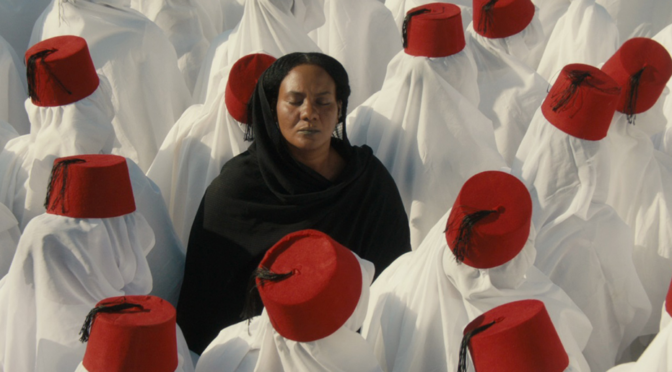
In the backdrop of a small village in Sudan, a boy is born and from the moment of his birth his destiny is already carved into the world – it is prophesied by the village sheikh that he will die at twenty. Whilst Muzamil’s peers indulge in the freedom of their adolescence and the blissful obliviousness surrounding the uncertainties of life, the certainty of his death is what plagues and probes every inch of Muzamil’s life. As a result, he feels ostracised from normal life and is not prepared for adulthood as this is regarded as pointless. He is teased by his peers who nickname him “son of death”, and the paralysing fear of his death causes him to attempt to live a sinless and pure life moulding him into a dull, lifeless individual with very little identity outside what others prophesise for him. ‘You Will Die at Twenty’ is the debut film of Director Amjad Abdu Alaa and is a morbid, bleak coming-of-age film that is centred around topics surrounding religion, family, culture and the adversity that comes with living your life when it is shrouded in death.

“Has sadness become a habit?” asks a village elder to Muzamil’s mother, Sakina, who has an ever-present look of despair and lifelessness etched onto her face. Throughout the film, she only wears black, as if to mourn her son’s impending death. Her life is dedicated to the protection of Muzamil attempting to shield him from the world, encouraging him into a complete dedication to religion and discouraging him away from normal life. His father has left and is yet to return, escaping from living the sorrowful life that Muzamil’s fate has bestowed upon their family. It is quite painful to watch his interactions with his mother, they are emotionless, almost as if she is practicing detachment in order to prepare for when the fateful day comes.

Some of the best scenes of the film come on screen when Muzamil interacts with two characters who do not define him entirely by the Sheikh’s prophecy. One of these characters is Naiema, a girl which Muzamil has grown up around in the village. Mutual feelings are shared between the pair and whilst these feelings are unspoken, the scenes between them emanate a youthful and free energy. As they sit against the visually beautiful backdrop of the Nile, a kiss is briefly shared between them before Muzamil cuts it short, too fearful for things to go any further between them. Ultimately, Muzamil’s fear and apprehension to live his life normally prevents their relationship from blossoming, which was heart-breaking and also quite frustrating to see. The other is Sulaiman, a rebellious older man who is cynical and critical of the village as well as the emptiness of Muzamil’s life due to living in fear of his death.  Sulaiman acts as a father figure to Muzamil providing him with tough love, encouraging him to question his life and take control of his destiny. He also introduces him to the beauty of cinema and art and presents him with an insight to an otherworldly life that exists outside the village with stories from a lifetime of travelling across the world. As the two watch a scene from the film ‘Cairo Station’, Muzamil is transfixed with what he sees – for him cinema presents an obscure, distant world that he will never get to experience and it is his only insight into being able to comprehend a life outside the confinements of the village. Muzamil’s interactions with Sulaiman cause him to question himself and the world around him.

You Will Die at Twenty’ poses the question of whether our futures and fates are really set in stone for us or whether we are the autonomous controllers of our destiny. After his 20th birthday arrives and Muzamil is not dead he decides to escape from the village.  In the final scene of the film, he chases after a carriage that is exiting the village.  He has not died, but the lifeless, soulless individual he once was has. We are left on a cliffhanger. What is next for Muzamil? Actor Mustafa Shehata does a wonderful job playing a despondent young boy, who finally begins to question his life after 19 years of nothingness. It is great to see a Sudanese film gaining worldwide attention and hopefully we can see more of this in the future. 

Book tickets to watch the film at the ICA here:  https://www.ica.art/films/you-will-die-at-20

Reviewed by Lian Lakhope. Lian is a MA Global Media and Communications student at SOAS and a volunteer writer for Abundant Art. Lian has written for a number of different publications, mostly about music, culture and film and she is enthusiastic about expressing her passion for creating art and media.



Review: Fabergé in London: Romance to Revolution

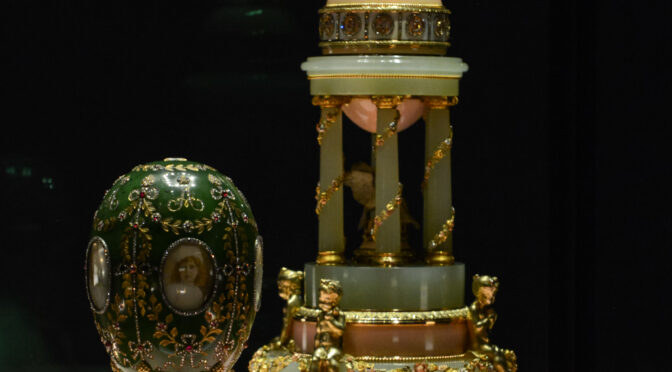
This dazzling exhibition at the V&A showcases the breathtakingly elegant work of the legendary Russian jeweler, Peter Carl Fabergé. Most famously known as the Romanovs’ personal goldsmith, this exhibition uses over 200 objects to delve deep into the work of Fabergé within and beyond Russia, admiring his excellent craftmanship. Fabergé in London celebrates the fact that London was the location of his only overseas branch and takes us on a journey through Carl Fabergé’s career. The exhibition is carefully planned out: as we move through the rooms, we uncover another layer of Fabergé’s work, before reaching the grand finale, which is the Imperial Easter Eggs.

The Romanovs were well-known for their extravagance; gift-giving played a significant role in their relationships. Fabergé’s intimate gifts perfectly represent an Empire marked by sex, jewels, and death. The first section of the exhibition explores the significance of Fabergé’s crafts in the Romanov family. From tiaras to trinket boxes, we begin to sense a flash of brilliance created by Fabergé’s work. We embark upon the intricate methods, such as enameling, and the precious materials used in Fabergé’s work.

The exhibition then moves on to Fabergé’s work outside of Russia. The London branch acted as a luxury retail destination for wealthy domestic and international clientele. Exchanging gifts was an important ritual in Edwardian society; Fabergé’s creations were desired by the elite as they were appreciated for their bespoke designs, rather than their value. Each item in this exhibition carries its own story, creating a real sense of intimacy and fascination.

The final room of the exhibition contains 15 Imperial Easter Eggs, many of which have never been seen in Britain – this is the largest collection of eggs to be exhibited in a generation. Each one so intricately designed and beautifully crafted, it is impossible to not be utterly stunned by the work of Fabergé. The Moscow Kremlin Egg is most definitely one which stood out to the eye.

Fabergé in London is a shining example of Russian craftsmanship and history. This exhibition is one that does not fail to amaze the eye, whilst telling a story of romance and revolution. I would highly recommend everyone to view this exhibition whilst they have the chance!

Get your tickets at: https://www.vam.ac.uk/exhibitions/faberge

Reviewed by Ridha Sheikh – Ridha is a volunteer writer for Abundant Art. She is a recent History and Politics graduate from Queen Mary – University of London. Ridha is excited to explore and share her strong passion for London’s art scene.

‘Get Up, Stand Up! The Bob Marley Musical – Review

A powerful, vibrant performance from Arinzé Kene, starring as Bob Marley, loudly celebrating the singer’s brilliance. Get Up, Stand Up! The Bob Marley Musical currently showing at London’s Lyric Theatre is a new, exuberant production which should not be missed!

As we watch Marley’s life unfold, from a small boy in Trench Town, Jamaica, to an international superstar, we witness the power that music held during both his struggles and successes. Jammin’ to classics like ‘Three Little Birds’, ‘Is this Love’, and ‘Stir It Up’, you truly start to feel Marley’s spirit and the joy that his music continues to bring.

What I enjoyed most about the production is that, whilst creating a wonderfully positive atmosphere, it also explored reggae music in a much deeper sense. We see that his music is rooted within politics and Rastafarianism as it is described as ‘spiritual, rebel music’. Throughout the musical, there are references to Haile Selassie, Marcus Garvey and colonialism – shedding light upon the struggles and philosophies within Marley’s music.

The production is one filled with emotion. Each song is performed with a real passion that does not fail to captivate the audience, not to mention the exceptional vocals throughout. There is a perfect balance between the music and story-telling, the most notable storyline being of his love affairs. The connection between Arinzé Kene and Gabrielle Brooks (playing Rita Marley) created scenes which were undeniably captivating and moved the audience.

The sets were kept simple, allowing us to focus on the costumes, choreography and music – all of which were sensational. It also emphasised the simplicity which remained constant in Marley’s life despite his fame. There were amazing theatrics, an engaging storyline and infectious music – it was brilliant.

Not only is this an exceptional performance, but it is also an important cultural event which I would urge everyone to go and see! It is an iconic tribute to Bob Marley, celebrating 36 passionate years of his life and lasting legacy.

Get your tickets now at: https://getupstandupthemusical.com/

Reviewed by Ridha Sheikh – Ridha is a volunteer writer for Abundant Art. She is a recent History and Politics graduate from Queen Mary – University of London. Ridha is excited to explore and share her strong passion for London’s art scene.

Dune – Barbican Film Review

Denis Villeneuve’s new blockbuster “Dune” is without a doubt the new sci-fi movie of the moment. With a current box office of 350 million worldwide, it proves to be one of the most prominent movies of the year. However, the film manages to be more than your typical seasonal blockbuster, as the Canadian director delivers what could be defined as a memorable and visually stunning epic saga of internal introspection

The film follows the adventure of Paul (Timothée Chalamet), son of the Duke of House Atreides (Oscar Isaak) and Lady Jessica (Rebecca Ferguson). His mother is a member of the Bene Gesserit, a powerful clan of witches with the power of controlling people’s minds, an ability that Paul inherits. House Atreides is ordered to move to the desert planet Arrakis to exploit it by harvesting the most important resource in the universe “the spice. However, Paul starts having different emblematic visions about Arrakis that seem to be of a prophetic nature, which leads the Bene Gesserit to think that he might be “the one”, a mysterious appellation that is not explained to the audience. In Arrakis, a series of dramatic events unfold one after another and Paul finds himself on the run in the desert, whilst trying to understand his hallucinations and his personal mission.

The film is an adaptation of the novel written by Frank Herbert in 1965, which has built a strong fanbase of readers, including Villeneuve himself. In an interview, he affirmed that he made the movie with the goal of satisfying one single hardcore fan, himself. His passion for the book is shown through the immaculate attention given to the world-building, that entirely plunges the viewer into the universe of the story. A universe that, despite being set in outer space, wishes to keep roots with our reality by borrowing some elements from existing cultures: House Atreides plays Scottish bagpipes to announce its arrival, the court’s doctor speaks Mandarin Chinese, the cultures of Arrakis seem to have an Arab root, and Paul’s name itself is French.

Although having all the elements to be an action-driven space odyssey, the movie is very introspective, typical to Villeneuve’s style, as it follows almost exclusively Pauls point of view on his quest for identity and purpose. The many dream-like sequences, the multiple close-up shots and the impressive performances of the actors make for a very character-driven narrative. The story explores the themes of the human spirit and its strength when facing adversity and fear, as it is repeated throughout the movie that “Fear is the mind-killer”. This is a character-driven movie of the sort that relies strongly on the actor’s performances perfectly delivered. The stellar Hollywoodian cast also includes Zendaya, Oscar Isaak, Charlotte Rampling, Jason Momoa, Josh Brolin, and many more, who take the mantle of very memorable characters.

With a running time of approximately 2h30, the movie is not afraid to take its time, as every scene is prolonged not only for an effect of gravitas but also to give us the time to appreciate the aesthetic of the universe. The settings are stunning, and the film knows it. The dialogue is indeed rather reduced, as most of the communication is made through visuality, the first example being Pauls silent but beautiful visions of Chani. Despite the use of visuals to communicate, one of the most striking features of the film is without a doubt Hans Zimmers breathtaking score. It manages to convey every single aspect of the plot with striking force, such as the mystery of the visions, the gravity of the situations of danger or the majesticness of the different settings.

The story-telling is dominated by the sense of doom of a prophecy that is impossible to escape. Pauls journey is already traced, and the plot is led by the invisible and powerful hand of ‘destiny’. Paul progressively becomes a messianic character, who wants to help the greater good by learning to follow his mysterious visions for a final goal that is still uncertain to both the audience and the main character. This unanswered aspect of the plot will certainly be explained in Dunes confirmed sequel, but the first movie by itself leaves the audiences with more questions than answers. One is extremely surprised when the screen suddenly fades to black and the credits start appearing, which teases the second movie in a way that makes the first one slightly underwhelming. However, one must remember that the role of this movie is s to set the scene for its sequel. It primarily introduces the audience to the complex universe of the story and puts Paul in a situation where he can finally start his prophetic journey in the sequel expected in 2023.

Overall, Dune is on the path of establishing itself as a memorable sci-fi movie of our generation and deserves all of the praise that it is currently receiving from critics and audiences. Check out Dune and many other movies at Barbican cinemas on https://www.barbican.org.uk/whats-on/cinema.

Reviewed by Céline Galletti- Celine is a volunteer writer for Abundant Art. Originally from France and Italy, she follows her passion for writing and art by studying Comparative Literature at UCL, London. As an international student living in London, she is determined to fully experience and understand the citys vibrant arts scene, and be a part of its creative storm.

Spencer – ICA Review

Director  Pablo Larrain’s ‘Spencer’ is not merely a biographical tale on the life of the people’s princess, it is a surrealist psychological thriller. We experience the life of a woman who can no longer bear the suffocation of having eager, piercing eyes scrutinize your every move. Larrain has clearly tried to establish an authentic royal family biopic rather than focusing on the drama surrounding the monarchy. He has successfully managed to create a film that focuses on the torment and troubles that being held to such high expectations had on an individual in this position.

Diana has been known as someone who did not act like a typical royal and she is portrayed like this in the film – she doesn’t wait for royal guards,  drives herself around, swears, purposely goes against the dress code and just wants to “eat fast food and watch Les Mis.” She is real. The film takes place in Sandringham in 1991 during the Christmas period. With the combination of Diana’s marriage crumbling and the Christmas period being marked by intense protocol and tradition, Diana finds herself frustrated at the heightened scrutiny of a world that seems to be against her, causing her eating disorder to worsen and we see her become on the edge of a mental breakdown.

Atmosphere and expression are integral parts of creating the image of augmenting isolation and agony felt by Diana and rather than a heavy script, we are presented with an abundance of anxious glances, wandering eyes and fearful looks. One scene where the family sits at the dinner table is particularly full of these apprehensive glances, paired with the powerful silence that fills the room. The sense of claustrophobia and distress felt by Diana is shifted onto the viewer and it is impossible not to feel uncomfortably tense and anxious for her. Following this, Diana slips into a hallucination, as she frantically fiddles with the pearls around her neck – the pearls which Charles has also given to his mistress – she sees the ghost of Anne Boleyn sitting across from her. The film parallels the lives of Princess Diana and Anne Boleyn, both monarchs tormented by their position in failing marriages, as well as the fear Diana has for the fate of her future reaching a similar melodramatic end to that of Anne Boleyn.

“There’s no hope for me, not with them” says Diana solemnly as she looks at herself in the mirror. For Diana, it was not a matter of, eventually growing accustomed to the royal lifestyle, she is too detached and too hyper-aware of how much she has to transform herself into the impossible image of the perfect princess to ever become one of them. She does not want to try and fit in, instead she yearns for a return to the past where things were different. When the present and future seem so full of sorrow, it is difficult to not be consumed by the blissful nostalgias of the past. In a scene where Diana escapes to her childhood home that has been boarded up and abandoned, a montage ensues of her dancing – this is one of the few times in the film where freedom and individuality are exuded rather than claustrophobia and conformity.

Kristen Stewart does a great job at presenting a sensitive, on edge Diana. She is especially good at playing her expressions and body language. Pablo Larrain has created a beautiful yet miserable tale of a weekend in the life of a tortured and repressed princess.

Spencer is available to watch in cinemas from November 5th. Book tickets to watch it at the ICA here: https://www.ica.art/films/spencer

Reviewed by Lian Lakhope. Lian is a MA Global Media and Communications student at SOAS and a volunteer writer for Abundant Art. Lian has written for a number of different publications, mostly about music, culture and film and she is enthusiastic about expressing her passion for creating art and media.

 

Hogarth and Europe -Tate Britain Review

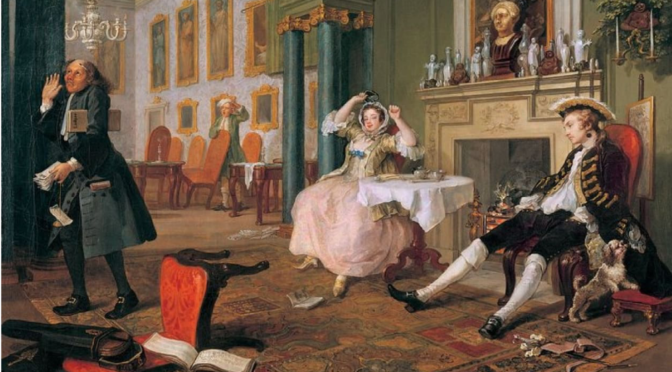
Tate Britain is currently hosting the exhibition “Hogarth and Europe”, which skillfully displays the works of the famous British painter, whilst offering an insight into the vibrant historical context of Europe in the XVIII century. The paintings act as a window into society at that time, in which flaws are drastically exaggerated through caricature and mockery. The artist takes the role of a witty and cynical observer. Often represented in the background of his paintings, he judges what he sees without ever being moralistic, offering a cheeky perspective on the ridicules made on society.

The exhibition immerses the audience in its historical context by showcasing the works of many other emblematic artists of the time, in addition to briefly focusing on four main cities that fostered culture and art at the time: Paris, Venice, Amsterdam, and of course London. Europe was experiencing a period of economic growth and deep social change, which contributed to the creation of new creative freedoms in art. Drunkenness, sex and all sorts of immoralities were depicted without filters and were used to mock the nobility, mirroring an age where the social hierarchies were crumbling. However, the main focus of mockery, especially in Hogarth’s painting, was the ever-growing bourgeoise, that he considered materialistic, greedy and hypocritical.

Contrary to what one might think, Hogarth’s depictions of London life weren’t considered controversial and were instead widely popular. The grotesque scenes he represented were warmly welcomed by audiences who considered them as a source of amusement. Hogarth was especially appreciated for his insightful and satirical worldview that avoided controversy by never calling for change or revolution. On the contrary, the artist was a strong supporter of the government and even became a painter for the King.

This form of art, stripped of everything that had made it sacred and untouchable up until that point, was given a brand new function: make the audiences laugh and also see the depravities of their society. This process of desacralisation of art, although making art more accessible and emancipated from the strict rules of Baroque and Classicism of the previous century, loses a little of its symbolical aspect. The paintings are sometimes closer to caricatures that you would find in a journal rather than what you would initially expect from art. The expansion of Romanticism in the following century comes almost as an answer to this satirical social art, as it represented a more internal and psychological search in an otherwise materialistic world.

On a compositional level, the paintings are extremely rich in information, characters and actions. Every painting will take you through moments of thorough observation, as each character has its own narrative dominated by chaos and dynamism. This sort of storytelling holds a sort of theatrical aspect typical to Hogarth, which is strongly reinforced by its caricatural and comedic overtone that could belong to the Commedia dell’Arte.

The exhibition repeatedly warns its audience of the political incorrectness of the paintings, almost as if anticipating some sort of scandal. There are indeed many depictions of assault, sexual misconduct and racist and xenophobic caricatures that the wall texts keep warning you about, incase Hogarth’s provocative humour offends even today’s audiences. Though this is something that I feel the artist would probably be extremely proud of.

More than an artist, Hogarth was an anthropologist, and today his exaggerated depictions of XVIII society are key to understanding that fervent time in history. Get your tickets at https://www.tate.org.uk/whats-on/tate-britain/exhibition/hogarth-and-europe.

Reviewed by Céline Galletti- Celine is a volunteer writer for Abundant Art. Originally from France and Italy, she follows her passion for writing and art by studying Comparative Literature at UCL, London. As an international student living in London, she is determined to fully experience and understand the city’s vibrant arts scene, and be a part of its creative storm.

Snowball – ICA Review

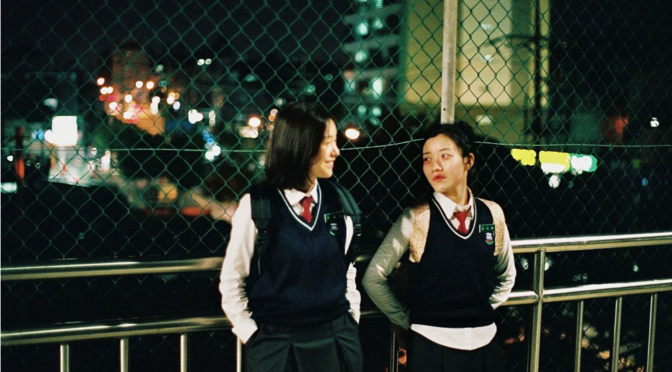
Snowball is a South-Korean teen-drama movie directed by Lee Woo-Jeon and adapted from the book “The Best Life” by Lim Sol-ah. It debuted in 2020 at the 25th Busan International Film Festival and has since been acclaimed in a succession of festivals, such as the Korean film festival at the ICA in London. The film offers a dark twist to the archetype of the typical feel-good coming of age movie, as it portrays the failed attempt of the rebellion of Korean youth against decadent authoritarian institutions. 

The story follows three high-school friends, who each correspond to a different high-school girl archetype: So-Yeong (Han Sung-min) is the beauty of the school, coming from a rich household, adored by her teachers and set on becoming a model. Ah-ram (Shim Dal-gi) is the typical school weirdo who spends most of her time alone and loves collecting random objects from the street. Kang-i (Bang Min-ah) is the main character who is narrating the story and appears to be a normal high-school girl, who is desperately trying to be the glue of this seemingly fragile friendship. Tired of the strict social rules and their authoritarian and often patriarchal environment, they decide to run away from their homes to go to Seoul. However, their dream of freedom shatters in the harsh reality of life as the constant struggle for money and their unkind environment end up breaking their friendship. The girls decide to go back home, where their lives unravel in dramatic events of bullying, abuse and betrayal.

This very intimate film explores the harsh discovery of the reality of idealist girls who gradually realise that beyond the world they are trying to escape lies an even harsher reality. Whilst the first half of the movie still holds that bubbly dreamy atmosphere typical to teenagers, full of heartfelt moments and playful bonding, the second half sees the shattering of their family lives, friendships, morals and dreams. However, Lee Woo-Jeon’s subtle portrayal hints that the lives of the girls were far from perfect even before their escape. In addition to having problematic families, they are completely disillusioned from their school lives, which results in a feeling of estrangement that can be felt all throughout the movie. Furthermore, the movie doesn’t miss to point out the social injustices when it comes to the privileges of So-Young compared to her other friends, as her good looks, grades and wealth get her away from most situations without that many repercussions.

The camera is often shaky and handheld, and the images display a greyish colour palette, mirroring the internal turmoil and the blandness of the girls’ lives. The film is definitely carried by the performance of the three actresses, who skilfully portray the evolution of the girls as well as their relationship, and the chemistry between them is palpable through the screen. Bang Min-ah, primarily known for being a member of the K-pop group Girl’s Day, proves to be a versatile artist as her acting performance stands out quite remarkably.

This bitter representation of teenage years will definitely leave you pensive, as Kang-i worlds sum up that particular period of life by commenting that “We didn’t know back then that we were doing the best we could.” Get your tickets for ICA’s screenings at https://www.ica.art/films

Reviewed by Céline Galletti- Celine is a volunteer writer for Abundant Art. Originally from France and Italy, she follows her passion for writing and art by studying Comparative Literature at UCL, London. As an international student living in London, she is determined to fully experience and understand the city’s vibrant arts scene, and be a part of its creative storm.


Can I Live? Barbican Review

Conversations about the realities of climate change can often be debilitating and unnerving. In ‘Can I Live?’ actor and activist Fehinti Balogun manages to make this conversation both emphatic, vibrant and energising, whilst still maintaining the potency and seriousness that issues surrounding the ticking time bomb of climate change ensue. Fehinti Balogun’s ‘Can I Live?’ is an informative piece about climate change from an intersectional point of view as well as an exploration of climate activism and the disproportionate number of black voices within the movement. It is told through afrobeat and hip-hop songs bustling with passion, emotive rhythmic spoken words and immersive performances.

‘Can I Live?’ is a very personal yet political story, the personal side combined with the political allows us to feel Balogun’s burning passion and power for the causes he is fighting for. Beginning in the comfort of his mother’s home Balogun reflects on his activism in relation to his family life; the path of an actor and environmental activist is not one which was carved for him growing up in a Nigerian household where his father pushed the motto “stay out of trouble, do your work and keep your head down” – he notes that staying out of trouble and keeping your head down are qualities that certainly do not mix well with activism. Additionally, he stresses the helplessness he felt whilst trapped inside the confinements of his mother’s home during the pandemic, unable to partake in the direct action that is fundamental to activism.

Balogun’s mother’s home is revealed to be the set of the Barbican theatre. We are plunged into a theatrical, surrealist performance where the extremities of global warming, climate genocide, the links between class and climate as well as the synonymy of climate change and colonialism are all exposed to us through Balogun’s zealous presentation. It is easy to feel detached from climate issues but Balogun does an extremely good job at both putting perspective (thus humanising them) and making this discourse around these issues compelling whilst stressing their gravity -“The more the emissions, the hotter it gets.” Balogun vigorously sings about the impact of greenhouse gasses on global warming, one of the facts that made it easier to internally imagine the impacts of global warming was the comparison between a 1.5 degree temperature rise of the planet is synonymous with the body reaching insanely feverish temperatures. Furthermore, Balogun centres much of his focus on Africa, particularly West Africa as a Nigerian man, this is where a large portion of his emotional attachment resides.

The visualisation of 1.5 degrees temperature increase causing a 6-month extension in drought season for West Africa and 3 degrees causing the drought season to last 2 years puts into viewpoint how alarming these issues really are – the extension of these seasons means crops cannot be grown for longer periods of time, starvation ensues and people die. This is just a glimpse of the sinister reality of climate genocide Balogun brings to light – it will give you chills.

“Why does nobody look like me?” is one of the core questions asked by Balogun in the play. The population of climate change activism circles is disproportionally white and Balogun has found himself uncomfortably aware of this throughout partaking in climate activism. This is something I’ve asked myself too – whilst we hear the necessary and powerful voices of those like Greta Thunberg, it is also important for voices like those of Vanessa Nakate and other black or POC voices to be at the forefront of the climate discourse. The perspective of a young black man is an important voice needed within the climate movement. An important conclusion he draws about the lack of POC within the climate movement is about necessity – survival is at the core of the lives of many POC, trying to put food on the table, looking after family at home and abroad, and in the words of Balogun’s mother in the play ‘waiting for home office papers.’ When these things are at the centre of your world it understandably becomes difficult to insert yourself into something like the climate movement.

Balogun’s rallying cries about the state of our planet come at an important time in climate change conversation as nations gather to discuss climate at COP26. Within the desperation and pleading sense of urgency of his words, he does stress that there is hope. Only 3.5% of the population is all that is needed for a successful political movement – climate change is not individual responsibility like we are often told, it is collective responsibility. Balogun stresses that we need to be angry and frustrated, we need to have our collective voice heard to enact change.

‘Can I Live?’ was directed by Daniel Bailey and in collaboration with the theatre company Complicite. It was filmed on the Barbican’s stage during the lockdown and is currently completing an online tour. Watch it here: https://www.barbican.org.uk/whats-on/2021/event/complicite-fehinti-balogun-can-i-live

Reviewed by Lian Lakhope. Lian is a MA Global Media and Communications student at SOAS and a volunteer writer for Abundant Art. Lian has written for a number of different publications, mostly about music, culture and film and she is enthusiastic about expressing her passion for creating art and media.

Sebastião Salgado: Amazônia – Review

Sebastião Salgado, the award-winning Brazilian photographer, launches his captivating photography exhibition of the natural, breath-taking beauty and diversity which lies within the Amazon rainforest. Captured across seven years, the exhibition explores the fascinating intricacies of nature, which are slowly beginning to disappear as we witness the destruction of the rainforest.

The exhibit presents 200 black-and-white photographs displaying the dramatic landscapes of the Amazon’s winding rivers, powerful waterfalls, and immense jungle, which certainly do not fail to amaze the eye. We are shown stunning portraits of the indigenous natives who have inhabited the rainforest for centuries, as we explore their homes.

At a crucial stage in the fight against climate change, Salgado’s exhibition puts into perspective the importance of protecting the Amazon rainforest for the future of our planet. Every year, tens of thousands of farms expand their area, eating away at the immense forest, which is having severe impacts on global climate change. If we continue like this, we will reach a ‘tipping point’, where the damage to the Earth will become irreversible. Salgado shows us many of the unique natural features of the Amazon, such as ‘Sleeping Beauty Mountains’ and ‘Flying Rivers’, which we must protect before it is too late.

Salgado also draws our attention to the fact that climate change is damaging and destroying the home of an estimated 370,000 natives, divided into 188 groups, and speaking around 150 languages. Through a series of images and videos, we are shown the incredible diversity within the Amazon. Each indigenous tribe has its own unique history, culture and traditions which they have upheld due to the impenetrability of the rainforest. It is fascinating to see the ways in which they distinguish themselves, from face and body painting, piercings, and the plants which they wear. Many of the tribes live in almost complete isolation, utilising the resources in the rainforest in magnificent ways. During one film, a woman from the Xingu tribe expressed how climate change is noticeably threatening their way of life as resources are being destroyed.

Amazônia is a powerful, moving exhibition that beautifully captures the extraordinary nature of the rainforest and its inhabitants. With climate change becoming an extremely important contemporary issue, the exhibition reminds us why it is so urgent for us to act now. I would highly recommend this exhibition to everyone, as it explores the importance of the Amazon, for all of our futures, as well as the unequaled power and beauty of the rainforest.

To book your tickets, click here: https://www.sciencemuseum.org.uk/see-and-do/amazonia

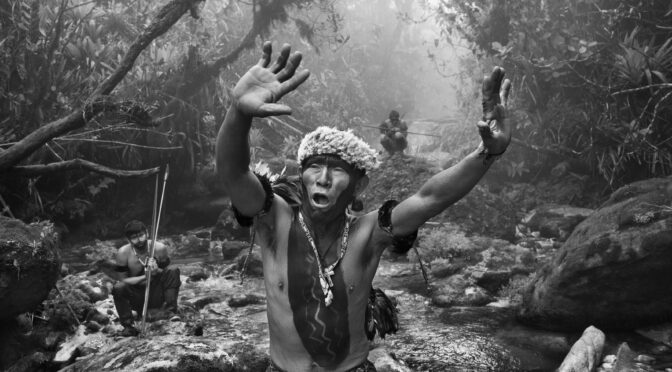
Chaman Yanomami en rituel avant la montee vers le Pico da Neblina, Etat d’Amazonas, Bresil, 2014 © Sebastiao Salgado / nppictures

Reviewed by Ridha Sheikh – Ridha is a volunteer writer for Abundant Art. She is a recent History and Politics graduate from Queen Mary – University of London. Ridha is excited to explore and share her strong passion for London’s art scene.

The French Dispatch – ICA Review

Cinemas are currently experiencing a long-awaited revival after the pandemic and a multitude of long-anticipated movies are finally being released. In the middle of this cinematic storm, one of the most acclaimed movies is “The French Dispatch”, the brand new movie by acclaimed director Wes Anderson. Impossible to miss, the film is currently in every cinema in London and showcases at the ICA until November 11.

Following the death of its Editor Arthur Howitzer Jr. (Bill Murray), the American magazine “The French Dispatch” issues one last edition, including an obituary, a travel guide, and three short chronicles under the sections “Painting”, “Poetry” and “Food”. The structure of the movie follows the structure of the magazine: the plot is divided into five sections that are introduced with chapter headlines and are heavily narrated as if we are reading the magazine.

The obituary introduces us to the members of “The French Dispatch” as well as the strict but beloved figure of the deceased editor, Howitzer. This introduction alone sets the tone of the movie, as it offers a succession of eccentric scenarios and characters, all within a rapid pace of humour and colourfulness. After the brief “travel guide” section introduces us to the French town of “Ennui-sur-Blasé” (literally “Boredom-on-Dull” in French), the “reading” of the magazine continues with three stories: “The Concrete Masterpiece” retraces how an institutionalised criminal painter invents abstract art out of love for his prison guard; “Revisions to a Manifesto” is a story of youth and love in the heart of student revolts; finally “The Private Dining Room of the Police Commissioner” is a suspenseful tale of food, identity and kidnapping. These three chronicles are presented by their respective writers with rather fast pacing which might be a little confusing to a less attentive viewer, and they definitely require multiple viewings to be appreciated fully.

From a technical perspective, Wes Anderson delivers perfectly: lovers of “The Grand Budapest Hotel” and “The Royal Tenenbaums” will be delighted, as every single frame of the movie is symmetrically perfect and extraordinarily original. Despite being led by oral narration, the visual aspect is probably the strongest element of the movie, and although the three chronicles are mostly shot in black and white, this doesn’t take anything away from the visual originality of the film. In addition to being a patchwork of stories, the film is indeed also a patchwork of different techniques: it jumps from extremely bright colours to black and white, as well as having some elements of cartoon animation, written sections, still frames, PowerPoint presentations, tv show segments, and entirely French-speaking characters. These technical creative liberties mixed with the original scenarios of the stories make for an extremely rich, eccentrically poetic movie, that could however confuse some audiences more familiar with a more “classical” structure in cinema.

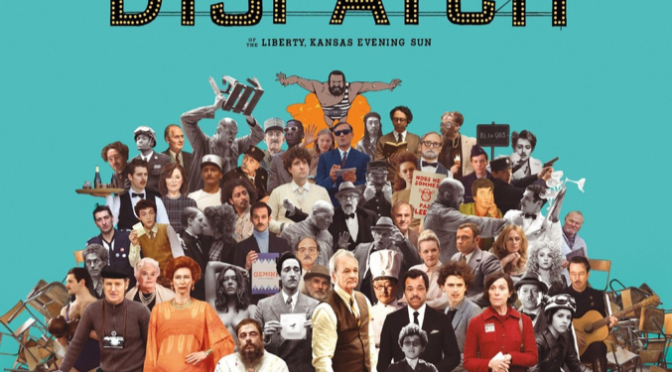
Despite being borderline fantasy stories, the chronicles are full of humanity as they tell very touching tales with attaching characters. The performances of the stellar cast are all worth mentioning, although the fast pace of the movie and the succession of different stories only allow for a very short screen time for each of the actors. Benicio del Toro, Tilda Swinton, Adrien Brody, Léa Seydoux, Timothée Chalamet, Jeffrey Writer, and many more are extremely memorable in their respective roles.

The movie is a love letter to journalism and art, packed in metronomically precise pacing and an immaculate mise-en-scène that will be thoroughly enjoyed by any Wes Anderson admirer. Get your tickets for an ICA cinema screening at https://ica.art/films/the-french-dispatch

Reviewed by Céline Galletti- Celine is a volunteer writer for Abundant Art. Originally from France and Italy, she follows her passion for writing and art by studying Comparative Literature at UCL, London. As an international student living in London, she is determined to fully experience and understand the city’s vibrant arts scene, and be a part of its creative storm.